5.0(1)

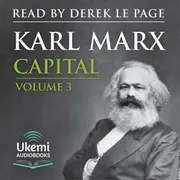
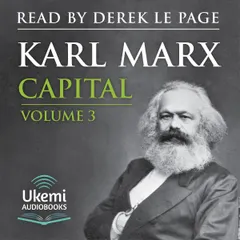
Capital : Volume 3: A Critique of Political Economy

After the detailed history and workings of the development of capitalism in Capital Volumes I and 2, Marx set out, in Capital Volume 3 to consider the future of capitalism, its direction and its inevitable fall from a series of crises and faults intrinsic to the system itself.

Published in 1894, 11 years after the death of Marx himself, Capital Volume 3 was the product of the untiring and meticulous work of Friedrich Engels working from Marx’s outline and notes and carried the subtitle The Process of Capitalist Production as a Whole.

In seven parts, Marx and Engels were determined to demonstrate that private property, competition and the market economy driven by the profit motive must lead to the demise of capitalism. They were convinced that only the curbing of the individual profit motive can lead to the end of the mass poverty and the destitution that was evident to Marx, Engels and many others concerned with the social inequities of civilisation continuing throughout history.

The following comes from chapter 5: 'Capitalist production, when considered in isolation from the process of circulation and the excesses of competition, is very economical with the materialised labour incorporated in commodities. Yet, more than any other mode of production, it squanders human lives, or living-labour, and not only blood and flesh, but also nerve and brain. Indeed, it is only by dint of the most extravagant waste of individual development that the development of the human race is at all safeguarded and maintained in the epoch of history immediately preceding the conscious reorganisation of society.'

The seven parts of Capital Volume 3 are:

The conversion of Surplus-Value into Profit and the Rate of Surplus-Value into the Rate of Profit.

Conversion of Profit into Average Profit.

The Law of the Tendency of the Rate of Profit to Fall.

Conversion of Commodity-Capital and Money-Capital into Commercial Capital and Money-Dealing Capital (Merchant's Capital).

Division of Profit Into Interest and Profit of Enterprise. Interest Bearing Capital.

Transformation of Surplus-Profit into Ground Rent.

Revenues and Their Sources.

Derek Le Page, in his masterly but temperate reading, sustains and clarifies the arguments and vision of Marx and Engels which had, and continues to have, such an impact on the world.
Über dieses Buch

After the detailed history and workings of the development of capitalism in Capital Volumes I and 2, Marx set out, in Capital Volume 3 to consider the future of capitalism, its direction and its inevitable fall from a series of crises and faults intrinsic to the system itself.

Published in 1894, 11 years after the death of Marx himself, Capital Volume 3 was the product of the untiring and meticulous work of Friedrich Engels working from Marx’s outline and notes and carried the subtitle The Process of Capitalist Production as a Whole.

In seven parts, Marx and Engels were determined to demonstrate that private property, competition and the market economy driven by the profit motive must lead to the demise of capitalism. They were convinced that only the curbing of the individual profit motive can lead to the end of the mass poverty and the destitution that was evident to Marx, Engels and many others concerned with the social inequities of civilisation continuing throughout history.

The following comes from chapter 5: 'Capitalist production, when considered in isolation from the process of circulation and the excesses of competition, is very economical with the materialised labour incorporated in commodities. Yet, more than any other mode of production, it squanders human lives, or living-labour, and not only blood and flesh, but also nerve and brain. Indeed, it is only by dint of the most extravagant waste of individual development that the development of the human race is at all safeguarded and maintained in the epoch of history immediately preceding the conscious reorganisation of society.'

The seven parts of Capital Volume 3 are:

The conversion of Surplus-Value into Profit and the Rate of Surplus-Value into the Rate of Profit.

Conversion of Profit into Average Profit.

The Law of the Tendency of the Rate of Profit to Fall.

Conversion of Commodity-Capital and Money-Capital into Commercial Capital and Money-Dealing Capital (Merchant's Capital).

Division of Profit Into Interest and Profit of Enterprise. Interest Bearing Capital.

Transformation of Surplus-Profit into Ground Rent.

Revenues and Their Sources.

Derek Le Page, in his masterly but temperate reading, sustains and clarifies the arguments and vision of Marx and Engels which had, and continues to have, such an impact on the world.
Starte noch heute mit diesem Buch für € 0

  • Hole dir während der Testphase vollen Zugriff auf alle Bücher in der App
  • Keine Verpflichtungen, jederzeit kündbar
Jetzt kostenlos testen
Mehr als 52 000 Menschen haben Nextory im App Store und auf Google Play 5 Sterne gegeben.

  1. Jüdisches literarisches Erbe – 70 Klassiker, die man kennen muss : Hiob, Professor Bernhardi, Der Prozess, Der Dybuk, Der Judenstaat, Die letzten Tage der Menschheit

    Franz Kafka, Arthur Schnitzler, Salomon An-ski, Karl Kraus, Franz Werfel, Joseph Roth, Jakob Wassermann, Stefan Zweig, Scholem Alejchem, Fritz Mauthner, Karl Emil Franzos, Ernst Toller, Berthold Auerbach, Egon Erwin Kisch, Peter Altenberg, Heinrich Heine, Marcel Proust, Sigmund Freud, Ernst Weiß, Walter Hasenclever, Hugo Salus, Oskar Baum, Edith Stein, Kurt Tucholsky, Friedrich Adler, Hermann Broch, Moses Mendelssohn, Karl Marx, Ludwig Wittgenstein, Theodor Herzl, Hugo Bettauer, Leopold von Sacher-Masoch, Karl Spindler, Walter Benjamin

  2. 50 Meisterwerke der Philosophie : Metaphysik, Das Gastmahl, Bhagavadgita, Tractatus logico-philosophicus, Kritik der reinen Vernunft, Also sprach Zarathustra, Selbstbetrachtungen von Marcus Aurelius

    Ludwig Wittgenstein, Edmund Husserl, Karl Marx, Søren Kierkegaard, Friedrich Nietzsche, Ralph Waldo Emerson, John Stuart Mill, Georg Wilhelm Hegel, Friedrich Schelling, Johann Gottlieb Fichte, Immanuel Kant, John Locke, Montesquieu, Jean-Jacques Rousseau, David Hume, Gottfried Wilhelm Leibniz, Baruch Spinoza, - Konfuzius, Lao Tse, Platon, Xenophon, - Aristoteles, Marcus Tullius Cicero, Seneca, Epiktet, Marc Aurel, Plotin, Thomas von Aquin, Nicolaus von Cues, - Erasmus von Rotterdam, Niccolò Machiavelli, Tommaso Campanella, Martin Luther, Giordano Bruno, Samuel von Pufendorf, Abbé Castel Saint-Pierre, Michel de Montaigne, René Descartes, Francis Bacon, Blaise Pascal

  3. 4.5

    Das kommunistische Manifest

    Karl Marx, Friedrich Engels

  4. Neu

    Manifesto of the Communist Party : The Pamphlet That Named the Struggle and Called the Workers to Unite

    Karl Marx

  5. Manifesto of the Communist Party

    Karl Marx

  6. Contribución a la crítica de la economía política : El código fuente del marxismo: los textos fundamentales para entender el método detrás de «El capital».

    Karl Marx

  7. The Communist Manfiesto :

    Friedrich Engels, Karl Marx

  8. Diferencia entre la filosofía de la naturaleza en Demócrito y en Epicuro : La tesis de Marx: una mirada griega para pensar el mundo moderno

    Karl Marx

  9. The Communist Manifesto

    Karl Marx, Friedrich Engels, Eden Garret

  10. 3.9

    The Communist Manifesto

    Karl Marx, Friedrich Engels

  11. Political Philosophy Collection: Common Sense, Candide, Anthem, and The Communist Manifesto

    Thomas Paine, Voltaire, Ayn Rand, Friedrich Engels, Karl Marx

  12. Trabajo asalariado y capital

    Karl Marx