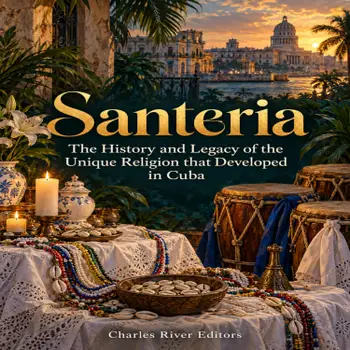
On a narrow street in Old Havana, in a room that opened onto a courtyard where laundry hung and a neighbor's radio played, a woman knelt before a small altar. At its center stood a plaster figure of Saint Barbara, crowned and armored, a golden sword in one hand and a red cloak falling from her shoulders. The woman lit a candle. She set down a slice of watermelon and a cup of red wine and spoke in a low voice, but the name on her lips was not Barbara. It was Changó, the Yoruba king of thunder and fire, master of the drum and the double axe, a spirit carried out of West Africa in the memory of enslaved men and women who refused to let him die. To a stranger passing the doorway, the scene looked like ordinary Catholic devotion, but underneath it was something much older, brought across the Atlantic in chains and kept alive in plain sight for the better part of two centuries.
That double image sits at the heart of the religion the world now knows as Santería. The name itself means roughly "the way of the saints," and it began as an insult. Spanish observers used it to mock the enslaved for what looked like an excessive, almost superstitious fondness for the Catholic holy figures, but of course, the mockery missed the point entirely. The people bowing before the saints were not confused Catholics - they were doing something deliberate and ingenious, folding an entire African cosmos behind a wall of familiar images so that it might survive in a world designed to erase it.
For most of the 20th century, popular culture reduced all of this to a cartoon. Films and cheap paperbacks turned Santeria into a combination of black magic, with pins driven into dolls, curses muttered in candlelit rooms, chickens killed in the dark. Almost none of it resembled the actual religion. What the enslaved Yoruba preserved and rebuilt on the island of Cuba was a coherent religion, one concerned with destiny and healing, with the proper relationship between the living and the divine.