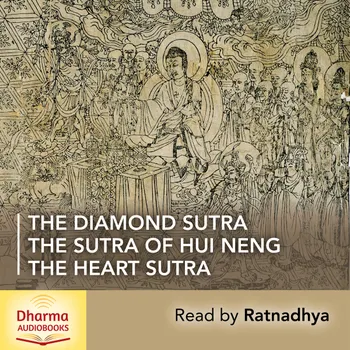
These three sutras are the most important texts for the Chan (Chinese) and Zen (Japanese) Buddhist traditions, though they are very different in character and provenance. The Diamond Sutra (Vajracheddika Prajña Paramita Sutra in Sanskrit) has the distinction of being 'the earliest complete survival of a dated (11 May 868) printed book’. It was found in the Dunhuang Caves in China in 1900.
The title, Diamond Cutter, outlines its purpose, which is to cut through ignorance to attain to perfect wisdom or ultimate reality. It is a relatively concise Mahayana text, using the Six Perfections (generosity, virtue, patience, spiritual vigour or energy, meditation and wisdom) to realise no-self and the emptiness of all phenomena.
Its origin is uncertain - even its date falls into a wide spectrum of somewhere between second and fifth centuries. The sutra is set in the context of a teaching given by the Buddha to the bhikkhu Subhuti who has asked for advice how to attain ‘supreme perfect enlightenment’. The translation used for this recording is by Wai-Tao. The Heart Sutra, another Mahayana text, is very different. It is short - barely 500 words - and is chanted, recited or read daily by many Buddhist communities across a wide range of traditions throughout the world.
It is placed in a teaching given by the Bodhisattva of Compassion, Avalokitesvara to the bhikkhu Šariputra. Despite its brevity, it is rich in meaning and reference, covering a number of Buddhist formulations, including the five skandhas (form, feeling, perception, formation and consciousness) and the Four Noble Truths. The core message of the Sutra is ‘form is emptiness, emptiness is form’ - again the declaration that all phenomena are empty. Its origin (likely before sixth century) and even original language is unknown, scholars differing on whether it was first written in Sanskrit or Chinese.
The Nalanda translation is used here. The Sutra of Hui Neng is the longest of these three works, and is different again. It is a remarkable document, telling the history of the Sixth Chan Patriarch, Hui Neng (638-713), a semi-legendary teacher who, though uneducated and illiterate, gained enlightenment when accidentally hearing The Diamond Sutra being recited. Also called The Platform Sutra (Buddhist teachers in China traditionally preached from a podium) Hui Neng relates his history and his exegesis of The Diamond Sutra. In contrast to the two preceding works, The Sutra of Hui Neng is an unusually informal text, with the personality of the Sixth Patriarch coming across the intervening centuries with affecting immediacy. The translation is by Wong Mou-Lam. The three sutras are read with clarity and understanding by Ratnadhya.