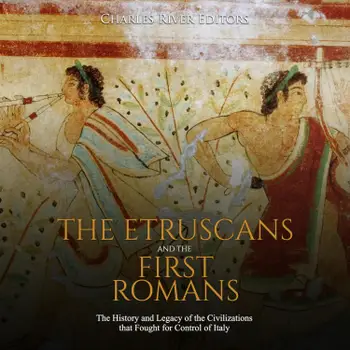
The Etruscans and the First Romans: The History and Legacy of the Civilizations that Fought for Control of Italy

“These people of Greek descent were called Etruscans, and it has been discovered that they had advanced so far in civilization, that they afterwards gave many of their customs to the city of Rome when it came to power. A confederacy known as the ‘Twelve Cities of Etruria’ became famous afterwards, though no one knows exactly which the twelve were.” – Arthur Gilman, The Story of Rome from the Earliest Times to the End of the Republic

When people think of ancient Italy, the Romans are usually the first and last people that come to mind, but long before Rome was built by Latin speaking people, the culture of Italy was dominated by the Etruscans. Although the Etruscans may not comprise the core of most histories of the ancient Mediterranean, they exerted a profound influence on the region from the 8th-5th centuries BCE that continued to resonate for centuries after as the Romans carried on many of their traditions. Today, much of what is known about the Etruscans comes from the ancient Roman and Greek writers who had a deep respect for them but saw them as exotic and foreign. As the famous Roman philosopher Seneca wrote about the Etruscans, “Whereas we believe lightning to be released as a result of the collision of clouds, they believe that the clouds collide so as to release lightning: for as they attribute all to deity, they are led to believe not that things have a meaning insofar as they occur, but rather that they occur because they must have a meaning.”

The Etruscans referred to themselves as “Rasenna” in their own language, but the Greeks called them “Tyrrhenians” and the Romans referred to them as “Etrusci”, which is where the modern term “Etruscan” is derived (Cornell 1995, 45). As this suggests, reconstructing Etruscan history is based primarily on the Greco-Roman accounts, but other sources are utilized by modern scholars to create a more accurate picture.
Starten Sie noch heute mit diesem Buch für € 0

  • Hol dir während der Testphase vollen Zugriff auf alle Bücher in der App
  • Keine Verpflichtungen, jederzeit kündbar
Jetzt kostenlos testen
Mehr als 52 000 Menschen haben Nextory im App Store und auf Google Play 5 Sterne gegeben.

  1. Neu
    4.0

    The Dodo: The History and Legacy of the Extinct Flightless Bird

    Charles River Editors

  2. Neu
    3.3

    Modern Latvia: The History and Legacy of Latvia’s Struggle for Independence in the 20th Century

    Charles River Editors

  3. Neu

    The California Trail: The History and Legacy of the 19th Century Routes that Led Americans to the Golden State

    Charles River Editors

  4. Neu

    Stephen Decatur and Oliver Hazard Perry: The Lives and Careers of America’s Most Famous Naval Officers during the War of 1812

    Charles River Editors

  5. Neu

    Persia and Islam: The History of the Islamic Empires that have Ruled Persia Since the Middle Ages

    Charles River Editors

  6. Neu

    Brandy Station and the March to Gettysburg: The History of the Confederate Invasion of Pennsylvania Before the Biggest Battle of the Civil War

    Charles River Editors

  7. Neu
    5.0

    Apollonius of Tyana: The Life and Legacy of the Influential Ancient Greek Philosopher

    Charles River Editors

  8. Neu

    Ma Barker and the Barker-Karpis Gang: The Controversial History of the Criminal Gang during the Great Depression

    Charles River Editors

  9. Neu

    The Studebaker Brothers: The Lives and Legacy of the Family Behind the Famous Automobile Company

    Charles River Editors

  10. Neu
    3.5

    Patrice Lumumba: The Life and Legacy of the Pan-African Politician Who Became Congo's First Prime Minister

    Charles River Editors

  11. Neu

    General Douglas MacArthur and Admiral Chester W. Nimitz: The Lives and Careers of America’s Commanders-in-Chief in the Pacific Theater during World War II

    Charles River Editors

  12. Neu
    5.0

    Admiral Chester W. Nimitz: The Life and Legacy of the U.S. Pacific Fleet's Commander in Chief during World War II

    Charles River Editors