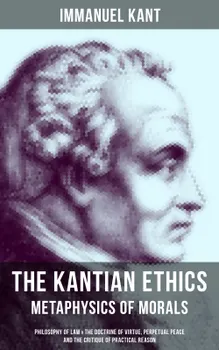
Über dieses Buch

Immanuel Kant's 'The Kantian Ethics: Metaphysics of Morals' delves into the realm of moral philosophy with a focus on the rational foundation of ethics. Kant's work is marked by its rigorous analytical approach and systematic examination of moral principles. Within the book, Kant explores the concept of moral duty, the categorical imperative, and the notion of autonomy in making ethical decisions. His writing style is dense and philosophical, requiring the reader's full attention to grasp the intricacies of his arguments. This work is a cornerstone of modern moral philosophy, influencing thinkers for centuries to come. It is a must-read for anyone interested in grappling with the complexities of ethics and moral reasoning. Immanuel Kant's background as a renowned philosopher and his keen interest in the nature of ethics and reason led him to develop the Kantian ethical framework presented in this book. Kant's deep understanding of metaphysics and ethics shines through in this seminal work, making it a timeless contribution to the field of philosophy.

In this enriched edition, we have carefully created added value for your reading experience:

- A comprehensive Introduction outlines these selected works' unifying features, themes, or stylistic evolutions.

- The Author Biography highlights personal milestones and literary influences that shape the entire body of writing.

- A Historical Context section situates the works in their broader era—social currents, cultural trends, and key events that underpin their creation.

- A concise Synopsis (Selection) offers an accessible overview of the included texts, helping readers navigate plotlines and main ideas without revealing critical twists.

- A unified Analysis examines recurring motifs and stylistic hallmarks across the collection, tying the stories together while spotlighting the different work's strengths.

- Reflection questions inspire deeper contemplation of the author's overarching message, inviting readers to draw connections among different texts and relate them to modern contexts.

- Lastly, our hand‐picked Memorable Quotes distill pivotal lines and turning points, serving as touchstones for the collection's central themes.

Starte noch heute mit diesem Buch für € 0

  • Hole dir während der Testphase vollen Zugriff auf alle Bücher in der App
  • Keine Verpflichtungen, jederzeit kündbar
Jetzt kostenlos testen
Mehr als 52 000 Menschen haben Nextory im App Store und auf Google Play 5 Sterne gegeben.

  1. 50 Meisterwerke der Philosophie : Metaphysik, Das Gastmahl, Bhagavadgita, Tractatus logico-philosophicus, Kritik der reinen Vernunft, Also sprach Zarathustra, Selbstbetrachtungen von Marcus Aurelius

    Ludwig Wittgenstein, Edmund Husserl, Karl Marx, Søren Kierkegaard, Friedrich Nietzsche, Ralph Waldo Emerson, John Stuart Mill, Georg Wilhelm Hegel, Friedrich Schelling, Johann Gottlieb Fichte, Immanuel Kant, John Locke, Montesquieu, Jean-Jacques Rousseau, David Hume, Gottfried Wilhelm Leibniz, Baruch Spinoza, - Konfuzius, Lao Tse, Platon, Xenophon, - Aristoteles, Marcus Tullius Cicero, Seneca, Epiktet, Marc Aurel, Plotin, Thomas von Aquin, Nicolaus von Cues, - Erasmus von Rotterdam, Niccolò Machiavelli, Tommaso Campanella, Martin Luther, Giordano Bruno, Samuel von Pufendorf, Abbé Castel Saint-Pierre, Michel de Montaigne, René Descartes, Francis Bacon, Blaise Pascal

  2. Lo Bello y Lo Sublime : Ensayo de Estética y Moral

    Immanuel Kant

  3. 100 Clásicos de la Literatura Universal

    Francis Scott Fitzgerald, Mary Shelley, Lyman Frank Baum, Louisa May Alcott, Dante Alighieri, Jane Austen, Ambrose Bierce, Emily Brontë, Edgar Rice Burroughs, Lewis Carroll, Wilkie Collins, René Descartes, Charles Dickens, Emily Dickinson, Alexandre Dumas, Gustave Flaubert, Benito Pérez Galdós, Johann Wolfgang von Goethe, Thomas Hardy, E T A Hoffmann, Washington Irving, Henry James, James Joyce, Franz Kafka, Gaston Leroux, Federico García Lorca, H.P. Lovecraft, Publio Virgilio Marón, Lucy Maud Montgomery, John William Polidori, Marco Polo, Antoine de Saint-Exupéry, Emilio Salgari, Walter Scott, Mark Twain, Jules Verne, Julio Verne, H.G. Wells, Edith Wharton, Mary Wollstonecraft, Stefan Zweig, Sun Tzu, Bram Stoker, - Aristoteles, George Bernard Shaw, Henryk Sienkiewicz, Concepción Arenal, Charlotte Brontë, Miguel de Cervantes, G.K. Chesterton, Daniel Defoe, Fyodor Mikhailovich Dostoyevsky, Arthur Conan Doyle, Sigmund Freud, H. Rider Haggard, Homero, Immanuel Kant, Rudyard Kipling, Molière, Friedrich Nietzsche, Fernando de Rojas, Sófocles, William Makepeace Thackeray, León Tolstói, Voltaire, Ramón María del Valle-Inclán, Oscar Wilde, Virginia Woolf

  4. Grundlegung zur Metaphysik der Sitten

    Immanuel Kant

  5. Beantwortung der Frage: Was ist Aufklärung?

    Immanuel Kant

  6. Hacia la paz perpetua

    Immanuel Kant

  7. Teoría y praxis : Estudio preliminar: Eduardo García Belsunce

    Immanuel Kant

  8. Crítica de la Razón Pura

    Immanuel Kant

  9. The Critique of Pure Reason

    Immanuel Kant

  10. Perpetual Peace: A Philosophical Essay

    Immanuel Kant

  11. La paz perpetua : Octava edición

    Immanuel Kant

  12. Yaşam Felsefesi

    Immanuel Kant