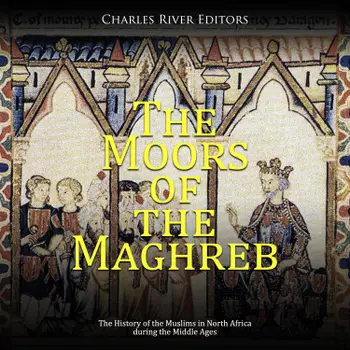
The Moors of the Maghreb: The History of the Muslims in North Africa during the Middle Ages

The term Moor is a historical rather than an ethnic name. It is an invention of European Christians for the Islamic inhabitants of Maghreb (North Africa), Andalusia (Spain), Sicily and Malta, and was sometimes use to designate all Muslims. It is derived from Mauri, the Latin name for the Berbers who lived in the Roman province of Mauretania, which ranged across modern Algeria and Morocco. Saracen was another European term used to designate Muslims, though it usually referred to the Arabic peoples of the Middle East and derives from an ancient name for the Arabs, Sarakenoi. The Muslims of those regions no more refer to themselves by that term than those of North Africa call themselves Moors. Maghreb, or al-Maghreb, is a historical term used by Arabic Muslims for the territory of coastal North Africa from Alexandria to the Atlantic Coast. It means “The West” and is used in opposition to Mashrek, “The East,” used to refer to the lands of Islam in the Middle East and north-eastern Africa. The Berbers refer to the region in their own language as Tamazgha. In a limited, precise sense it can also refer to the Kingdom of Morocco, the proper name of which is al-Mamlakah al-Maghribiyyah, “Kingdom of the West.”

Ethnically the people of North Africa are mostly of mixed Arab-Berber descent, and the Berbers are a proud and noble group of peoples dating from ancient times. The term Berber is again a foreign designation, coming from the Greek barbaroi, meaning stranger. By implication, as far as the Greeks and Romans were concerned, the word indicated the people were uncivilized. From this comes the archaic English name Barbary, used to designate the north coast of Africa and still used in “Barbary ape” and the breed of horse known as the Barb. The Berbers call themselves Imazighen, though in truth they are a grouping of different tribes rather than a strictly homogenous group.
Starte noch heute mit diesem Buch für € 0

  • Hole dir während der Testphase vollen Zugriff auf alle Bücher in der App
  • Keine Verpflichtungen, jederzeit kündbar
Jetzt kostenlos testen
Mehr als 52 000 Menschen haben Nextory im App Store und auf Google Play 5 Sterne gegeben.

  1. Anatoliy Golitsyn: The Life and Legacy of the KGB Defector Who Became a CIA Asset

    Charles River Editors

  2. Native American Games: The History and Legacy of the Different Sports Played by Indigenous Groups across the Americas

    Charles River Editors

  3. The Death Ray: The History and Conspiracy Theories Surrounding Nikola Tesla’s Futuristic Weapon

    Charles River Editors

  4. The Counter-Reformation: The History of the Catholic Church’s Response to the Protestant Reformation

    Charles River Editors

  5. The Iranian Revolution and Iran Hostage Crisis: The History of the Events that Broke American Relations with Iran

    Charles River Editors

  6. The Age of Sail’s Most Famous Battles: The History of the Naval Engagements that Shaped Europe in the Early Modern Period

    Charles River Editors

  7. Persepolis and Susa: The History of the Achaemenid Persian Empire’s Capitals

    Charles River Editors

  8. Indian Removal: The History of the Battles and Policies that Displaced Native Americans East of the Mississippi River

    Charles River Editors

  9. The Christianization of Rome: The History of the Roman Empire’s Religious Conversion

    Charles River Editors

  10. The Dawn of the Age of Exploration: The History of the Initial Expeditions that Led to European Imperialism across the Globe

    Charles River Editors

  11. The Height of the Cold War: The History of the Events that Brought the Soviet Union and United States to the Brink

    Charles River Editors

  12. Kublai Khan and Marco Polo: The History of a Unique Partnership at the Court of the Mongol Empire

    Charles River Editors