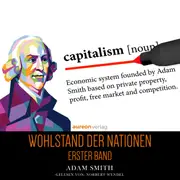
Über dieses Buch

Das Meisterwerk der Wirtschaftsanalyse, das erstmals 1776 von dem schottischen Philosophen und Ökonomen Adam Smith unter dem Originaltitel “The Wealth of Nations” veröffentlicht wurde. Obwohl das Buch bereits vor über 200 Jahren verfasst wurde, sind viele der Aussagen und Analysen von Smith nach wie vor relevant und zutreffend. Mehr noch, sie bilden die grundlegende Grundlage der klassischen Wirtschaftstheorie. Mit “The Wealth of Nations” liefert Adam Smith die erste und eloquenteste Beschreibung der Funktionsweise einer Marktwirtschaft und behandelt dabei ein äußerst breites Spektrum an wirtschaftlichen Grundsatzthemen wie der Arbeitsteilung, den Kapitalarten, dem Geld- und Warenwert und vielen mehr. Eine zentrale Erkenntnis von Smith, die der Intuition zuwiderläuft, ist dabei, dass das Eigeninteresse und das durch den Eigennutz geleitete Handeln des Individuums zum Wohle des Gemeinwesens beiträgt. Das Ergebnis von Smiths Bemühungen ist ein geistreiches und sehr hörenswertes Meisterwerk für alle Wirtschaftsinteressierten.

Starte noch heute mit diesem Buch für € 0

  • Hole dir während der Testphase vollen Zugriff auf alle Bücher in der App
  • Keine Verpflichtungen, jederzeit kündbar
Jetzt kostenlos testen
Mehr als 52 000 Menschen haben Nextory im App Store und auf Google Play 5 Sterne gegeben.

Mehr von Adam Smith

  1. Neu

    An Inquiry into the Nature and Causes of the Wealth of Nations

    Adam Smith

  2. Harvard Classics : The Five-Foot Shelf of Books

    Aesop, Dante Alighieri, Hans Christian Andersen, Augustine of Hippo, Marcus Aurelius, Jane Austen, Francis Bacon, Honoré de Balzac, Francis Beaumont, Bjørnstjerne Bjørnson, Thomas Browne, Robert Browning, John Bunyan, EDMUND BURKE, Robert Burns, Lord Byron, Thomas Carlyle, Benvenuto Cellini, Miguel de Cervantes, Marcus Tullius Cicero, Richard Henry Jr., Charles Darwin, Alphonse Daudet, Thomas Dekker, Charles Dickens, Fyodor Dostoevsky, John Dryden, Charles W. Eliot, George Eliot, Ralph Waldo Emerson, Epictetus, John Fletcher, Theodor Fontane, Benjamin Franklin, Johann Wolfgang Goethe, Oliver Goldsmith, Jacob Grimm, Edward Everett Hale, Bret Harte, Nathaniel Hawthorne, Homer, Victor Hugo, Washington Irving, Henry James, Ben Jonson, Gottfried Keller, Thomas à Kempis, Alexander L. Kielland, Martin Luther, Niccolò Machiavelli, Alessandro Manzoni, Christopher Marlowe, Philip Massinger, Guy De Maupassant, John Stuart Mill, John Milton, Thomas More, William Morris, Alfred de Musset, William Allan Neilson, William Penn, Plato, Pliny the Younger, Plutarch, George Sand, Percy Bysshe Shelley, Richard Brinsley Sheridan, Adam Smith, Laurence Sterne, Theodor Storm, William Makepeace Thackeray, Leo Tolstoy, Ivan Turgenev, Mark Twain, Juan Valera, Virgil, Izaak Walton, John Webster, John Woolman

  3. Essays on Philosophical Subjects

    Adam Smith

  4. La Teoría de Los Sentimientos Morales

    Adam Smith

  5. An Inquiry into the Nature and Causes of the Wealth of Nations

    Adam Smith

  6. The Wealth of Nations : An Inquiry into the Nature and Causes of the Wealth of Nations

    Adam Smith

  7. An Inquiry into the Nature and Causes of the Wealth of Nations

    Adam Smith

  8. An Inquiry into the Nature and Causes of the Wealth of Nations

    Adam Smith

  9. La Mano Invisible : El Origen de la Riqueza: Por qué el Interés Propio Mueve el Mundo

    Adam Smith

  10. Analytic Summary of The Wealth of Nations : Book III: Of the Different Progress of Opulence in Different Nations

    Adam Smith

  11. Analytic Summary of The Wealth of Nations : Book IV: Of Systems of Political Economy

    Adam Smith