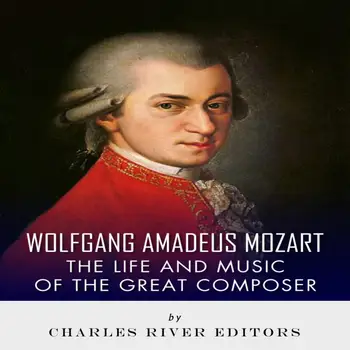
Wolfgang Amadeus Mozart: The Life and Music of the Great Composer

Mozart once called music “my life”, and indeed few were as naturally gifted at it. Mozart’s memory and genius for music allowed him to compose lengthy works, even full-length operas, without transferring them to paper until he had fully visualized and retained them. He regarded copying as a tedious task, and this caused no small amount of consternation among performers, in particular the orchestra, some of whom received their parts minutes before curtain. This was said to be the case for the premiere of Don Giovanni, where Mozart was furiously scrawling and handing out parts to the overture with the audience in attendance. Surprisingly, these entire works, sometimes hundreds of pages, not penned until they were complete in his mind, usually arrived to the manuscript without a single blemish or change of heart. Mozart’s eccentricities are remembered centuries after his death, to the point that much of his life, illnesses and death have been mythologized, and today a lot of his legacy has been shaped by the manner in which his personality has been depicted in biographical works like Amadeus.

In addition to a large and consistently high-level body of work, Mozart represents for some the real beginning of the German lineage to the 20th century, although Ludwig Beethoven, greatly under Mozart’s influence, created much of that transition’s reality. Three of Mozart’s operas are continually in the top 10 works performed around the world, his piano concerti and symphonies are all in the standard repertoire (save for some of the earliest), and his choral works are treasures of the West. The bulk of his reputation was not garnered by breaking with tradition and destroying it but rather by fulfilling it with a greater beauty and naturalness than was possible for any other artist of the time.


Über dieses Buch

Mozart once called music “my life”, and indeed few were as naturally gifted at it. Mozart’s memory and genius for music allowed him to compose lengthy works, even full-length operas, without transferring them to paper until he had fully visualized and retained them. He regarded copying as a tedious task, and this caused no small amount of consternation among performers, in particular the orchestra, some of whom received their parts minutes before curtain. This was said to be the case for the premiere of Don Giovanni, where Mozart was furiously scrawling and handing out parts to the overture with the audience in attendance. Surprisingly, these entire works, sometimes hundreds of pages, not penned until they were complete in his mind, usually arrived to the manuscript without a single blemish or change of heart. Mozart’s eccentricities are remembered centuries after his death, to the point that much of his life, illnesses and death have been mythologized, and today a lot of his legacy has been shaped by the manner in which his personality has been depicted in biographical works like Amadeus.

In addition to a large and consistently high-level body of work, Mozart represents for some the real beginning of the German lineage to the 20th century, although Ludwig Beethoven, greatly under Mozart’s influence, created much of that transition’s reality. Three of Mozart’s operas are continually in the top 10 works performed around the world, his piano concerti and symphonies are all in the standard repertoire (save for some of the earliest), and his choral works are treasures of the West. The bulk of his reputation was not garnered by breaking with tradition and destroying it but rather by fulfilling it with a greater beauty and naturalness than was possible for any other artist of the time.
Starte noch heute mit diesem Buch für € 0

  • Hole dir während der Testphase vollen Zugriff auf alle Bücher in der App
  • Keine Verpflichtungen, jederzeit kündbar
Jetzt kostenlos testen
Mehr als 52 000 Menschen haben Nextory im App Store und auf Google Play 5 Sterne gegeben.

  1. Niels Bohr and J. Robert Oppenheimer: The Lives and Careers of the Physicists Who Pioneered Atomic Energy

    Charles River Editors

  2. 3.8

    The Domestication of Cats: The History of the Only Domesticated Felidae Species and Their Relationship with Humans

    Charles River Editors

  3. 3.5

    The Boxer Rebellion: The History and Legacy of the Anti-Imperialist Uprising in China at the End of the 19th Century

    Charles River Editors

  4. The Domestication of Dogs and Cats: The History and Legacy of People’s Favorite Pets

    Charles River Editors

  5. The Iranian Revolution and Iran Hostage Crisis: The History of the Events that Broke American Relations with Iran

    Charles River Editors

  6. The Age of Sail’s Most Famous Battles: The History of the Naval Engagements that Shaped Europe in the Early Modern Period

    Charles River Editors

  7. The Counter-Reformation: The History of the Catholic Church’s Response to the Protestant Reformation

    Charles River Editors

  8. Persepolis and Susa: The History of the Achaemenid Persian Empire’s Capitals

    Charles River Editors

  9. Indian Removal: The History of the Battles and Policies that Displaced Native Americans East of the Mississippi River

    Charles River Editors

  10. The Christianization of Rome: The History of the Roman Empire’s Religious Conversion

    Charles River Editors

  11. The Height of the Cold War: The History of the Events that Brought the Soviet Union and United States to the Brink

    Charles River Editors

  12. Across the Silk Road and the Atlantic: The History of Marco Polo and Christopher Columbus’ Groundbreaking Voyages

    Charles River Editors