Civil War in the Roman Republic : A time of great civil, military and political strife that mirrors our own | 106 to 44BCE

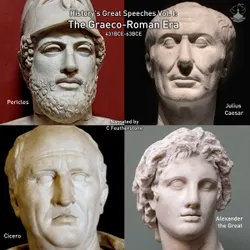
While compiling and narrating these speeches, I've often been struck by how easily they could be translated into a modern day context. Frequently, a speech has reminded me of the news of the day, somewhere in the world. Nowhere has this been more evident than in these speeches. Given over two thousand years ago, every single one could be applied to situations and people today with barely any revision.

The late republic (from about 133BCE) was characterized by civil discontent, with three Servile Wars, two attempted coups, a Social War between Rome and Italian allies, and endless conflict.

We begin in 110-106BCE with two speeches railing against the fixed social order and corruption of the highborn, as well as the scorn poured on those of lower birth. We then jump to the Cataline Conspiracy in 63 BCE, an attempt to overthrow the Senate that was only defeated at great cost, and continued to be a symbol of Rome’s troubles. Here we see Cataline exhorting his troops, Cato arguing for harsh punishment, C icero calling Cataline every contemptible name under the sun, and the only known speech of Julius Caesar, in which he argues for a sensible and jurisprudential response to this great crime.

Cicero’s leadership of Rome is then documented, covering the beliefs and actions that saw him exiled and then returned to power by the Senate. Finally, we have Mark Antony’s hagiographic oration of Julius Caesar, and then two speeches of Cicero’s railing against the perversion of Caesar’s legacy that Mark Antony was putting into practice, and the need to hold onto tradition for the right reasons, not simply to cover the misdeeds of politicians. Antony became Consul in this time, and Cicero saw in him the final downfall of the republic, which lasted for only seventeen years after this moment before becoming an Empire.

À propos de ce livre

While compiling and narrating these speeches, I've often been struck by how easily they could be translated into a modern day context. Frequently, a speech has reminded me of the news of the day, somewhere in the world. Nowhere has this been more evident than in these speeches. Given over two thousand years ago, every single one could be applied to situations and people today with barely any revision.

The late republic (from about 133BCE) was characterized by civil discontent, with three Servile Wars, two attempted coups, a Social War between Rome and Italian allies, and endless conflict.

We begin in 110-106BCE with two speeches railing against the fixed social order and corruption of the highborn, as well as the scorn poured on those of lower birth. We then jump to the Cataline Conspiracy in 63 BCE, an attempt to overthrow the Senate that was only defeated at great cost, and continued to be a symbol of Rome’s troubles. Here we see Cataline exhorting his troops, Cato arguing for harsh punishment, C icero calling Cataline every contemptible name under the sun, and the only known speech of Julius Caesar, in which he argues for a sensible and jurisprudential response to this great crime.

Cicero’s leadership of Rome is then documented, covering the beliefs and actions that saw him exiled and then returned to power by the Senate. Finally, we have Mark Antony’s hagiographic oration of Julius Caesar, and then two speeches of Cicero’s railing against the perversion of Caesar’s legacy that Mark Antony was putting into practice, and the need to hold onto tradition for the right reasons, not simply to cover the misdeeds of politicians. Antony became Consul in this time, and Cicero saw in him the final downfall of the republic, which lasted for only seventeen years after this moment before becoming an Empire.
Commencez ce livre dès aujourd'hui pour 0 €

  • Accédez à tous les livres de l'app pendant la période d'essai
  • Sans engagement, annulez à tout moment
Essayer gratuitement
Plus de 52 000 personnes ont noté Nextory 5 étoiles sur l'App Store et Google Play.

  1. #1

    The Graeco-Roman Era :

    Pericles, Julius Caesar, Cicero, Alexander the Great

  2. Forpligtelser : Gyldendals Filosofibibliotek

    Cicero

  3. 600 Quotes from Political Philosophy

    Cicero, Confucius, Alexis de Tocqueville, Karl Marx, Friedrich Nietzsche, Henry David Thoreau

  4. 4.0

    3500 Final Quotes

    Marcus Aurelius, Jane Austen, Beaumarchais, Napoleon Bonaparte, Buddha, Winston Churchill, Cicero, Confucius, Nicolas de Chamfort, Charles de Gaulle, Antoine de Saint-Exupéry, Denis Diderot, Fyodor Dostoevsky, Albert Einstein, Ralph Waldo Emerson, Anne Frank, Mahatma Gandhi, Immanuel Kant, Søren Kierkegaard, Martin Luther King, Georg Christoph Lichtenberg, Abraham Lincoln, Montesquieu, Friedrich Nietzsche, Plato, Marcel Proust, Arthur Schopenhauer, William Shakespeare, Socrates, Baruch Spinoza, Henry David Thoreau, Leonardo da Vinci, Voltaire, Oscar Wilde, Laozi

  5. 4.0

    700 Quotations from Ancient Philosophy

    Aristotle, Marcus Aurelius, Cicero, Epictetus, Heraclitus, Plato, Seneca the Younger

  6. 2000 Final Quotations

    Marcus Aurelius, Jane Austen, Buddha, Anton Chekhov, Cicero, Emil Cioran, Confucius, Albert Einstein, Anne Frank, Mahatma Gandhi, Johann Wolfgang Goethe, Carl Jung, Immanuel Kant, Friedrich Nietzsche, Marcel Proust, Arthur Schopenhauer, William Shakespeare, Baruch Spinoza, Leonardo da Vinci, Laozi

  7. Tusculan Disputations (Unabridged)

    Cicero

  8. 3.8

    100 Quotes by Cicero

    Cicero

  9. 400 Quotations from Ancient Roman Philosophers

    Marcus Aurelius, Cicero, Epictetus, Seneca the Younger

  10. Tusculan Disputations

    Cicero

  11. On the Nature of the Gods

    Cicero