À propos de ce livre

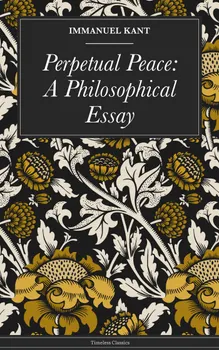
Discover the Path to Global Harmony with "Perpetual Peace: A Philosophical Essay" by Immanuel Kant"Perpetual Peace: A Philosophical Essay" is a profound exploration of the principles necessary for establishing lasting peace among nations. In this seminal work, Kant articulates a visionary blueprint for international relations grounded in reason, justice, and moral duty. He advocates for republican governments, the abolition of standing armies, and the establishment of a federation of free states committed to universal law. Kant's insights remain remarkably relevant today, offering a philosophical foundation for understanding how peace can be achieved and maintained in an increasingly interconnected world. The essay delves into the ethical responsibilities of nations and individuals alike, emphasizing that peace is not merely the absence of war but a positive condition rooted in mutual respect and shared human rights. Through rigorous argumentation, Kant challenges readers to reconsider the moral imperatives that underpin international diplomacy and to recognize the importance of law and morality in fostering global stability. This work is essential for students of philosophy, political science, and international relations, providing timeless guidance on the pursuit of peace through rational cooperation and ethical governance.Immanuel Kant (1724–1804) was a renowned German philosopher whose work laid the foundations of modern Western philosophy. A central figure of the Enlightenment, Kant's contributions span epistemology, ethics, and political philosophy. His critical philosophy, especially the "Critique of Pure Reason," revolutionized the way we understand human knowledge and perception. Kant's moral philosophy, encapsulated in the concept of the categorical imperative, emphasizes duty and universal moral laws. His ideas on autonomy, enlightenment, and perpetual peace have profoundly influenced contemporary thought, making him one of the most influential philosophers in history.
Commencez ce livre dès aujourd'hui pour 0 €

  • Accédez à tous les livres de l'app pendant la période d'essai
  • Sans engagement, annulez à tout moment
Essayer gratuitement
Plus de 52 000 personnes ont noté Nextory 5 étoiles sur l'App Store et Google Play.

  1. Lo Bello y Lo Sublime : Ensayo de Estética y Moral

    Immanuel Kant

  2. 100 Clásicos de la Literatura Universal

    Francis Scott Fitzgerald, Mary Shelley, Lyman Frank Baum, Louisa May Alcott, Dante Alighieri, Jane Austen, Ambrose Bierce, Emily Brontë, Edgar Rice Burroughs, Lewis Carroll, Wilkie Collins, René Descartes, Charles Dickens, Emily Dickinson, Alexandre Dumas, Gustave Flaubert, Benito Pérez Galdós, Johann Wolfgang von Goethe, Thomas Hardy, E T A Hoffmann, Washington Irving, Henry James, James Joyce, Franz Kafka, Gaston Leroux, Federico García Lorca, H.P. Lovecraft, Publio Virgilio Marón, Lucy Maud Montgomery, John William Polidori, Marco Polo, Antoine de Saint-Exupéry, Emilio Salgari, Walter Scott, Mark Twain, Jules Verne, Julio Verne, H.G. Wells, Edith Wharton, Mary Wollstonecraft, Stefan Zweig, Sun Tzu, Bram Stoker, - Aristoteles, George Bernard Shaw, Henryk Sienkiewicz, Concepción Arenal, Charlotte Brontë, Miguel de Cervantes, G.K. Chesterton, Daniel Defoe, Fyodor Mikhailovich Dostoyevsky, Arthur Conan Doyle, Sigmund Freud, H. Rider Haggard, Homero, Immanuel Kant, Rudyard Kipling, Molière, Friedrich Nietzsche, Fernando de Rojas, Sófocles, William Makepeace Thackeray, León Tolstói, Voltaire, Ramón María del Valle-Inclán, Oscar Wilde, Virginia Woolf

  3. Hacia la paz perpetua

    Immanuel Kant

  4. Teoría y praxis : Estudio preliminar: Eduardo García Belsunce

    Immanuel Kant

  5. Crítica de la Razón Pura

    Immanuel Kant

  6. The Critique of Pure Reason

    Immanuel Kant

  7. La paz perpetua : Octava edición

    Immanuel Kant

  8. Yaşam Felsefesi

    Immanuel Kant

  9. La Paz Perpetua :

    Immanuel Kant

  10. 12 Masterpieces You Have to Read Before You Die. Philosophy

    Niccolo Machiavelli, Tommaso Campanella, Francis Bacon, Thomas More, John Stuart Mill, Immanuel Kant, Kahlil Gibran, Leo Tolstoy, G.K. Chesterton, Henry David Thoreau

  11. 2.5

    An Answer to the Question: What is Enlightenment?

    Immanuel Kant