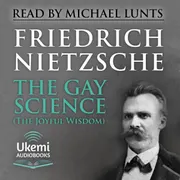
The Gay Science (The Joyful Wisdom)

The Gay Science (The Joyful Wisdom) is one of Nietzsche's greatest books. His wonderfully fertile mind roams over mankind, his thoughts, his emotions, his behaviour and his weaknesses with remarkable clarity, with insight - but also with humour!

In this work are 383 separate paragraphs, some short, some long, but all singular observations - the epitome of his famous aphoristic style. 'Morality is the herd instinct in the individual.' 'The world is overfull of beautiful things, but it is nevertheless poor, very poor, in beautiful moments.' Being intellectual, he declares, is not equivalent to 'taking things seriously': why not laugh while thinking!

When should one be an Epicurean and when a Stoic? Nietzsche may be best known for Thus Spoke Zarathustra (The Gay Science was published in 1882, a year before Zarathustra, and actually contains its opening paragraph!) but with its potpourri of comments, some wild, some sharp, some rather odd, it is totally different in tone. The Gay Science represents the Friedrich Nietzsche one would want to meet.

All of the 77 poems included by Nietzsche in The Gay Science have been placed at the end of the main text, to be enjoyed by dedicated Nietzscheans.

The aphorisms and poems are persuasively read by Michael Lunts.
À propos de ce livre

The Gay Science (The Joyful Wisdom) is one of Nietzsche's greatest books. His wonderfully fertile mind roams over mankind, his thoughts, his emotions, his behaviour and his weaknesses with remarkable clarity, with insight - but also with humour!

In this work are 383 separate paragraphs, some short, some long, but all singular observations - the epitome of his famous aphoristic style. 'Morality is the herd instinct in the individual.' 'The world is overfull of beautiful things, but it is nevertheless poor, very poor, in beautiful moments.' Being intellectual, he declares, is not equivalent to 'taking things seriously': why not laugh while thinking!

When should one be an Epicurean and when a Stoic? Nietzsche may be best known for Thus Spoke Zarathustra (The Gay Science was published in 1882, a year before Zarathustra, and actually contains its opening paragraph!) but with its potpourri of comments, some wild, some sharp, some rather odd, it is totally different in tone. The Gay Science represents the Friedrich Nietzsche one would want to meet.

All of the 77 poems included by Nietzsche in The Gay Science have been placed at the end of the main text, to be enjoyed by dedicated Nietzscheans.

The aphorisms and poems are persuasively read by Michael Lunts.

Commencez ce livre dès aujourd'hui pour 0 €

  • Accédez à tous les livres de l'app pendant la période d'essai
  • Sans engagement, annulez à tout moment
Essayer gratuitement
Plus de 52 000 personnes ont noté Nextory 5 étoiles sur l'App Store et Google Play.

  1. 50 Chefs-D'œuvre Que Vous Devez Lire Avant De Mourir: Vol 2

    Honoré de Balzac, Alphonse Daudet, Arthur Conan Doyle, Alexandre Dumas, Gustave Flaubert, Francis Scott Fitzgerald, Nikolai Gogol, Victor Hugo, Maurice Leblanc, Jack London, Madame de La Fayette, Guy De Maupassant, Friedrich Nietzsche, Jean-Jacques Rousseau, Robert Louis Stevenson, Jules Verne, H.G. Wells, Michel de Montaigne, Golden Deer Classics

  2. Nouveau

    50 Clásicos que Debes Leer Antes de Morir : Un viaje literario por los tesoros de la literatura universal

    Dante Alighieri, Aristóteles, Jane Austen, Charles Baudelaire, Giovanni Boccaccio, Anne Brontë, C. Collodi, James Fenimore Cooper, Fedor Mikhaïlovitch Dostoïevski, Arthur Conan Doyle, Alexandre Dumas, José de Espronceda, Gustave Flaubert, Sigmund Freud, Benito Pérez Galdós, Kahlil Gibran, Johann Wolfgang Goethe, Victor Hugo, Thomas Hardy, Nathaniel Hawthorne, Vicente Blasco Ibáñez, Washington Irving, James Joyce, Mariano José Larra, Jack London, Federico García Lorca, H.P. Lovecraft, Antonio Machado, Gustav Meyrink, John Stuart Mill, Amado Nervo, Friedrich Nietzsche, Solomon Northup, Alexander Sergeyevich Pushkin, Francisco de Quevedo, Walter Scott, William Shakespeare, Robert Louis Stevenson, Harriet Beecher Stowe, Jonathan Swift, Mark Twain, Miguel De Unamuno, Ramón María Valle-Inclán, Julio Verne, Virginia Woolf

  3. Nouveau

    The Birth of Tragedy

    Friedrich Nietzsche

  4. 3.3

    Beyond Good and Evil

    Friedrich Nietzsche

  5. 50 Clásicos que Debes Leer Antes de Morir : Un viaje literario por los tesoros de la literatura universal

    Dante Alighieri, Aristóteles, Jane Austen, Charles Baudelaire, Giovanni Boccaccio, Anne Brontë, C. Collodi, James Fenimore Cooper, Fedor Mikhaïlovitch Dostoïevski, Arthur Conan Doyle, Alexandre Dumas, José de Espronceda, Gustave Flaubert, Sigmund Freud, Benito Pérez Galdós, Kahlil Gibran, Johann Wolfgang Goethe, Johann Wolfgang von Goethe, Victor Hugo, Thomas Hardy, Nathaniel Hawthorne, Vicente Blasco Ibáñez, Washington Irving, James Joyce, Mariano José de Larra, Jack London, Federico García Lorca, H.P. Lovecraft, Antonio Machado, Gustav Meyrink, John Stuart Mill, Amado Nervo, Friedrich Nietzsche, Solomon Northup, Alexander Sergeyevich Pushkin, Francisco de Quevedo, Walter Scott, William Shakespeare, Robert Louis Stevenson, Harriet Beecher Stowe, Jonathan Swift, Mark Twain, Miguel De Unamuno, Ramón María del Valle-Inclán, Julio Verne, Virginia Woolf

  6. 100 Clásicos de la Literatura Universal

    Francis Scott Fitzgerald, Mary Shelley, Lyman Frank Baum, Louisa May Alcott, Dante Alighieri, Jane Austen, Ambrose Bierce, Emily Brontë, Edgar Rice Burroughs, Lewis Carroll, Wilkie Collins, René Descartes, Charles Dickens, Emily Dickinson, Alexandre Dumas, Gustave Flaubert, Benito Pérez Galdós, Johann Wolfgang von Goethe, Thomas Hardy, E T A Hoffmann, Washington Irving, Henry James, James Joyce, Franz Kafka, Gaston Leroux, Federico García Lorca, H.P. Lovecraft, Publio Virgilio Marón, Lucy Maud Montgomery, John William Polidori, Marco Polo, Antoine de Saint-Exupéry, Emilio Salgari, Walter Scott, Mark Twain, Jules Verne, Julio Verne, H.G. Wells, Edith Wharton, Mary Wollstonecraft, Stefan Zweig, Sun Tzu, Bram Stoker, - Aristoteles, George Bernard Shaw, Henryk Sienkiewicz, Concepción Arenal, Charlotte Brontë, Miguel de Cervantes, G.K. Chesterton, Daniel Defoe, Fyodor Mikhailovich Dostoyevsky, Arthur Conan Doyle, Sigmund Freud, H. Rider Haggard, Homero, Immanuel Kant, Rudyard Kipling, Molière, Friedrich Nietzsche, Fernando de Rojas, Sófocles, William Makepeace Thackeray, León Tolstói, Voltaire, Ramón María del Valle-Inclán, Oscar Wilde, Virginia Woolf

  7. 4.0

    Thus Spoke Zarathustra :

    Friedrich Nietzsche

  8. El nacimiento de la tragedia : El origen de la rebeldía moderna: el diagnóstico profético de Nietzsche sobre la crisis de nuestra cultura

    Friedrich Nietzsche

  9. Beyond Good And Evil :

    Friedrich Nietzsche, Eden Garret

  10. On the Genealogy of Morals (Grapevine Edition)

    Friedrich Nietzsche

  11. ECCE HOMO (TOMO 2)

    Friedrich Nietzsche

  12. Beyond Good and Evil

    Friedrich Nietzsche