À propos de ce livre

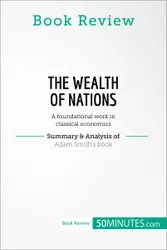
The Wealth of Nations, is the magnum opus of the Scottish economist and moral philosopher Adam Smith. First published in 1776, the book offers one of the world's first collected descriptions of what builds nations' wealth and is today a fundamental work in classical economics. Through reflection over the economics at the beginning of the Industrial Revolution the book touches upon such broad topics as the division of labour, productivity and free markets. The Wealth of Nations is a clearly written account of economics at the dawn of the Industrial Revolution. The book was a landmark work in the history and economics as it was comprehensive and an accurate characterization of the economic mechanisms at work in modern economics. Smith believed in a Meritocracy. Smith emphasized the advancement that one could take based on their will to better themselves. This is simply one of the most important books ever written on the subject of economics.
Commencez ce livre dès aujourd'hui pour 0 €

  • Accédez à tous les livres de l'app pendant la période d'essai
  • Sans engagement, annulez à tout moment
Essayer gratuitement
Plus de 52 000 personnes ont noté Nextory 5 étoiles sur l'App Store et Google Play.

Livres similaires

Plus de Adam Smith

  1. Nouveau

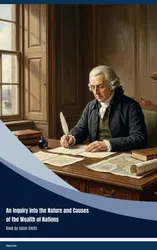
    An Inquiry into the Nature and Causes of the Wealth of Nations

    Adam Smith

  2. Harvard Classics : The Five-Foot Shelf of Books

    Aesop, Dante Alighieri, Hans Christian Andersen, Augustine of Hippo, Marcus Aurelius, Jane Austen, Francis Bacon, Honoré de Balzac, Francis Beaumont, Bjørnstjerne Bjørnson, Thomas Browne, Robert Browning, John Bunyan, EDMUND BURKE, Robert Burns, Lord Byron, Thomas Carlyle, Benvenuto Cellini, Miguel de Cervantes, Marcus Tullius Cicero, Richard Henry Jr., Charles Darwin, Alphonse Daudet, Thomas Dekker, Charles Dickens, Fyodor Dostoevsky, John Dryden, Charles W. Eliot, George Eliot, Ralph Waldo Emerson, Epictetus, John Fletcher, Theodor Fontane, Benjamin Franklin, Johann Wolfgang Goethe, Oliver Goldsmith, Jacob Grimm, Edward Everett Hale, Bret Harte, Nathaniel Hawthorne, Homer, Victor Hugo, Washington Irving, Henry James, Ben Jonson, Gottfried Keller, Thomas à Kempis, Alexander L. Kielland, Martin Luther, Niccolò Machiavelli, Alessandro Manzoni, Christopher Marlowe, Philip Massinger, Guy De Maupassant, John Stuart Mill, John Milton, Thomas More, William Morris, Alfred de Musset, William Allan Neilson, William Penn, Plato, Pliny the Younger, Plutarch, George Sand, Percy Bysshe Shelley, Richard Brinsley Sheridan, Adam Smith, Laurence Sterne, Theodor Storm, William Makepeace Thackeray, Leo Tolstoy, Ivan Turgenev, Mark Twain, Juan Valera, Virgil, Izaak Walton, John Webster, John Woolman

  3. Essays on Philosophical Subjects

    Adam Smith

  4. La Teoría de Los Sentimientos Morales

    Adam Smith

  5. An Inquiry into the Nature and Causes of the Wealth of Nations

    Adam Smith

  6. The Wealth of Nations : An Inquiry into the Nature and Causes of the Wealth of Nations

    Adam Smith

  7. An Inquiry into the Nature and Causes of the Wealth of Nations

    Adam Smith

  8. An Inquiry into the Nature and Causes of the Wealth of Nations

    Adam Smith

  9. La Mano Invisible : El Origen de la Riqueza: Por qué el Interés Propio Mueve el Mundo

    Adam Smith

  10. Analytic Summary of The Wealth of Nations : Book III: Of the Different Progress of Opulence in Different Nations

    Adam Smith

  11. Analytic Summary of The Wealth of Nations : Book IV: Of Systems of Political Economy

    Adam Smith