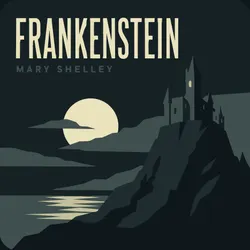
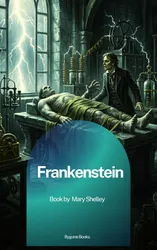
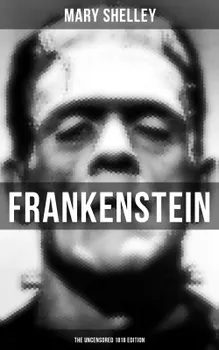
FRANKENSTEIN (The Uncensored 1818 Edition)

Mary Shelley's 'Frankenstein (The Uncensored 1818 Edition)' is a seminal work of gothic fiction that delves into the ethical consequences of scientific exploration and the hubris of mankind. Through the haunting tale of Victor Frankenstein's creation of a grotesque being, Shelley explores themes of ambition, responsibility, and the nature of humanity. The novel is characterized by its evocative prose and vivid descriptions, creating a chilling atmosphere that lingers with the reader long after the final page. Originally published anonymously in 1818, the novel has since become a classic of English literature and a touchstone for discussions of identity and monstrosity in the modern age. Shelley's use of multiple narrative perspectives adds layers of complexity to the story, inviting readers to contemplate the consequences of unchecked ambition and the power of creation. Mary Shelley's own tumultuous life, marked by personal tragedy and intellectual curiosity, undoubtedly influenced the creation of 'Frankenstein'. Her experiences with loss and the scientific debates of her time provided the fertile ground from which this profound work of fiction emerged. 'Frankenstein (The Uncensored 1818 Edition)' is essential reading for anyone interested in the intersection of science, ethics, and the human condition. Shelley's masterpiece continues to provoke thought and discussion, challenging readers to confront the darker aspects of human nature and the unforeseen consequences of our actions.
Über dieses Buch

Mary Shelley's 'Frankenstein (The Uncensored 1818 Edition)' is a seminal work of gothic fiction that delves into the ethical consequences of scientific exploration and the hubris of mankind. Through the haunting tale of Victor Frankenstein's creation of a grotesque being, Shelley explores themes of ambition, responsibility, and the nature of humanity. The novel is characterized by its evocative prose and vivid descriptions, creating a chilling atmosphere that lingers with the reader long after the final page. Originally published anonymously in 1818, the novel has since become a classic of English literature and a touchstone for discussions of identity and monstrosity in the modern age. Shelley's use of multiple narrative perspectives adds layers of complexity to the story, inviting readers to contemplate the consequences of unchecked ambition and the power of creation. Mary Shelley's own tumultuous life, marked by personal tragedy and intellectual curiosity, undoubtedly influenced the creation of 'Frankenstein'. Her experiences with loss and the scientific debates of her time provided the fertile ground from which this profound work of fiction emerged. 'Frankenstein (The Uncensored 1818 Edition)' is essential reading for anyone interested in the intersection of science, ethics, and the human condition. Shelley's masterpiece continues to provoke thought and discussion, challenging readers to confront the darker aspects of human nature and the unforeseen consequences of our actions.

Starte noch heute mit diesem Buch für CHF 0

  • Hole dir während der Testphase vollen Zugriff auf alle Bücher in der App
  • Keine Verpflichtungen, jederzeit kündbar
Jetzt kostenlos testen
Mehr als 52 000 Menschen haben Nextory im App Store und auf Google Play 5 Sterne gegeben.

  1. The Rise of Deathwatch : A Journey Through Gothic Horror: Explore 19th Century Dark Romance and Haunting Victorian Mysteries

    Horace Walpole, William Thomas Beckford, Eliza Parsons, William Godwin, Ann Radcliffe, Matthew Gregory Lewis, Charles Brockden Brown, Jane Austen, Mary Shelley, Thomas love Peacock, Edgar Allan Poe, John William Polidori, Washington Irving, Charles Robert Maturin, James Hogg, Victor Hugo, Frederick Marryat, Nikolai Gogol, Charlotte Brontë, Emily Brontë, James Malcolm Rymer, Thomas Peckett Prest, Nathaniel Hawthorne, George Eliot, Wilkie Collins, Robert Louis Stevenson, Charles Dickens, Joseph Sheridan Fanu, Arthur Conan Doyle, Oscar Wilde, Guy De Maupassant, Anna Katharine Green, Charlotte Perkins Gilman, Arthur Machen, George MacDonald, John Meade Falkner, H.G. Wells, Richard Marsh, Henry James, Bram Stoker, W. W. Jacobs, Robert Hugh Benson, Gaston Leroux, Théophile Gautier, William Hope Hodgson, Grant Allen

  2. Neu

    Falkner : Ein psychologischer Klassiker

    Mary Shelley

  3. Neu

    30 Occult and Supernatural masterpieces in one book

    Washington Irving, Mary Shelley, Charles Dickens, Joseph Sheridan Fanu, Elizabeth Cleghorn Gaskell, Louisa May Alcott, Oscar Wilde, Rudyard Kipling, Edith Nesbit, John Meade Falkner, Henry James, H.G. Wells, Montague Rhodes James, Arnold Bennett, Henry Rider Haggard, William Hope Hodgson, Virginia Woolf, Master Hendrick Certain, Pastor Tappau's, Lefebvre, De Lacy

  4. Neu

    The Dawn of Science Fiction : The Visionaries Who Imagined Tomorrow First

    H.G. Wells, Mary Shelley, Voltaire, Jack London, Frank R. Stockton, Edgar Allan Poe

  5. Neu

    Tomorrow Belonged to Her : Classic Science Fiction Written by Women

    Leigh Brackett, Evelyn E. Smith, Mary Shelley, Andre Norton, Margaret St. Clair, Lynn Venable, Miriam Allen deFord, Francis Stevens, Katherine MacLean, Dorothy Quick, Mary Carlson, Gerda Rhoads

  6. Neu
    3.9

    Frankenstein

    Mary Shelley

  7. Neu

    On Ghosts

    Mary Shelley

  8. Neu
    3.9

    Frankenstein

    Mary Shelley

  9. Neu

    Der letzte Mensch : Dystopischer Klassiker

    Mary Shelley

  10. Neu
    3.3

    The Mortal Immortal : The Tragic Romance of an Accidental Immortal by the Author of Frankenstein

    Mary Shelley

  11. Mondolfos arv

    Mary Shelley

  12. 100 Obras Maestras Que Debes Leer Antes De Morir

    Francis Scott Fitzgerald, Mary Shelley, Lyman Frank Baum, Edith Nesbit, Dante Alighieri, Jane Austen, Ambrose Bierce, Emily Brontë, Edgar Rice Burroughs, Lewis Carroll, Wilkie Collins, René Descartes, Charles Dickens, Emily Dickinson, Alexandre Dumas, Gustave Flaubert, Benito Pérez Galdós, Johann Wolfgang von Goethe, Thomas Hardy, E T A Hoffmann, Washington Irving, Henry James, James Joyce, Franz Kafka, Gaston Leroux, Federico García Lorca, H.P. Lovecraft, Publio Virgilio Marón, Lucy Maud Montgomery, John William Polidori, Marco Polo, Antoine de Saint-Exupéry, Emilio Salgari, Walter Scott, Mark Twain, Jules Verne, H.G. Wells, Edith Wharton, Mary Wollstonecraft, Fernando de Rojas