Über dieses Buch

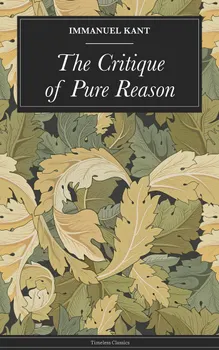
Unlock the Foundations of Human Knowledge with Kant's "The Critique of Pure Reason"Immanuel Kant's "The Critique of Pure Reason" is a groundbreaking philosophical work that revolutionized the way we understand the nature and limits of human cognition. In this seminal text, Kant explores the fundamental questions of how we perceive the world, what we can know, and the boundaries between experience and reason. He introduces his critical philosophy, emphasizing the importance of understanding the faculties of the mind and how they shape our knowledge of reality. The book meticulously examines concepts such as phenomena and noumena, the roles of space and time, and the nature of causality, offering a comprehensive framework that bridges rationalism and empiricism. Its profound insights have influenced countless disciplines, from metaphysics to epistemology, and continue to be a cornerstone of modern philosophy. Whether you are a student, scholar, or curious reader, this work provides essential perspectives on human understanding and the pursuit of truth. Dive into Kant's intricate analysis and discover the profound depths of philosophical inquiry that challenge and expand our view of the world.Immanuel Kant (1724–1804) was a German philosopher widely regarded as one of the central figures in modern philosophy. His work laid the groundwork for many philosophical movements and significantly impacted ethics, metaphysics, and epistemology. Kant's rigorous approach to critical thinking and his quest to reconcile rationalism and empiricism have made him a towering figure whose ideas continue to shape philosophical discourse today.
Starte noch heute mit diesem Buch für CHF 0

  • Hole dir während der Testphase vollen Zugriff auf alle Bücher in der App
  • Keine Verpflichtungen, jederzeit kündbar
Jetzt kostenlos testen
Mehr als 52 000 Menschen haben Nextory im App Store und auf Google Play 5 Sterne gegeben.

  1. Immanuel Kant zum Reinhören

    Immanuel Kant

  2. 3.0

    Classic Philosophical Works (Thus Spoke Zarathustra, The Apology of Socrates, Tao Te Ching...)

    Plato, Friedrich Nietzsche, Herman Hesse, Leo Tolstoy, Immanuel Kant, Sun Tzu

  3. Neu

    Lo Bello y Lo Sublime : Ensayo de Estética y Moral

    Immanuel Kant

  4. 100 Clásicos de la Literatura Universal

    Francis Scott Fitzgerald, Mary Shelley, Lyman Frank Baum, Louisa May Alcott, Dante Alighieri, Jane Austen, Ambrose Bierce, Emily Brontë, Edgar Rice Burroughs, Lewis Carroll, Wilkie Collins, René Descartes, Charles Dickens, Emily Dickinson, Alexandre Dumas, Gustave Flaubert, Benito Pérez Galdós, Johann Wolfgang von Goethe, Thomas Hardy, E T A Hoffmann, Washington Irving, Henry James, James Joyce, Franz Kafka, Gaston Leroux, Federico García Lorca, H.P. Lovecraft, Publio Virgilio Marón, Lucy Maud Montgomery, John William Polidori, Marco Polo, Antoine de Saint-Exupéry, Emilio Salgari, Walter Scott, Mark Twain, Jules Verne, Julio Verne, H.G. Wells, Edith Wharton, Mary Wollstonecraft, Stefan Zweig, Sun Tzu, Bram Stoker, - Aristoteles, George Bernard Shaw, Henryk Sienkiewicz, Concepción Arenal, Charlotte Brontë, Miguel de Cervantes, G.K. Chesterton, Daniel Defoe, Fyodor Mikhailovich Dostoyevsky, Arthur Conan Doyle, Sigmund Freud, H. Rider Haggard, Homero, Immanuel Kant, Rudyard Kipling, Molière, Friedrich Nietzsche, Fernando de Rojas, Sófocles, William Makepeace Thackeray, León Tolstói, Voltaire, Ramón María del Valle-Inclán, Oscar Wilde, Virginia Woolf

  5. Grundlegung zur Metaphysik der Sitten

    Immanuel Kant

  6. Beantwortung der Frage: Was ist Aufklärung?

    Immanuel Kant

  7. Hacia la paz perpetua

    Immanuel Kant

  8. #1

    Ästhetik : Die klassische Philosophie der sinnlichen Wahrnehmung

    Immanuel Kant

  9. Teoría y praxis : Estudio preliminar: Eduardo García Belsunce

    Immanuel Kant

  10. Crítica de la Razón Pura

    Immanuel Kant

  11. Perpetual Peace: A Philosophical Essay

    Immanuel Kant