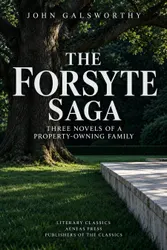
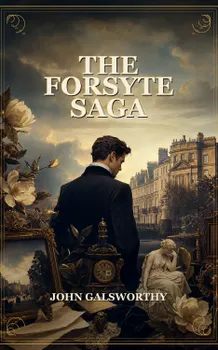
The Forsyte Saga

Between 1906 and 1921 John Galsworthy published three novels chronicling the Forsyte family, a fictional upper-middle class family at the end of the Victorian era: The Man of Property , In Chancery , and To Let . In 1922 Galsworthy wrote two interconnecting short stories to bind the three novels together and published the whole as The Forsyte Saga . While the novels follow the Forsyte family at large, the action centers around Soames Forsyte—the scion of a nouveau-riche London tea merchant—his wife Irene, and their unhappy marriage. Soames and his sprawling family are portrayed as stereotypes of unhappy gilded-age wealth, their family having entered the industrial revolution poor farmers and emerged as wealthy bourgeoise. Their rise was powered by their capacity to acquire, won at the expense of their capacity for almost anything else. Thematically, the saga focuses on the mores of the wealthy upper-middle class, which was still a newish feature in the class landscape of England at the time; duty, honor, and love; and the rapidly growing differences across generations occurring in a period of war and social change. The characters are complex and nuanced, and the situations they find themselves in—both of their own making, and of the making of society around them—provide a rich field for analyzing the close of the Victorian age, the dawn of the Edwardian age, and the societal frameworks that were forged in that frisson. Galsworthy went on to win the Nobel Prize in Literature in 1932 for The Forsyte Saga , one of the rare occasions in which the Swedish Academy has awarded a prize for a specific work instead of for a lifetime of work.
Über dieses Buch

Between 1906 and 1921 John Galsworthy published three novels chronicling the Forsyte family, a fictional upper-middle class family at the end of the Victorian era: The Man of Property , In Chancery , and To Let . In 1922 Galsworthy wrote two interconnecting short stories to bind the three novels together and published the whole as The Forsyte Saga . While the novels follow the Forsyte family at large, the action centers around Soames Forsyte—the scion of a nouveau-riche London tea merchant—his wife Irene, and their unhappy marriage. Soames and his sprawling family are portrayed as stereotypes of unhappy gilded-age wealth, their family having entered the industrial revolution poor farmers and emerged as wealthy bourgeoise. Their rise was powered by their capacity to acquire, won at the expense of their capacity for almost anything else. Thematically, the saga focuses on the mores of the wealthy upper-middle class, which was still a newish feature in the class landscape of England at the time; duty, honor, and love; and the rapidly growing differences across generations occurring in a period of war and social change. The characters are complex and nuanced, and the situations they find themselves in—both of their own making, and of the making of society around them—provide a rich field for analyzing the close of the Victorian age, the dawn of the Edwardian age, and the societal frameworks that were forged in that frisson. Galsworthy went on to win the Nobel Prize in Literature in 1932 for The Forsyte Saga , one of the rare occasions in which the Swedish Academy has awarded a prize for a specific work instead of for a lifetime of work.

Starte noch heute mit diesem Buch für CHF 0

  • Hole dir während der Testphase vollen Zugriff auf alle Bücher in der App
  • Keine Verpflichtungen, jederzeit kündbar
Jetzt kostenlos testen
Mehr als 52 000 Menschen haben Nextory im App Store und auf Google Play 5 Sterne gegeben.

  1. Neu

    Nykyaikainen komedia

    John Galsworthy

  2. Forsytein taru

    John Galsworthy

  3. La saga dei Forsyte. Primo volume

    John Galsworthy

  4. 100 Meisterwerke der englischen Literatur - Klassiker, die man kennen muss

    George Orwell, Charles Dickens, Jane Austen, Katherine Mansfield, H.P. Lovecraft, William Wordsworth, John Keats, Percy Bysshe Shelley, Robert Burns, John Milton, William Shakespeare, Christopher Marlowe, Geoffrey Chaucer, Laurence Sterne, Henry Fielding, Mary Shelley, Emily Brontë, Charlotte Brontë, Anne Brontë, William Makepeace Thackeray, George Eliot, D. H. Lawrence, Herman Melville, Thomas Wolfe, Virginia Woolf, Joseph Conrad, Sinclair Lewis, Walt Whitman, Edgar Allan Poe, Oscar Wilde, Jerome K Jerome, Washington Irving, Bram Stoker, H.G. Wells, Daniel Defoe, Lew Wallace, James Fenimore Cooper, Jonathan Swift, Robert Louis Stevenson, Mark Twain, Lewis Carrol, Edward Bulwer-Lytton, F. Scott Fitzgerald, Arthur Conan Doyle, Jack London, Henry David Thoreau, G.K. Chesterton, Edith Wharton, Henry James, Thomas Hardy, Margaret Mitchell, Kate Chopin, Willa Cather, Charlotte Perkins Gilman, James Joyce, John Galsworthy, Francis Hodgson Burnett, Lucy Maud Montgomery, Louisa May Alcott, Rudyard Kipling

  5. Nobelpreis

    Omenapuu

    John Galsworthy

  6. Nobelpreis
    #3

    La saga dei Forsyte. Affittasi

    John Galsworthy

  7. Nobelpreis
    #2

    La saga dei Forsyte. In tribunale

    John Galsworthy

  8. Nobelpreis
    #1

    La saga dei Forsyte. Il Possidente

    John Galsworthy

  9. Die größten Liebesgeschichten des Vergoldeten Zeitalters : Gilded Age Romance Sammelband: Aus guter Familie, Die Herrin des Großen Hauses, Die Aßmanns, Der Maskenball, Die Kameliendame

    Gabriele Reuter, John Galsworthy, Wilhelmine Heimburg, D. H. Lawrence, Hermann Heiberg, Joseph Roth, Edward Bulwer-Lytton, Ernst Wichert, Jack London, Alexandre Dumas, Lew Tolstoi, Gabriele D’Annunzio, Fjodor Michailowitsch Dostojewski, Theodor Fontane, Guy De Maupassant, George Eliot, Rudyard Kipling, Arthur Schnitzler, Anatole France, Johanna Spyri, Gustave Flaubert, Ida Boy-Ed, Hedwig Courths-Mahler, Eugenie Marlitt, Eufemia von Adlersfeld-Ballestrem, Nataly von Eschstruth, Elisabeth Bürstenbinder, Franziska Gräfin zu Reventlow, Elisabeth von Heyking

  10. Nobelpreis
    4.7
    #2

    In Chancery

    John Galsworthy

  11. Nobelpreis
    #2

    Indian Summer

    John Galsworthy