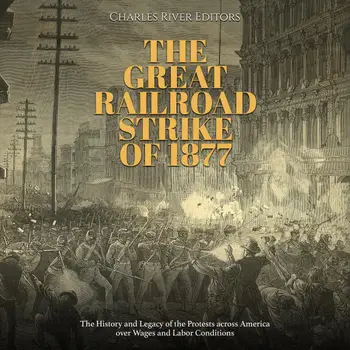
The Great Railroad Strike of 1877: The History and Legacy of the Protests across America over Wages and Labor Conditions

When trains were introduced as a popular means of transportation, some of the first tracks laid terminated in New York, and the expansion of railroads led to the birth of train stations across the country. In general, these were small buildings where passenger could buy tickets and wait for their trains to arrive, and according an article written by Samuel Dunn around the turn of the 20th century, “The first Manhattan terminal was opened in 1832 at Centre Street, near the present City Hall, by the New York and Harlem road, now leased to the New York Central. Trains were run by steam as far south as Fourteenth Street and pulled from there by horses.” If it is hard to conceive of large box cars or even heavier locomotives being pulled by horse, it’s important to remember that the first train cars were little more than traditional carriages designed to move on iron tracks.

Initially, the nation’s railway system was a fragmented, often chaotic system, but Cornelius Vanderbilt went about creating an interregional system, integrating a network of smaller railroads that ran according to their own policies, procedures, and even timetables. It was not only more customer-friendly, but it helped lower shipping costs and created a more efficient system of transporting goods and people. This led to the creation of one of the nation’s first corporations, the New York Central and Hudson Railroad.

While companies competed with each other, the employees themselves were often squeezed, not only working long hours in hazardous conditions, but making pitiful pay. Put simply, in an age before widespread labor regulations were enacted and unions organized, the employers exercised nearly absolute power over employees.
Starte noch heute mit diesem Buch für CHF 0

  • Hole dir während der Testphase vollen Zugriff auf alle Bücher in der App
  • Keine Verpflichtungen, jederzeit kündbar
Jetzt kostenlos testen
Mehr als 52 000 Menschen haben Nextory im App Store und auf Google Play 5 Sterne gegeben.

  1. The Rise and Fall of the Third Reich: The History and Legacy of Nazi Germany under Adolf Hitler

    Charles River Editors

  2. Benito Mussolini and Francisco Franco: The History of Europe’s Other Fascist Dictators

    Charles River Editors

  3. The Age of Sail’s Most Famous Battles: The History of the Naval Engagements that Shaped Europe in the Early Modern Period

    Charles River Editors

  4. The Iranian Revolution and Iran Hostage Crisis: The History of the Events that Broke American Relations with Iran

    Charles River Editors

  5. The Counter-Reformation: The History of the Catholic Church’s Response to the Protestant Reformation

    Charles River Editors

  6. The Christianization of Rome: The History of the Roman Empire’s Religious Conversion

    Charles River Editors

  7. Indian Removal: The History of the Battles and Policies that Displaced Native Americans East of the Mississippi River

    Charles River Editors

  8. Persepolis and Susa: The History of the Achaemenid Persian Empire’s Capitals

    Charles River Editors

  9. The Dawn of the Age of Exploration: The History of the Initial Expeditions that Led to European Imperialism across the Globe

    Charles River Editors

  10. Kublai Khan and Marco Polo: The History of a Unique Partnership at the Court of the Mongol Empire

    Charles River Editors

  11. The Height of the Cold War: The History of the Events that Brought the Soviet Union and United States to the Brink

    Charles River Editors

  12. Across the Silk Road and the Atlantic: The History of Marco Polo and Christopher Columbus’ Groundbreaking Voyages

    Charles River Editors