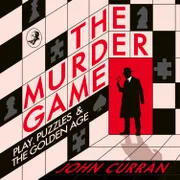
The Murder Game : Play, Puzzles and The Golden Age

From The Murder of Roger Ackroyd to Magpie Murders, and related diversions including cryptic crosswords and Cain’s Jawbone, The Murder Game examines the games authors played with their readers and the importance of puzzles in Golden Age whodunits.

With books flourishing in the 1920s and ’30s like never before, no genre was more innovative or popular than detective fiction. It was an era that saw the emergence of Agatha Christie, Dorothy L. Sayers, John Dickson Carr, Ellery Queen and dozens of other authors who became household names for a generation of readers.

The Golden Age of Detection has enjoyed a great resurgence of interest in recent years, with publishers mining back catalogues to bring the best of yesteryear to very receptive new audiences. What is it about a literary movement that took off in the 1920s that still appeals to book lovers in the 2020s?

In this authoritative new study, John Curran reveals that it is the ludic qualities of classic crime fiction that continue to intrigue. At its heart is the ‘whodunit’ game between writer and reader, but there is also the game between detective and murderer, between publisher and book-buyer, even between the writers themselves.

Coinciding with an increase in leisure time and literacy, the Golden Age also saw the development of the crossword, the growth of bridge and Mahjong, the enduring popularity of jigsaws and the emergence of Cluedo – all activities requiring the ‘little grey cells’. The Murder Game considers all of these, and many other sporting and competitive recreations, helping to explain the reading public’s ongoing love affair with the Golden Age.

Über dieses Buch

From The Murder of Roger Ackroyd to Magpie Murders, and related diversions including cryptic crosswords and Cain’s Jawbone, The Murder Game examines the games authors played with their readers and the importance of puzzles in Golden Age whodunits.

With books flourishing in the 1920s and ’30s like never before, no genre was more innovative or popular than detective fiction. It was an era that saw the emergence of Agatha Christie, Dorothy L. Sayers, John Dickson Carr, Ellery Queen and dozens of other authors who became household names for a generation of readers.

The Golden Age of Detection has enjoyed a great resurgence of interest in recent years, with publishers mining back catalogues to bring the best of yesteryear to very receptive new audiences. What is it about a literary movement that took off in the 1920s that still appeals to book lovers in the 2020s?

In this authoritative new study, John Curran reveals that it is the ludic qualities of classic crime fiction that continue to intrigue. At its heart is the ‘whodunit’ game between writer and reader, but there is also the game between detective and murderer, between publisher and book-buyer, even between the writers themselves.

Coinciding with an increase in leisure time and literacy, the Golden Age also saw the development of the crossword, the growth of bridge and Mahjong, the enduring popularity of jigsaws and the emergence of Cluedo – all activities requiring the ‘little grey cells’. The Murder Game considers all of these, and many other sporting and competitive recreations, helping to explain the reading public’s ongoing love affair with the Golden Age.

Starten Sie noch heute mit diesem Buch für CHF 0

  • Hol dir während der Probezeit vollen Zugriff auf alle Bücher in der App
  • Keine Verpflichtungen, du kannst jederzeit kündigen
Jetzt kostenlos testen
Mehr als 52 000 Menschen haben Nextory im App Store und auf Google Play 5 Sterne gegeben.