Über dieses Buch

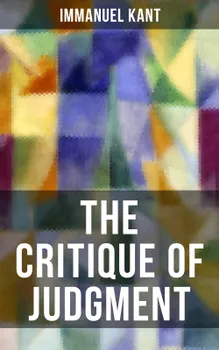
Immanuel Kant's 'The Critique of Judgment' is a seminal work in the realm of philosophy, exploring the nature of aesthetic and teleological judgments. Kant delves into the realms of art, beauty, and nature, examining how the mind processes ideas of taste and purposiveness. Written in a clear and precise manner, the book combines elements of metaphysics, epistemology, and ethics, making it a profound and comprehensive read for students of philosophy. Kant's analysis of the subjective and universal aspects of judgment offers valuable insights into the human experience of art and the natural world. Immanuel Kant, a prominent figure in the Enlightenment era, was a German philosopher known for his groundbreaking theories on metaphysics, ethics, and epistemology. His background in theology and philosophy influenced his critical approach to understanding the principles of human thought and perception, leading to the creation of 'The Critique of Judgment.' Kant's meticulous reasoning and intellectual rigor are apparent in this work, demonstrating his commitment to exploring the complexities of human cognition. For readers interested in delving into the profound insights of one of the most influential philosophers in history, 'The Critique of Judgment' by Immanuel Kant is a must-read. This book not only sheds light on the nature of aesthetic and teleological judgments but also offers a glimpse into Kant's philosophical legacy, making it a valuable addition to any scholarly collection.

In this enriched edition, we have carefully created added value for your reading experience:

- A succinct Introduction situates the work's timeless appeal and themes.

- The Synopsis outlines the central plot, highlighting key developments without spoiling critical twists.

- A detailed Historical Context immerses you in the era's events and influences that shaped the writing.

- An Author Biography reveals milestones in the author's life, illuminating the personal insights behind the text.

- A thorough Analysis dissects symbols, motifs, and character arcs to unearth underlying meanings.

- Reflection questions prompt you to engage personally with the work's messages, connecting them to modern life.

- Hand‐picked Memorable Quotes shine a spotlight on moments of literary brilliance.

- Interactive footnotes clarify unusual references, historical allusions, and archaic phrases for an effortless, more informed read.

Starte noch heute mit diesem Buch für 0 €

  • Hole dir während der Testphase vollen Zugriff auf alle Bücher in der App
  • Keine Verpflichtungen, jederzeit kündbar
Jetzt kostenlos testen
Mehr als 52 000 Menschen haben Nextory im App Store und auf Google Play 5 Sterne gegeben.

  1. 50 Meisterwerke der Philosophie : Metaphysik, Das Gastmahl, Bhagavadgita, Tractatus logico-philosophicus, Kritik der reinen Vernunft, Also sprach Zarathustra, Selbstbetrachtungen von Marcus Aurelius

    Ludwig Wittgenstein, Edmund Husserl, Karl Marx, Søren Kierkegaard, Friedrich Nietzsche, Ralph Waldo Emerson, John Stuart Mill, Georg Wilhelm Hegel, Friedrich Schelling, Johann Gottlieb Fichte, Immanuel Kant, John Locke, Montesquieu, Jean-Jacques Rousseau, David Hume, Gottfried Wilhelm Leibniz, Baruch Spinoza, - Konfuzius, Lao Tse, Platon, Xenophon, - Aristoteles, Marcus Tullius Cicero, Seneca, Epiktet, Marc Aurel, Plotin, Thomas von Aquin, Nicolaus von Cues, - Erasmus von Rotterdam, Niccolò Machiavelli, Tommaso Campanella, Martin Luther, Giordano Bruno, Samuel von Pufendorf, Abbé Castel Saint-Pierre, Michel de Montaigne, René Descartes, Francis Bacon, Blaise Pascal

  2. Immanuel Kant zum Reinhören

    Immanuel Kant

  3. Essenzielle Klassiker der politischen Philosophie : Der Staat, Der Gesellschaftsvertrag, Der Fürst, Utopia, Manifest der Kommunistischen Partei, Geschichte der Socialdemokratie

    Niccolò Machiavelli, Montesquieu, Friedrich der Große, Platon, - Aristoteles, Marcus Tullius Cicero, Tommaso Campanella, Thomas Morus, Samuel von Pufendorf, Abbé Castel Saint-Pierre, Jean-Jacques Rousseau, Immanuel Kant, Johann Gottlieb Fichte, Karl Marx, Friedrich Engels, Wilhelm von Humboldt, Friedrich Christoph Dahlmann, Franz Mehring, Johann Most, John Henry Mackay, Rosa Luxemburg, Erich Mühsam

  4. Klassiker des politischen Denkens: Die große Hörbuch Box : Ein Grundlagenwerk der Politik

    Karl Marx, Sun Tzu, Immanuel Kant, Max Weber, Benjamin Franklin, Platon, Niccolò Machiavelli, Georg Büchner

  5. Erkenne Dich selbst: Die große Hörbuch Box der philosophischen Anregungen : Kant, Montaigne, Seneca, Nietzsche, Konfuzius

    - Konfuzius, Lucius Annaeus Seneca, Immanuel Kant, Michel de Montaigne, Friedrich Nietzsche

  6. 4.0

    3500 Final Quotes

    Marcus Aurelius, Jane Austen, Beaumarchais, Napoleon Bonaparte, Buddha, Winston Churchill, Cicero, Confucius, Nicolas de Chamfort, Charles de Gaulle, Antoine de Saint-Exupéry, Denis Diderot, Fyodor Dostoevsky, Albert Einstein, Ralph Waldo Emerson, Anne Frank, Mahatma Gandhi, Immanuel Kant, Søren Kierkegaard, Martin Luther King, Georg Christoph Lichtenberg, Abraham Lincoln, Montesquieu, Friedrich Nietzsche, Plato, Marcel Proust, Arthur Schopenhauer, William Shakespeare, Socrates, Baruch Spinoza, Henry David Thoreau, Leonardo da Vinci, Voltaire, Oscar Wilde, Laozi

  7. 900 Quotations from Modern Philosophy

    Francis Bacon, Michel de Montaigne, Immanuel Kant, Nicolas Machiavel, Montesquieu, Blaise Pascal, Jean-Jacques Rousseau, Baruch Spinoza, Voltaire

  8. Kritik der reinen Vernunft

    Immanuel Kant

  9. Kritik der reinen Vernunft - Der Grundriss für Transzendentalphilosophie : Bereicherte Ausgabe. Die Erste Kritik: Vorläufer der Kritik der praktischen Vernunft und der Kritik der Urteilskraft

    Immanuel Kant

  10. Neu

    Lo Bello y Lo Sublime : Ensayo de Estética y Moral

    Immanuel Kant

  11. 100 Clásicos de la Literatura Universal

    Francis Scott Fitzgerald, Mary Shelley, Lyman Frank Baum, Louisa May Alcott, Dante Alighieri, Jane Austen, Ambrose Bierce, Emily Brontë, Edgar Rice Burroughs, Lewis Carroll, Wilkie Collins, René Descartes, Charles Dickens, Emily Dickinson, Alexandre Dumas, Gustave Flaubert, Benito Pérez Galdós, Johann Wolfgang von Goethe, Thomas Hardy, E T A Hoffmann, Washington Irving, Henry James, James Joyce, Franz Kafka, Gaston Leroux, Federico García Lorca, H.P. Lovecraft, Publio Virgilio Marón, Lucy Maud Montgomery, John William Polidori, Marco Polo, Antoine de Saint-Exupéry, Emilio Salgari, Walter Scott, Mark Twain, Jules Verne, Julio Verne, H.G. Wells, Edith Wharton, Mary Wollstonecraft, Stefan Zweig, Sun Tzu, Bram Stoker, - Aristoteles, George Bernard Shaw, Henryk Sienkiewicz, Concepción Arenal, Charlotte Brontë, Miguel de Cervantes, G.K. Chesterton, Daniel Defoe, Fyodor Mikhailovich Dostoyevsky, Arthur Conan Doyle, Sigmund Freud, H. Rider Haggard, Homero, Immanuel Kant, Rudyard Kipling, Molière, Friedrich Nietzsche, Fernando de Rojas, Sófocles, William Makepeace Thackeray, León Tolstói, Voltaire, Ramón María del Valle-Inclán, Oscar Wilde, Virginia Woolf

  12. Grundlegung zur Metaphysik der Sitten

    Immanuel Kant