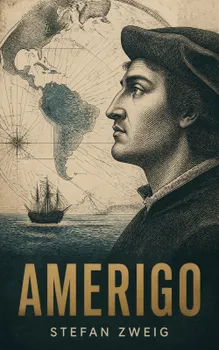
Über dieses Buch

Amerigo by Stefan Zweig is a concise yet intellectually compelling historical study devoted to one of the most consequential and controversial figures of the Age of Discovery: Amerigo Vespucci. Rather than presenting the navigator merely as the namesake of two continents, Zweig examines how Vespucci's voyages, writings, and reputation became intertwined with the European discovery of the New World and with the historical forces that reshaped the understanding of the globe.

Zweig reconstructs Vespucci's life against the turbulent background of Renaissance Europe, where maritime exploration, commercial ambition, geographical speculation, and political rivalry were transforming the intellectual map of the world. As Vespucci encounters the new lands across the Atlantic, his observations and accounts contribute to a growing realization that these territories are not simply the eastern fringes of Asia, but part of an entirely new continent. Zweig also explores the roles of other explorers and contemporary figures whose voyages and reports form the wider historical context, including Christopher Columbus, whose achievements and claims inevitably stand in contrast to Vespucci's developing reputation.

With his characteristic ability to transform historical investigation into a vivid human narrative, Zweig pays particular attention to the uncertainty, ambition, misunderstandings, and competing interpretations surrounding the discoveries. The central question is not simply who discovered America, but how historical fame is created—and why a name can acquire an importance far greater than the intentions of the person who bore it.

The significance of Amerigo extends beyond the biography of a Renaissance navigator. Zweig uses a relatively narrow historical episode to illuminate the unpredictable mechanisms of fame, historical memory, and cultural legacy. His study remains valuable for the way it connects individual lives with the vast transformations of an era and demonstrates how historical reputations can emerge from circumstance as much as achievement. As a work of historical biography, Amerigo reflects Zweig's enduring fascination with individuals caught at decisive moments of civilization, making it an engaging and thought-provoking contribution to the literature of history and biography.

Starte noch heute mit diesem Buch für 0 €

  • Hole dir während der Testphase vollen Zugriff auf alle Bücher in der App
  • Keine Verpflichtungen, jederzeit kündbar
Jetzt kostenlos testen
Mehr als 52 000 Menschen haben Nextory im App Store und auf Google Play 5 Sterne gegeben.

  1. 1.0

    100 Meisterwerke der Weltliteratur - Klassiker die man kennen muss : Bereicherte Ausgabe. Ein literarisches Panorama: Meisterwerke, Klassiker und Autoren der Weltliteratur

    Johann Wolfgang Goethe, Jules Verne, Gustave Flaubert, Franz Kafka, Lewis Carroll, Selma Lagerlöf, Sigmund Freud, Johanna Spyri, Theodor Storm, Rainer Maria Rilke, Charles Dickens, Stefan Zweig, Heinrich Heine, Honoré de Balzac, Theodor Fontane, Karl May, Gottfried Keller, Mark Twain, Heinrich Mann, Else Lasker-Schüler, Robert Musil, Walt Whitman, Oscar Wilde, Annette von Droste-Hülshoff, Arthur Schopenhauer, Robert Louis Stevenson, Gustav Freytag, James Fenimore Cooper, Edgar Allan Poe, Heinrich von Kleist, William Shakespeare, Dante Alighieri, Charlotte Brontë, Emily Brontë, Jack London, Arthur Conan Doyle, Joseph Conrad, Jane Austen, Herman Melville, Guy De Maupassant, Walter Scott, Jonathan Swift, Jacob Grimm, Wilhelm Grimm, Alexandre Dumas, Rudyard Kipling, Nathaniel Hawthorne, Homer, O.Henry, Voltaire, Lew Wallace, John Galsworthy, E. T. Hoffmann, Marcus Aurelius, Hans Christian Andersen, Anton Pawlowitsch Tschechow, Platon, Friedrich Nietzsche, Iwan Sergejewitsch Turgenew, Tacitus, Nikolai Gogol, Miguel de Cervantes, Mary Shelley, Thomas Wolfe, Emile Zola, Fjodor Michailowitsch Dostojewski, Leo Tolstoi, Joseph Roth, Joseph von Eichendorff, Kurt Tucholsky, Iwan Alexandrowitsch Gontscharow, Oswald Spengler, Moliere, Alfred Adler, Sophie von Roche, Klaus Mann, Rumi

  2. 4.5

    Schachnovelle (Ungekürzte Fassung)

    Stefan Zweig

  3. 50 Meisterwerke Musst Du Lesen, Bevor Du Stirbst: Vol. 2

    Jakob Christoph Heer, Immanuel Kant, Ernst Weiß, Stefan Zweig, Franz Kafka, Theodor Fontane, Fyodor Dostoyevsky, Emile Zola, Karl May, Antoine François Prévos, Hugo von Hofmannsthal, E. T. Hoffmann, Lev Tolstoy, Charles Baudelaire, Heinrich von Kleist, Edgar Allan Poe, Rainer Maria Rilke, Hermann Hesse, Jules Verne, Joseph Conrad, Gustave Flaubert, Jacques-Henri Bernardin, Joseph Roth, Anton Pavlovich Chekhov, Ludwig Ganghofer, Thomas Morus, Leopold von Sacher-Masoch, BookTime

  4. 3.0

    200 Meisterwerke der Literaturgeschichte (Kommentiert) : Erweiterte Ausgabe. Die größten Klassiker der Weltliteratur

    Franz Kafka, Victor Hugo, Fjodor Michailowitsch Dostojewski, Lord Byron, Giacomo Leopardi, Marcel Proust, Henrik Ibsen, Percy Bysshe Shelley, Charles Dickens, Jane Austen, Mary Shelley, Emily Brontë, Charlotte Brontë, Anne Brontë, William Makepeace Thackeray, Bram Stoker, Henry Fielding, George Eliot, William Shakespeare, D. H. Lawrence, Walt Whitman, Herman Melville, Thomas Wolfe, Virginia Woolf, Joseph Conrad, Sinclair Lewis, Lewis Carrol, Edgar Allan Poe, Edward Bulwer-Lytton, Oscar Wilde, H.G. Wells, Daniel Defoe, James Fenimore Cooper, Lew Wallace, Jonathan Swift, Mark Twain, Walter Scott, Nathaniel Hawthorne, Harriet Beecher Stowe, Laurence Sterne, Frances Hodgson Burnett, Arthur Conan Doyle, Wilkie Collins, Edgar Wallace, Robert Louis Stevenson, Jack London, Henry David Thoreau, John Galsworthy, F. Scott Fitzgerald, Rudyard Kipling, G.K. Chesterton, Washington Irvin, O.Henry, Ambrose Bierce, Alexander Sergejewitsch Puschkin, Michail Lermontow, Iwan Sergejewitsch Turgenew, Leo Tolstoi, Nikolai Gogol, Iwan Gontscharow, Nikolai Leskow, Anton Pawlowitsch Tschechow, Maxim Gorki, François Rabelais, Jean De Fontaine, Blaise Pascal, Pierre Corneille, Moliere, Jean Baptiste Racine, Charles Perrault, Voltaire, Denis Diderot, Jean-Jacques Rousseau, Pierre Ambroise Laclos, Antoine-François Prévost, Marquis De Sade, François René Chateaubriand, Stendhal, Honoré de Balzac, Alexandre Dumas, Alphonse de Lamartine, George Sand, Gustave Flaubert, Emile Zola, Guy De Maupassant, Alphonse Daudet, Jules Verne, Joris-Karl Huysmans, Prosper Mérimée, Charles Baudelaire, Stéphane Mallarmé, Arthur Rimbaud, André Gide, Arthur Schopenhauer, Heinrich Heine, Friedrich Schiller, Johann Wolfgang Goethe, Jacob Grimm, Gottfried von Straßburg, Wolfram von Eschenbach, E. T. Hoffmann, Annette von Droste-Hülshoff, Heinrich von Kleist, Friedrich Hölderlin, Theodor Fontane, Gustav Freytag, Gottfried Keller, Theodor Storm, Stefan Zweig, Joseph von Eichendorff, Klaus Mann, Rainer Maria Rilke, Johanna Spyri, Joseph Roth, Karl May, Robert Musil, Heinrich Mann, Sigmund Freud, Friedrich Nietzsche, Dante Alighieri, Giovanni Boccaccio, Giacomo Casanova, Luigi Pirandello, Giosuè Carducci, Gabriele D’Annunzio, Niccolo Machiavelli, Miguel Cervantes Saavedra, Pedro Calderón Barca, Vicente Blasco Ibañez, Knut Hamsun, Homer, Äsop, Herodot, Thukydides, Xenophon, Platon, - Aristoteles, - Sophokles, Euripides, - Aristophanes, Lao Tse, - Konfuzius, Siddhartha Gautama Buddha, Titus Livius, Tacitus, Marcus Tullius Cicero, Vergil, Ovid, Lukian, Petronius, Apuleius, Longos von Lesbos, Mark Aurel, Aurelius Augustinus

  5. 100 Klassiker der Romantik - Meisterwerke, die man kennen muss : Liebes-, Bildungs- und Gesellschaftsromane der europäischen Literaturgeschichte

    Jane Austen, Louisa May Alcott, D. H. Lawrence, Fjodor Dostojewski, William Shakespeare, Hedwig Courths-Mahler, Frances Burney, Charlotte Brontë, Alexandre Dumas, Margaret Mitchell, Charles Dickens, L.M. Montgomery, Eugenie Marlitt, Wilhelmine Heimburg, Elisabeth Bürstenbinder, Stendhal, Johann Wolfgang Goethe, Walter Scott, Guy De Maupassant, Victor Hugo, George Sand, Leo Tolstoi, Gabriele D’Annunzio, Rudyard Kipling, Gustave Flaubert, Nathaniel Hawthorne, Jean-Jacques Rousseau, Bernardin de Saint-Pierre, F. Scott Fitzgerald, Prosper Mérimée, Edith Wharton, Lena Christ, François-René de Chateaubriand, Stefan Zweig, Alexander Sergejewitsch Puschkin, Ida Boy-Ed, Arthur Schnitzler, Anatole France, Johanna Spyri, George Eliot, Gaston Leroux, Nataly von Eschstruth, Gottfried von Straßburg, Sophie Mereau, Caroline von Wolzogen, Benedikte Naubert, Henry De Stacpoole, Levin Schücking

  6. 4.3

    Schachnovelle - Hörbuch Klassiker

    Stefan Zweig, Hörbuch Klassiker

  7. 30. Okt.

    Der Amokläufer. Eine Novelle. : Hörbuchzeit: Klassiker der Weltliteratur

    Hörbuchzeit, Stefan Zweig

  8. Neu

    Brief einer Unbekannten / Angst : Zwei Novellen

    Stefan Zweig

  9. 5.0

    Die Welt von gestern : Erinnerungen eines Europäers

    Stefan Zweig

  10. 4.0

    Tolstoi

    Stefan Zweig

  11. 5.0

    Sigmund Freud : Heilung durch den Geist

    Stefan Zweig

  12. 5.0

    Magellan : Der Mann und seine Tat

    Stefan Zweig