Über dieses Buch

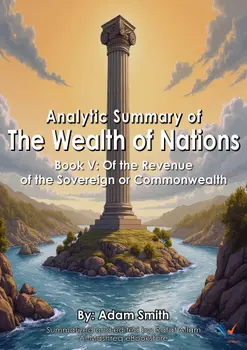
In The Wealth of Nations, Book V: Of the Revenue of the Sovereign or Commonwealth, Adam Smith brings his masterwork to a powerful conclusion by turning to the most enduring question of political economy: what is the proper role of government? Here he analyzes the legitimate expenses of the state—defense, justice, public works, and education—before turning to the sources of public revenue and the principles of fair taxation. With his famous "four maxims of taxation" still cited by economists and policymakers today, Smith shows how governments can raise funds without crushing liberty or prosperity. Finally, in a prophetic warning, he examines the rise of public debt, describing how constant borrowing to fund wars risks weakening nations and burdening future generations. Book V is both practical and visionary: a blueprint for responsible governance that balances freedom with necessity, and a cautionary tale about the dangers of fiscal irresponsibility. For readers who want to understand not only markets but also the responsibilities of the state, this book is a timeless guide.
Starte noch heute mit diesem Buch für 0 €

  • Hole dir während der Testphase vollen Zugriff auf alle Bücher in der App
  • Keine Verpflichtungen, jederzeit kündbar
Jetzt kostenlos testen
Mehr als 52 000 Menschen haben Nextory im App Store und auf Google Play 5 Sterne gegeben.

Ähnliche Bücher

Mehr von Adam Smith

  1. 3.9
    #1

    Doctor Who, Vol. 1: Short Trips (Unabridged)

    George Mann, David A., Jamie Hailstone, Damian Sawyer, Ally Kennen, Colin Baker, Adam Smith, Dorothy Koomson

  2. Neu

    An Inquiry into the Nature and Causes of the Wealth of Nations

    Adam Smith

  3. Neu

    La riqueza de las naciones : División del trabajo, libre mercado y fundamentos de la economía moderna

    Adam Smith

  4. An Inquiry into the Nature and Causes of the Wealth of Nations

    Adam Smith

  5. Harvard Classics : The Five-Foot Shelf of Books

    Aesop, Dante Alighieri, Hans Christian Andersen, Augustine of Hippo, Marcus Aurelius, Jane Austen, Francis Bacon, Honoré de Balzac, Francis Beaumont, Bjørnstjerne Bjørnson, Thomas Browne, Robert Browning, John Bunyan, EDMUND BURKE, Robert Burns, Lord Byron, Thomas Carlyle, Benvenuto Cellini, Miguel de Cervantes, Marcus Tullius Cicero, Richard Henry Jr., Charles Darwin, Alphonse Daudet, Thomas Dekker, Charles Dickens, Fyodor Dostoevsky, John Dryden, Charles W. Eliot, George Eliot, Ralph Waldo Emerson, Epictetus, John Fletcher, Theodor Fontane, Benjamin Franklin, Johann Wolfgang Goethe, Oliver Goldsmith, Jacob Grimm, Edward Everett Hale, Bret Harte, Nathaniel Hawthorne, Homer, Victor Hugo, Washington Irving, Henry James, Ben Jonson, Gottfried Keller, Thomas à Kempis, Alexander L. Kielland, Martin Luther, Niccolò Machiavelli, Alessandro Manzoni, Christopher Marlowe, Philip Massinger, Guy De Maupassant, John Stuart Mill, John Milton, Thomas More, William Morris, Alfred de Musset, William Allan Neilson, William Penn, Plato, Pliny the Younger, Plutarch, George Sand, Percy Bysshe Shelley, Richard Brinsley Sheridan, Adam Smith, Laurence Sterne, Theodor Storm, William Makepeace Thackeray, Leo Tolstoy, Ivan Turgenev, Mark Twain, Juan Valera, Virgil, Izaak Walton, John Webster, John Woolman

  6. Essays on Philosophical Subjects

    Adam Smith

  7. La Teoría de Los Sentimientos Morales

    Adam Smith

  8. An Inquiry into the Nature and Causes of the Wealth of Nations

    Adam Smith

  9. The Wealth of Nations : An Inquiry into the Nature and Causes of the Wealth of Nations

    Adam Smith

  10. An Inquiry into the Nature and Causes of the Wealth of Nations

    Adam Smith

  11. 3.0

    Wohlstand der Nationen : Erster Band

    Adam Smith

  12. An Inquiry into the Nature and Causes of the Wealth of Nations

    Adam Smith