Über dieses Buch

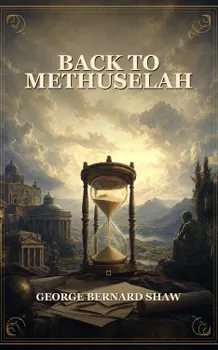
George Bernard Shaw published this series of five linked plays in a single volume in 1921. It was first performed in 1922 in New York. We begin in the year 4004 BC. In the Garden of Eden, Adam and Eve discover death, and a serpent teaches them what it is to conceive new life. It is the early twentieth century. The brothers Barnabas are discussing the political need for people to live for three centuries when the leaders of the Liberal party arrive to convince one of them to run for Parliament. It is the year 2170. British public services are provided so effectively by the Chinese that government has become largely ceremonial and Parliament full of the insane. Life expectancy is 78, the public are expected to work from the age of 13 through to retirement at 43, and the Accountant General discovers that the Archbishop is 283 years old. It is the year 3000. An elderly short-lived man is visiting Ireland from Baghdad, the capitol of the British Commonwealth, with the British Prime Minister and the Emperor of Turania, who have come to ask for advice from the Oracle. He finds that even though everyone speaks the same language, he can't communicate with the local long-lived population. It is the farthest future, the year 31,920. In idyllic surroundings people hatch, physically mature, spend four years playing and dancing, and then live for an eternity, changing their physical forms as they wish. A new child is born, a Festival of Art is held, and a youth has discovered how to breath life into artificial humans. When staged, Back to Methuselah tends to be split across multiple evenings, or is heavily abridged; some critics have argued that it was intended to be read and not staged. In a lengthy preface Shaw discusses the need for humans to learn to live longer and to gain more wisdom to be able to govern effectively. In it he argues against both the theory of Darwinian evolution and the church, writing that the purpose of the plays is to "homeopathically educate" the population against Darwinist thinking when choosing their political leaders. His counterarguments are the Lamarckian view of evolution, his concept of the Life Force (which he previously explored in Man.
Starte noch heute mit diesem Buch für 0 €

  • Hole dir während der Testphase vollen Zugriff auf alle Bücher in der App
  • Keine Verpflichtungen, jederzeit kündbar
Jetzt kostenlos testen
Mehr als 52 000 Menschen haben Nextory im App Store und auf Google Play 5 Sterne gegeben.

Mehr von George Bernard Shaw

  1. 500 Quotes of Humour

    Woody Allen, Albert Einstein, Groucho Marx, George Bernard Shaw, Oscar Wilde

  2. Nobelpreis

    Gesammelte Werke : Vollständige Ausgaben: Cashel Byrons Beruf, Der Amateur-Sozialist, Künstlerliebe u.v.m.

    George Bernard Shaw

  3. Gekürzt

    500 humoristische Zitate : Sammlung bester Zitate

    Oscar Wilde, Groucho Marx, George Bernard Shaw, Woody Allen, Albert Einstein

  4. 1. Nov.
    3.3

    Pygmalion

    George Bernard Shaw

  5. 1. Nov.

    Arms and the Man

    George Bernard Shaw

  6. 1. Nov.

    Man and Superman: A Comedy and a Philosophy

    George Bernard Shaw

  7. 1. Nov.

    Candida

    George Bernard Shaw

  8. 1. Nov.

    The Philanderer

    George Bernard Shaw

  9. 1. Nov.

    Der Mann Des Schicksals: Komödie in Einem Akt

    George Bernard Shaw

  10. 1. Nov.

    Caesar and Cleopatra

    George Bernard Shaw

  11. #33

    Mrs. Warren's Profession

    George Bernard Shaw

  12. 100 Clásicos de la Literatura Universal

    Francis Scott Fitzgerald, Mary Shelley, Lyman Frank Baum, Louisa May Alcott, Dante Alighieri, Jane Austen, Ambrose Bierce, Emily Brontë, Edgar Rice Burroughs, Lewis Carroll, Wilkie Collins, René Descartes, Charles Dickens, Emily Dickinson, Alexandre Dumas, Gustave Flaubert, Benito Pérez Galdós, Johann Wolfgang von Goethe, Thomas Hardy, E T A Hoffmann, Washington Irving, Henry James, James Joyce, Franz Kafka, Gaston Leroux, Federico García Lorca, H.P. Lovecraft, Publio Virgilio Marón, Lucy Maud Montgomery, John William Polidori, Marco Polo, Antoine de Saint-Exupéry, Emilio Salgari, Walter Scott, Mark Twain, Jules Verne, Julio Verne, H.G. Wells, Edith Wharton, Mary Wollstonecraft, Stefan Zweig, Sun Tzu, Bram Stoker, - Aristoteles, George Bernard Shaw, Henryk Sienkiewicz, Concepción Arenal, Charlotte Brontë, Miguel de Cervantes, G.K. Chesterton, Daniel Defoe, Fyodor Mikhailovich Dostoyevsky, Arthur Conan Doyle, Sigmund Freud, H. Rider Haggard, Homero, Immanuel Kant, Rudyard Kipling, Molière, Friedrich Nietzsche, Fernando de Rojas, Sófocles, William Makepeace Thackeray, León Tolstói, Voltaire, Ramón María del Valle-Inclán, Oscar Wilde, Virginia Woolf