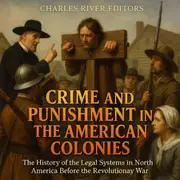
Crime and Punishment in the American Colonies: The History of the Legal Systems in North America Before the Revolutionary War

Even though the colonists eventually broke free from Great Britain, plenty of British customs and practices affected the fledgling United States, particularly when it came to law. While the most notable ramifications can be found in the Fourth Amendment to the Constitution, which forbids illegal searches and seizures by the government, the extensive legal background from Britain impacted how American lawyers and courts operated as well, even as legal codes differed considerably from colony to colony because of their charters. The local codes had to broadly conform with the current laws in England, and the early equivalent of the Colonial Office examined colonial laws if someone sued. Laws found to be inconsistent with English practice were sometimes voided.

On paper, the New England codes were extremely harsh, but in practice, they were often mildly enforced, if enforced at all. One law on the books was that a son could be executed if he cursed his parents, but no one was ever executed for it. Many crimes were offenses against public decorum, but there was a wide range of things considered misbehaviors. Punishments varied but tended to be either financial or public, with humiliation and shame being a large part of it.

Conversely, while the New Englanders tended to base their codes on the Old Testament, in Pennsylvania, the Quaker establishment sought to reform criminals rather than punish them. Consequently, they probably had the least number of capital offenses of any place in the English-speaking world. Furthermore, over time, the list of what constituted crimes changed somewhat, as did the emphasis. The fast growth of populations brought large numbers of immigrants and indentured servants and a more complex society. Diversity increased, and the rise of slavery concentrated in (but was not limited to) the Southern colonies, bringing with it codes of law to control slaves and deal with offenses committed by them.
Über dieses Buch

Even though the colonists eventually broke free from Great Britain, plenty of British customs and practices affected the fledgling United States, particularly when it came to law. While the most notable ramifications can be found in the Fourth Amendment to the Constitution, which forbids illegal searches and seizures by the government, the extensive legal background from Britain impacted how American lawyers and courts operated as well, even as legal codes differed considerably from colony to colony because of their charters. The local codes had to broadly conform with the current laws in England, and the early equivalent of the Colonial Office examined colonial laws if someone sued. Laws found to be inconsistent with English practice were sometimes voided.

On paper, the New England codes were extremely harsh, but in practice, they were often mildly enforced, if enforced at all. One law on the books was that a son could be executed if he cursed his parents, but no one was ever executed for it. Many crimes were offenses against public decorum, but there was a wide range of things considered misbehaviors. Punishments varied but tended to be either financial or public, with humiliation and shame being a large part of it.

Conversely, while the New Englanders tended to base their codes on the Old Testament, in Pennsylvania, the Quaker establishment sought to reform criminals rather than punish them. Consequently, they probably had the least number of capital offenses of any place in the English-speaking world. Furthermore, over time, the list of what constituted crimes changed somewhat, as did the emphasis. The fast growth of populations brought large numbers of immigrants and indentured servants and a more complex society. Diversity increased, and the rise of slavery concentrated in (but was not limited to) the Southern colonies, bringing with it codes of law to control slaves and deal with offenses committed by them.
Starte noch heute mit diesem Buch für 0 €

  • Hole dir während der Testphase vollen Zugriff auf alle Bücher in der App
  • Keine Verpflichtungen, jederzeit kündbar
Jetzt kostenlos testen
Mehr als 52 000 Menschen haben Nextory im App Store und auf Google Play 5 Sterne gegeben.

  1. 2.0

    Die Panzer: Die Geschichte und das Vermächtnis von Nazideutschlands berühmtesten Panzern des Zweiten Weltkriegs

    Charles River Editors

  2. The Iranian Revolution and Iran Hostage Crisis: The History of the Events that Broke American Relations with Iran

    Charles River Editors

  3. The Byzantines and Ottomans: The History of the Medieval Middle East’s Most Influential Empires

    Charles River Editors

  4. Imperial Germany’s Colonization in Africa: The History of the German Efforts and Conflicts to Colonize Parts of Africa

    Charles River Editors

  5. The Carlist Wars and the Spanish Civil War: The History of the Conflicts that Divided Spain in the Last 200 Years

    Charles River Editors

  6. The Biggest Tank Battles of the World Wars: Tank Warfare in History’s Deadliest Conflicts

    Charles River Editors

  7. The Texas Revolution and Mexican-American War: The History and Legacy of the Conflicts that Led to Mexico’s Cession of the American Southwest

    Charles River Editors

  8. Das mittelalterliche Russland: Die Geschichte und das Erbe der Gruppen, die den russischen Staat im Mittelalter entwickelten

    Charles River Editors

  9. 3.9

    Hans-Ulrich Rudel: The Life and Legacy of the Luftwaffe’s Deadliest Stuka Pilot

    Charles River Editors

  10. The Colonization of South Africa: The History and Legacy of the European Subjugation of South Africa

    Charles River Editors

  11. The Ancient Kingdoms of Africa: The History and Legacy of the African Continent’s Most Prominent Kingdoms in Antiquity

    Charles River Editors

  12. The Spanish Empire in the Americas: The History of Spain’s Colonization across Central America and South America

    Charles River Editors