Kant's Three Critiques : The Critique of Pure Reason, The Critique of Practical Reason & The Critique of Judgment

In "Kant's Three Critiques," Immanuel Kant presents a foundational exploration of human knowledge, ethics, and aesthetics through his seminal texts: the "Critique of Pure Reason," "Critique of Practical Reason," and "Critique of Judgment." Each critique serves a unique purpose; the first interrogates the limits and scope of human understanding, the second articulates the principles of moral philosophy, and the third bridges the realms of beauty and morality. Kant's prose, renowned for its complexity and rigor, demands thoughtful engagement, situating his work within the Enlightenment context that champions reason, autonomy, and scientific inquiry. Kant, a pivotal figure in modern philosophy, published these critiques in the late 18th century, emerging from a milieu ripe for intellectual revolution. His experiences in the rapidly changing landscape of Prussia, coupled with exposure to rationalist and empiricist thought, catalyzed his inquiries into the structures of human cognition, ethical imperatives, and aesthetic appreciation. His rich background in mathematics and natural sciences also influenced his systematic approach to philosophy. Readers seeking a profound engagement with the questions of existence, morality, and perception will find "Kant's Three Critiques" indispensable. Kant's work challenges us to reconsider not just our understanding of knowledge, but also the ethical frameworks and aesthetic values that shape our lives, making it a vital resource for philosophers and general readers alike.
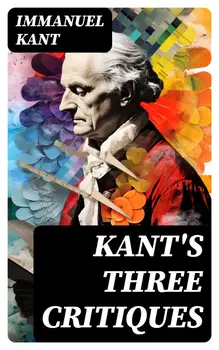
Über dieses Buch

In "Kant's Three Critiques," Immanuel Kant presents a foundational exploration of human knowledge, ethics, and aesthetics through his seminal texts: the "Critique of Pure Reason," "Critique of Practical Reason," and "Critique of Judgment." Each critique serves a unique purpose; the first interrogates the limits and scope of human understanding, the second articulates the principles of moral philosophy, and the third bridges the realms of beauty and morality. Kant's prose, renowned for its complexity and rigor, demands thoughtful engagement, situating his work within the Enlightenment context that champions reason, autonomy, and scientific inquiry. Kant, a pivotal figure in modern philosophy, published these critiques in the late 18th century, emerging from a milieu ripe for intellectual revolution. His experiences in the rapidly changing landscape of Prussia, coupled with exposure to rationalist and empiricist thought, catalyzed his inquiries into the structures of human cognition, ethical imperatives, and aesthetic appreciation. His rich background in mathematics and natural sciences also influenced his systematic approach to philosophy. Readers seeking a profound engagement with the questions of existence, morality, and perception will find "Kant's Three Critiques" indispensable. Kant's work challenges us to reconsider not just our understanding of knowledge, but also the ethical frameworks and aesthetic values that shape our lives, making it a vital resource for philosophers and general readers alike.

Starte noch heute mit diesem Buch für 0 €

  • Hole dir während der Testphase vollen Zugriff auf alle Bücher in der App
  • Keine Verpflichtungen, jederzeit kündbar
Jetzt kostenlos testen
Mehr als 52 000 Menschen haben Nextory im App Store und auf Google Play 5 Sterne gegeben.

  1. Grundlegung zur Metaphysik der Sitten

    Immanuel Kant

  2. Immanuel Kant zum Reinhören

    Immanuel Kant

  3. Die Kritik der reinen Vernunft : Die transzendentale Ästhetik

    Immanuel Kant

  4. 50 Meisterwerke der Philosophie : Metaphysik, Das Gastmahl, Bhagavadgita, Tractatus logico-philosophicus, Kritik der reinen Vernunft, Also sprach Zarathustra, Selbstbetrachtungen von Marcus Aurelius

    Ludwig Wittgenstein, Edmund Husserl, Karl Marx, Søren Kierkegaard, Friedrich Nietzsche, Ralph Waldo Emerson, John Stuart Mill, Georg Wilhelm Friedrich Hegel, Friedrich Schelling, Johann Gottlieb Fichte, Immanuel Kant, John Locke, Montesquieu, Jean-Jacques Rousseau, David Hume, Gottfried Wilhelm Leibniz, Baruch Spinoza, - Konfuzius, Lao Tse, Platon, Xenophon, - Aristoteles, Marcus Tullius Cicero, Seneca, Epiktet, Marc Aurel, Plotin, Thomas von Aquin, Nicolaus von Cues, - Erasmus von Rotterdam, Niccolò Machiavelli, Tommaso Campanella, Martin Luther, Giordano Bruno, Samuel von Pufendorf, Abbé Castel de Saint-Pierre, Michel de Montaigne, René Descartes, Francis Bacon, Blaise Pascal

  5. Essenzielle Klassiker der politischen Philosophie : Der Staat, Der Gesellschaftsvertrag, Der Fürst, Utopia, Manifest der Kommunistischen Partei, Geschichte der Socialdemokratie

    Niccolò Machiavelli, Montesquieu, Friedrich der Große, Platon, - Aristoteles, Marcus Tullius Cicero, Tommaso Campanella, Thomas Morus, Samuel von Pufendorf, Abbé Castel de Saint-Pierre, Jean-Jacques Rousseau, Immanuel Kant, Johann Gottlieb Fichte, Karl Marx, Friedrich Engels, Wilhelm von Humboldt, Friedrich Christoph Dahlmann, Franz Mehring, Johann Most, John Henry Mackay, Rosa Luxemburg, Erich Mühsam

  6. Kant's Three Critiques : The Critique of Pure Reason, The Critique of Practical Reason & The Critique of Judgment

    Immanuel Kant

  7. Erkenne Dich selbst: Die große Hörbuch Box der philosophischen Anregungen : Kant, Montaigne, Seneca, Nietzsche, Konfuzius

    - Konfuzius, Lucius Annaeus Seneca, Immanuel Kant, Michel de Montaigne, Friedrich Nietzsche

  8. 300 Quotes from Idealistic Philosophers

    Immanuel Kant, Plato, Arthur Schopenhauer

  9. Kritik der reinen Vernunft

    Immanuel Kant

  10. 1.0

    Immanuel Kant: Was ist Aufklärung? : Ein philosophischer Essay

    Immanuel Kant

  11. 50 Meisterwerke Musst Du Lesen, Bevor Du Stirbst: Vol. 2

    Jakob Christoph Heer, Immanuel Kant, Ernst Weiß, Stefan Zweig, Franz Kafka, Theodor Fontane, Fyodor Dostoyevsky, Emile Zola, Karl May, Antoine François Prévos, Hugo von Hofmannsthal, E. T. Hoffmann, Lev Tolstoy, Charles Baudelaire, Heinrich von Kleist, Edgar Allan Poe, Rainer Maria Rilke, Hermann Hesse, Jules Verne, Joseph Conrad, Gustave Flaubert, Jacques-Henri Bernardin, Joseph Roth, Anton Pavlovich Chekhov, Ludwig Ganghofer, Thomas Morus, Leopold von Sacher-Masoch, BookTime