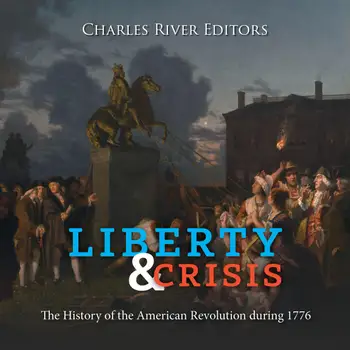
Liberty and Crisis: The History of the American Revolution during 1776

Although the Declaration of Independence is now considered one of the most important political documents in history, the men that drafted it did not initially favor such a move at the start of the American Revolution. Despite its assumption of governing duties, the Second Continental Congress never intended, at least initially, to become the governing body of a new nation. Instead, it merely hoped to transform the relationship between Britain and her colonies to allow for greater self-government on their side of the Atlantic. Separation between the two was rarely favored, and this initial sentiment coalesced into the Olive Branch Petition, which sought a reasonable motion of reconciliation between George III and the colonies. It was drafted by one of Virginia’s delegates, Thomas Jefferson.

By April of 1776, talk had heated up concerning independence, and a consensus was quickly growing in Congress. However, one problem was in the way: did the Congress have the authority to declare independence for its 13 member colonies? The process was riddled with confusion across the colonies. independence. And of course, simply declaring independence did not mean the British were going to grant it, and during that time, things were looking quite dire for the cause. After the siege of Boston forced the British to evacuate that city in March 1776, Continental Army commander George Washington suspected that the British would move by sea to New York City, the next logical target in an attempt to end a colonial insurrection. He thus rushed his army south to defend the city.

In the summer of 1776, the British conducted the largest amphibious expedition in North America’s history at the time, landing over 20,000 troops on Long Island. They easily captured Staten Island, which Washington was incapable of defending without a proper navy. Washington’s army attempted to fight, but Washington was badly outmaneuvered, and his army was nearly cut off from escape.

Über dieses Buch

Although the Declaration of Independence is now considered one of the most important political documents in history, the men that drafted it did not initially favor such a move at the start of the American Revolution. Despite its assumption of governing duties, the Second Continental Congress never intended, at least initially, to become the governing body of a new nation. Instead, it merely hoped to transform the relationship between Britain and her colonies to allow for greater self-government on their side of the Atlantic. Separation between the two was rarely favored, and this initial sentiment coalesced into the Olive Branch Petition, which sought a reasonable motion of reconciliation between George III and the colonies. It was drafted by one of Virginia’s delegates, Thomas Jefferson.

By April of 1776, talk had heated up concerning independence, and a consensus was quickly growing in Congress. However, one problem was in the way: did the Congress have the authority to declare independence for its 13 member colonies? The process was riddled with confusion across the colonies. independence. And of course, simply declaring independence did not mean the British were going to grant it, and during that time, things were looking quite dire for the cause. After the siege of Boston forced the British to evacuate that city in March 1776, Continental Army commander George Washington suspected that the British would move by sea to New York City, the next logical target in an attempt to end a colonial insurrection. He thus rushed his army south to defend the city.

In the summer of 1776, the British conducted the largest amphibious expedition in North America’s history at the time, landing over 20,000 troops on Long Island. They easily captured Staten Island, which Washington was incapable of defending without a proper navy. Washington’s army attempted to fight, but Washington was badly outmaneuvered, and his army was nearly cut off from escape.

Starte noch heute mit diesem Buch für 0 €

  • Hole dir während der Testphase vollen Zugriff auf alle Bücher in der App
  • Keine Verpflichtungen, jederzeit kündbar
Jetzt kostenlos testen
Mehr als 52 000 Menschen haben Nextory im App Store und auf Google Play 5 Sterne gegeben.

  1. 2.0

    Die Panzer: Die Geschichte und das Vermächtnis von Nazideutschlands berühmtesten Panzern des Zweiten Weltkriegs

    Charles River Editors

  2. The Iranian Revolution and Iran Hostage Crisis: The History of the Events that Broke American Relations with Iran

    Charles River Editors

  3. The Byzantines and Ottomans: The History of the Medieval Middle East’s Most Influential Empires

    Charles River Editors

  4. Imperial Germany’s Colonization in Africa: The History of the German Efforts and Conflicts to Colonize Parts of Africa

    Charles River Editors

  5. The Carlist Wars and the Spanish Civil War: The History of the Conflicts that Divided Spain in the Last 200 Years

    Charles River Editors

  6. The Biggest Tank Battles of the World Wars: Tank Warfare in History’s Deadliest Conflicts

    Charles River Editors

  7. The Texas Revolution and Mexican-American War: The History and Legacy of the Conflicts that Led to Mexico’s Cession of the American Southwest

    Charles River Editors

  8. Das mittelalterliche Russland: Die Geschichte und das Erbe der Gruppen, die den russischen Staat im Mittelalter entwickelten

    Charles River Editors

  9. 3.9

    Hans-Ulrich Rudel: The Life and Legacy of the Luftwaffe’s Deadliest Stuka Pilot

    Charles River Editors

  10. The Colonization of South Africa: The History and Legacy of the European Subjugation of South Africa

    Charles River Editors

  11. The Ancient Kingdoms of Africa: The History and Legacy of the African Continent’s Most Prominent Kingdoms in Antiquity

    Charles River Editors

  12. The Spanish Empire in the Americas: The History of Spain’s Colonization across Central America and South America

    Charles River Editors