3.0(1)

Poor Folk

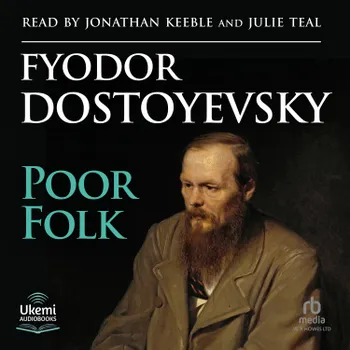
Poor Folk, Fyodor Dostoyevsky’s first novel, is almost forgotten now, living as it does under the long shadow of Crime and Punishment, Anna Karenina, The Brothers Karamazov and much more. Yet when it was published in 1846, it brought him instant fame.

It is an epistolary novel, presenting the relationship between neighbours, who happen to be distant cousins. An older man and a much younger woman, they are both living in straightened circumstances in rented accommodation and, though their letters, reveal their thoughts, their hopes, their anxieties and their daily struggles at the lower end of social and economic life of mid-19th century St Petersburg.

Yet it was exactly this situation that was a revelation to the readers of the time who were more accustomed to encountering tailored emotions in a less challenged class. For the first time, ordinary life, challenging life and the effect on the individual was presented to readers, many of which could identify with the protagonists: Makar Devushkin, an impoverished clerk, and Varvara Dobroselova who hopes to work as a governess, but earns money as a seamstress. Yet this was no ordinary portrait of emotion enmeshed in common hardships, but a writer in full command of his medium.

After he left the manuscript with the publisher Nikolay Nekrasov he told himself, ‘They will poke fun at my Poor Folk.’ In fact, Nekrasov read it at one sitting at burst into Dostoyevsky’s room at 4am to shower him with kisses. ‘A new Gogol has been born,’ he declared. It sold widely, and was dubbed ‘Russia’s first social novel’. Poor Folk is fascinating as the first important step in the career of one of the greatest novelists of all time.

"Both Jonathan Keeble and Julie Teal do a splendid job of narrating this production of Dostoyevsky's first novel. " - AUDIOFILE MAGAZINE
Über dieses Buch

Poor Folk, Fyodor Dostoyevsky’s first novel, is almost forgotten now, living as it does under the long shadow of Crime and Punishment, Anna Karenina, The Brothers Karamazov and much more. Yet when it was published in 1846, it brought him instant fame.

It is an epistolary novel, presenting the relationship between neighbours, who happen to be distant cousins. An older man and a much younger woman, they are both living in straightened circumstances in rented accommodation and, though their letters, reveal their thoughts, their hopes, their anxieties and their daily struggles at the lower end of social and economic life of mid-19th century St Petersburg.

Yet it was exactly this situation that was a revelation to the readers of the time who were more accustomed to encountering tailored emotions in a less challenged class. For the first time, ordinary life, challenging life and the effect on the individual was presented to readers, many of which could identify with the protagonists: Makar Devushkin, an impoverished clerk, and Varvara Dobroselova who hopes to work as a governess, but earns money as a seamstress. Yet this was no ordinary portrait of emotion enmeshed in common hardships, but a writer in full command of his medium.

After he left the manuscript with the publisher Nikolay Nekrasov he told himself, ‘They will poke fun at my Poor Folk.’ In fact, Nekrasov read it at one sitting at burst into Dostoyevsky’s room at 4am to shower him with kisses. ‘A new Gogol has been born,’ he declared. It sold widely, and was dubbed ‘Russia’s first social novel’. Poor Folk is fascinating as the first important step in the career of one of the greatest novelists of all time.

"Both Jonathan Keeble and Julie Teal do a splendid job of narrating this production of Dostoyevsky's first novel. " - AUDIOFILE MAGAZINE
Starte noch heute mit diesem Buch für 0 €

  • Hole dir während der Testphase vollen Zugriff auf alle Bücher in der App
  • Keine Verpflichtungen, jederzeit kündbar
Jetzt kostenlos testen
Mehr als 52 000 Menschen haben Nextory im App Store und auf Google Play 5 Sterne gegeben.

  1. 10 Masterpieces You Have to Read Before You Die, Vol. 3

    Edgar Allan Poe, William Shakespeare, H.P. Lovecraft, Mary W. Shelley, Osamu Dazai, Jack London, Fyodor Dostoyevsky, Nathaniel Hawthorne, Frances Hodgson Burnett, Robert Louis Stevenson

  2. The Possessed (The Devils)

    Fyodor Dostoyevsky

  3. 50 Meisterwerke Musst Du Lesen, Bevor Du Stirbst: Vol. 2

    Jakob Christoph Heer, Immanuel Kant, Ernst Weiß, Stefan Zweig, Franz Kafka, Theodor Fontane, Fyodor Dostoyevsky, Emile Zola, Karl May, Antoine François Prévos, Hugo von Hofmannsthal, E. T. Hoffmann, Lev Tolstoy, Charles Baudelaire, Heinrich von Kleist, Edgar Allan Poe, Rainer Maria Rilke, Hermann Hesse, Jules Verne, Joseph Conrad, Gustave Flaubert, Jacques-Henri Bernardin, Joseph Roth, Anton Pavlovich Chekhov, Ludwig Ganghofer, Thomas Morus, Leopold von Sacher-Masoch, BookTime

  4. 50 Meisterwerke Musst Du Lesen, Bevor Du Stirbst: Vol. 1

    Voltaire, Johann Wolfgang von Goethe, Joseph von Eichendorff, Mary Shelley, Sir Walter Scott, Honoré de Balzac, Jonathan Swift, Stendhal, Franz Kafka, James Fenimore Cooper, Edgar Allan Poe, Nikolai Gogol, Charles Dickens, Charlotte Brontë, Alexandre Dumas, Arthur Schopenhauer, Nathaniel Hawthorne, Christian Johann Heinrich Heine, Herman Melville, Gustave Flaubert, Iwan Alexandrowitsch Gontscharow, Fyodor Dostoyevsky, Lewis Carroll, Jules Verne, Emile Zola, Friedrich Nietzsche, Guy De Maupassant, Mark Twain, Molière, Robert Louis Stevenson, Karl May, Rudyard Kipling, Theodore Fontane, Joseph Conrad, Dietrich Theden, Arthur Schnitzler, August Strindberg, Oscar Wilde, Robert Musil, Stefan Zweig, Joseph Roth, Kurt Tucholsk, BookTime

  5. 5.0

    Crime and Punishment

    Fyodor Dostoyevsky

  6. 4.0

    Demons - The Possessed

    Fyodor Dostoyevsky

  7. 4.4

    The Brothers Karamazov

    Fyodor Dostoyevsky

  8. 5.0

    The Possessed

    Fyodor Dostoyevsky

  9. 3.8
    #8

    Notes from Underground

    Fyodor Dostoyevsky

  10. #9

    Crime and Punishment by Fyodor Dostoyevsky

    Fyodor Dostoyevsky

  11. #13

    The Possessed by Fyodor Dostoyevsky

    Fyodor Dostoyevsky

  12. #11

    The Idiot by Fyodor Dostoyevsky

    Fyodor Dostoyevsky