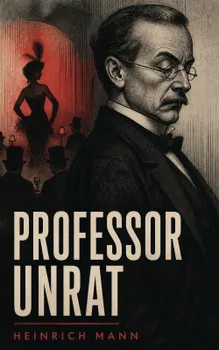
Über dieses Buch

Professor Unrat, one of Heinrich Mann's most important novels, is a sharp and unsettling satire of authoritarianism, social hypocrisy, and the destructive abuse of power. The novel follows Professor Unrat, a rigid and despised schoolteacher whose pupils mockingly call him "Unrat" ("Filth"). Obsessed with maintaining discipline and his authority, Raat becomes increasingly consumed by his determination to punish several students who have challenged him, particularly the rebellious young Lohmann.

His pursuit leads him into the world of Rosa Fröhlich, a cabaret singer whose performances have fascinated his students. Instead of remaining the stern moral guardian he imagines himself to be, Raat becomes captivated by Rosa and gradually abandons the principles and social conventions that once defined him. As he enters her theatrical and morally ambiguous circle, his relationship with Rosa transforms his position in the community and exposes the contradictions underlying his authority. Lohmann, meanwhile, remains an important counterpoint to Raat, embodying an intellectual independence that clashes with the professor's authoritarian temperament.

Mann's satire becomes increasingly dark as personal obsession and social resentment merge with a broader critique of German society. Raat's conduct reveals how authority can become corrupted when it is driven by wounded pride, fear, and the desire for domination. Behind its grotesque humor, the novel therefore contains a serious examination of the psychology of authoritarianism and the fragility of respectable social institutions.

The novel acquired particular historical significance through its later association with the rise of National Socialism. Heinrich Mann was an outspoken opponent of Hitler and was forced into exile after the Nazis came to power in 1933. His books were banned and publicly burned during the Nazi book burnings, making Professor Unrat part of a literary legacy that stood in direct opposition to the values of the dictatorship. The novel's depiction of authoritarian power, conformity, persecution, and manipulated public morality consequently gained a new and disturbing resonance.

Its enduring importance lies in the way Mann transforms a seemingly comic story of a disgraced teacher into a penetrating study of power and social corruption. Professor Unrat remains one of Heinrich Mann's defining works and an influential example of German political and social satire, demonstrating how literature can expose the mechanisms of domination long before they reach their most dangerous historical form.

Starte noch heute mit diesem Buch für 0 €

  • Hole dir während der Testphase vollen Zugriff auf alle Bücher in der App
  • Keine Verpflichtungen, jederzeit kündbar
Jetzt kostenlos testen
Mehr als 52 000 Menschen haben Nextory im App Store und auf Google Play 5 Sterne gegeben.

Mehr von Heinrich Mann

  1. 3.0

    200 Meisterwerke der Literaturgeschichte (Kommentiert) : Erweiterte Ausgabe. Die größten Klassiker der Weltliteratur

    Franz Kafka, Victor Hugo, Fjodor Michailowitsch Dostojewski, Lord Byron, Giacomo Leopardi, Marcel Proust, Henrik Ibsen, Percy Bysshe Shelley, Charles Dickens, Jane Austen, Mary Shelley, Emily Brontë, Charlotte Brontë, Anne Brontë, William Makepeace Thackeray, Bram Stoker, Henry Fielding, George Eliot, William Shakespeare, D. H. Lawrence, Walt Whitman, Herman Melville, Thomas Wolfe, Virginia Woolf, Joseph Conrad, Sinclair Lewis, Lewis Carrol, Edgar Allan Poe, Edward Bulwer-Lytton, Oscar Wilde, H.G. Wells, Daniel Defoe, James Fenimore Cooper, Lew Wallace, Jonathan Swift, Mark Twain, Walter Scott, Nathaniel Hawthorne, Harriet Beecher Stowe, Laurence Sterne, Frances Hodgson Burnett, Arthur Conan Doyle, Wilkie Collins, Edgar Wallace, Robert Louis Stevenson, Jack London, Henry David Thoreau, John Galsworthy, F. Scott Fitzgerald, Rudyard Kipling, G.K. Chesterton, Washington Irvin, O.Henry, Ambrose Bierce, Alexander Sergejewitsch Puschkin, Michail Lermontow, Iwan Sergejewitsch Turgenew, Leo Tolstoi, Nikolai Gogol, Iwan Gontscharow, Nikolai Leskow, Anton Pawlowitsch Tschechow, Maxim Gorki, François Rabelais, Jean De Fontaine, Blaise Pascal, Pierre Corneille, Moliere, Jean Baptiste Racine, Charles Perrault, Voltaire, Denis Diderot, Jean-Jacques Rousseau, Pierre Ambroise Laclos, Antoine-François Prévost, Marquis De Sade, François René Chateaubriand, Stendhal, Honoré de Balzac, Alexandre Dumas, Alphonse de Lamartine, George Sand, Gustave Flaubert, Emile Zola, Guy De Maupassant, Alphonse Daudet, Jules Verne, Joris-Karl Huysmans, Prosper Mérimée, Charles Baudelaire, Stéphane Mallarmé, Arthur Rimbaud, André Gide, Arthur Schopenhauer, Heinrich Heine, Friedrich Schiller, Johann Wolfgang Goethe, Jacob Grimm, Gottfried von Straßburg, Wolfram von Eschenbach, E. T. Hoffmann, Annette von Droste-Hülshoff, Heinrich von Kleist, Friedrich Hölderlin, Theodor Fontane, Gustav Freytag, Gottfried Keller, Theodor Storm, Stefan Zweig, Joseph von Eichendorff, Klaus Mann, Rainer Maria Rilke, Johanna Spyri, Joseph Roth, Karl May, Robert Musil, Heinrich Mann, Sigmund Freud, Friedrich Nietzsche, Dante Alighieri, Giovanni Boccaccio, Giacomo Casanova, Luigi Pirandello, Giosuè Carducci, Gabriele D’Annunzio, Niccolo Machiavelli, Miguel Cervantes Saavedra, Pedro Calderón Barca, Vicente Blasco Ibañez, Knut Hamsun, Homer, Äsop, Herodot, Thukydides, Xenophon, Platon, - Aristoteles, - Sophokles, Euripides, - Aristophanes, Lao Tse, - Konfuzius, Siddhartha Gautama Buddha, Titus Livius, Tacitus, Marcus Tullius Cicero, Vergil, Ovid, Lukian, Petronius, Apuleius, Longos von Lesbos, Mark Aurel, Aurelius Augustinus

  2. 1.0

    100 Meisterwerke der Weltliteratur - Klassiker die man kennen muss : Bereicherte Ausgabe. Ein literarisches Panorama: Meisterwerke, Klassiker und Autoren der Weltliteratur

    Johann Wolfgang Goethe, Jules Verne, Gustave Flaubert, Franz Kafka, Lewis Carroll, Selma Lagerlöf, Sigmund Freud, Johanna Spyri, Theodor Storm, Rainer Maria Rilke, Charles Dickens, Stefan Zweig, Heinrich Heine, Honoré de Balzac, Theodor Fontane, Karl May, Gottfried Keller, Mark Twain, Heinrich Mann, Else Lasker-Schüler, Robert Musil, Walt Whitman, Oscar Wilde, Annette von Droste-Hülshoff, Arthur Schopenhauer, Robert Louis Stevenson, Gustav Freytag, James Fenimore Cooper, Edgar Allan Poe, Heinrich von Kleist, William Shakespeare, Dante Alighieri, Charlotte Brontë, Emily Brontë, Jack London, Arthur Conan Doyle, Joseph Conrad, Jane Austen, Herman Melville, Guy De Maupassant, Walter Scott, Jonathan Swift, Jacob Grimm, Wilhelm Grimm, Alexandre Dumas, Rudyard Kipling, Nathaniel Hawthorne, Homer, O.Henry, Voltaire, Lew Wallace, John Galsworthy, E. T. Hoffmann, Marcus Aurelius, Hans Christian Andersen, Anton Pawlowitsch Tschechow, Platon, Friedrich Nietzsche, Iwan Sergejewitsch Turgenew, Tacitus, Nikolai Gogol, Miguel de Cervantes, Mary Shelley, Thomas Wolfe, Emile Zola, Fjodor Michailowitsch Dostojewski, Leo Tolstoi, Joseph Roth, Joseph von Eichendorff, Kurt Tucholsky, Iwan Alexandrowitsch Gontscharow, Oswald Spengler, Moliere, Alfred Adler, Sophie von Roche, Klaus Mann, Rumi

  3. Niemals vergessen! - Deutsche Schriftsteller im Widerstand gegen den Faschismus : Literatur im NS-Regime: Antifaschistische Essays, Reden, Romane & Gedichte

    Thomas Mann, Klaus Mann, Sophie Scholl, Fritz Gerlich, Stefan Zweig, Carl von Ossietzky, Joseph Roth, Kurt Tucholsky, Egon Erwin Kisch, Ricarda Huch, Heinrich Mann

  4. Die Manns - Widerstand gegen den Nationalsozialismus : Antifaschistische Werke von Thomas Mann, Klaus Mann & Heinrich Mann

    Thomas Mann, Klaus Mann, Heinrich Mann

  5. #1

    Die Jugend des Königs Henri Quatre : Roman

    Heinrich Mann

  6. Der Untertan : Roman

    Heinrich Mann

  7. Lachen gegen die Dunkelheit – Klassiker der deutschen Satire (Kommentiert) : Erweiterte Ausgabe. Die Verwandlung, Die Legende vom heiligen Trinker, Der Untertan, Ein Hungerkünstler, Till Eulenspiegel, Die Stadt ohne Juden

    Franz Kafka, Heinrich Mann, Jean Paul, Gotthold Ephraim Lessing, Heinrich von Kleist, Theodor Fontane, Ödön von Horváth, Ludwig Thoma, Erich Mühsam, Joseph Roth, Hugo Bettauer, Georg Christoph Lichtenberg, Ludwig Tieck, Wilhelm Busch, Sebastian Brant, Hans Jakob Grimmelshausen, Hermann Bote

  8. Die größten Klassiker der deutschen Literatur : Erweiterte Ausgabe. Der Prozess, Jeder stirbt für sich allein, Die Leiden des jungen Werther, Die Elixiere des Teufels, Radetzkymarsch

    Hans Fallada, Franz Kafka, Robert Musil, Heinrich Mann, Joseph Roth, Hermann Broch, Ödön von Horváth, Elisabeth Langgässer, Kurt Tucholsky, Karl May, Rainer Maria Rilke, Klaus Mann, Joseph von Eichendorff, Lou Andreas-Salomé, Gustav Freytag, Johanna Spyri, Theodor Fontane, E. T. Hoffmann, Jean Paul, Friedrich Hölderlin, Christoph Martin Wieland, Johann Wolfgang Goethe

  9. Widerspenstige Frauen in der Literaturgeschichte : Weibliche Auflehnung, Leidenschaft und Emanzipation in europäischen Klassikern

    Gustave Flaubert, Dora Duncker, Charles-Louis Philippe, Pierre Choderlos Laclos, Restif de Bretonne, Heinrich Vollrat Schumacher, Euripides, Honoré de Balzac, Heinrich Mann, Lena Christ, William Makepeace Thackeray, Emily Brontë, John Cleland, Marquis De Sade, Lew Tolstoi

  10. Der Haß komplett

    Heinrich Mann

  11. Die Gemme

    Heinrich Mann

  12. Der Haß 2 : Das Bekenntnis, Nachher auch eine Revolution.

    Heinrich Mann