Über dieses Buch

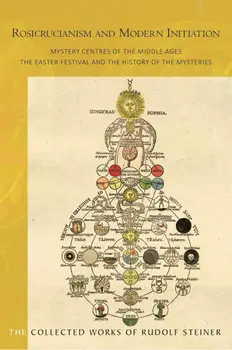
'Steiner has been able to clarify the historical reality behind the Rosicrucian story, with all its aura of glamour and fantasy. That effected, he points to the enormity of its vision for the future evolution of ideas…' – Dr Andrew Welburn (from the Introduction)In the immediate aftermath of the 'Mystery-act' of the Christmas Foundation Conference, Rudolf Steiner chose to speak on the subject of 'Rosicrucianism and Modern Initiation, Mystery Centres of the Middle Ages'. Clearly connected to the events that had just taken place in Dornach – in which he not only refounded the Anthroposophical Society but took a formal position within it – Steiner begins by exploring the intellectual life of the Middle Ages and the role that Mystery culture played within it. He throws new light on the foundations of Rosicrucianism, its principles of initiation and its inherent impulse for freedom. Steiner also discusses the secret teachings of the eighteenth and nineteenth centuries, and the dawn of the age of the Archangel Michael.In the second series of lectures, entitled 'The Easter Festival and the History of the Mysteries' (April 1924), Steiner describes how festivals grew out of the Mysteries themselves. He speaks of Mysteries connected to Spring and Autumn, Adonis and Ephesus, and the significance of Sun and Moon. Throughout the volume he discusses the roles of Alexander the Great and Aristotle in world history and the significance of Aristotle's 'Categories'. Published for the first time as a single volume, the freshly revised text is complemented with an extensive introduction by Dr Andrew Welburn, detailed notes and appendices by Professor Frederick Amrine and an index.
Starte noch heute mit diesem Buch für 0 €

  • Hole dir während der Testphase vollen Zugriff auf alle Bücher in der App
  • Keine Verpflichtungen, jederzeit kündbar
Jetzt kostenlos testen
Mehr als 52 000 Menschen haben Nextory im App Store und auf Google Play 5 Sterne gegeben.

  1. Neu

    Rudolf Steiner : Ausgesprochenes und Unausgesprochenes im Denken, Schauen, Sinnen einer Reihe deutscher und österreichischer Persönlichkeiten. Ein Grundlagenwerk der Anthroposophie

    Rudolf Steiner

  2. #21

    Die geistige Führung des Menschen und der Menschheit : Geisteswissenschaftliche Ergebnisse über die Menschheits-Entwicklung

    Rudolf Steiner

  3. #31

    Grundlegendes für eine Erweiterung der Heilkunst : nach geisteswissenschaftlichen Erkenntnissen

    Rudolf Steiner, Ita Wegman

  4. #4

    Die Philosophie der Freiheit : Grundzüge einer modernen Weltanschauung

    Rudolf Steiner

  5. Die vergängliche Wahrheit in der Metaphysik : Erweiterte Ausgabe. Metaphysische Anfangsgründe der Naturwissenschaft, Träume eines Geistersehers, Grundzüge der Philosophie, Götzen-Dämmerung

    Platon, - Aristoteles, Plotin, Thomas von Aquin, René Descartes, Baruch Spinoza, Thomas Hobbes, Immanuel Kant, Gottfried Wilhelm Leibniz, Friedrich Wilhelm Schelling, Georg Wilhelm Hegel, Arthur Schopenhauer, Moses Mendelssohn, Friedrich Nietzsche, Rudolf Steiner

  6. Die Philosophie der Freiheit : Bereicherte Ausgabe. Grundzüge einer modernen Weltanschauung - seelische Beobachtungsresultate nach naturwissenschaftlicher Methode: die Vorbereitung der Anthroposophie

    Rudolf Steiner

  7. Der Seelen Erwachen : Bereicherte Ausgabe. Seelische und geistige Vorgänge in szenischen Bildern

    Rudolf Steiner

  8. Klassiker des philosophischen Denkens: Die große Hörbuch Box : Ein Grundlagenwerk der Philosophie

    Francesco Petrarca, Rudolf Steiner, - Konfuzius, Marc Aurel, Lao Tse, - Aristoteles, Platon, Lucius Annaeus Seneca, Voltaire, Max Stirner, Henry David Thoreau, Friedrich Nietzsche, Étienne de La Boétie, Epiktet, Blaise Pascal

  9. 5.0

    Rudolf Steiner: Philosophie der Freiheit : Grundzüge einer modernen Weltanschauung

    Rudolf Steiner

  10. Die Philosophie der Freiheit: Grundzüge einer modernen Weltanschauung - Seelische Beobachtungsresultate nach naturwissenschaftlicher Methode

    Rudolf Steiner

  11. Die Nebenübungen: Sechs Schritte zur Selbsterziehung

    Rudolf Steiner

  12. Stichwort Karma

    Rudolf Steiner