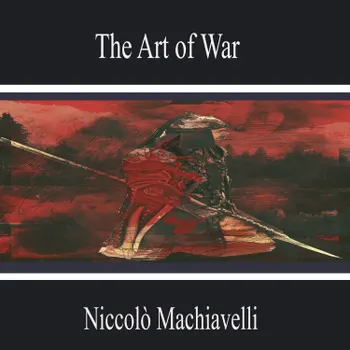
The Art of War

""The Art of War" is a treatise by the Italian Renaissance political philosopher and historian Niccolò Machiavelli. Written between 1519 and 1520, it was published the following year and remains one of his most important works. Unlike the more widely read "The Prince" and "The Discourses", this book focuses specifically on military matters. Here are the key features of "The Art of War": Format: The book takes the form of a Socratic dialogue. Lord Fabrizio Colonna, perhaps Machiavelli's persona, declares the purpose at the outset: "To honor and reward virtù, not to have contempt for poverty, to esteem the modes and orders of military discipline, to constrain citizens to love one another, to live without factions, to esteem less the private than the public good." The military is likened to the roof of a palazzo protecting its contents. Setting: The dialogues occur in the Orti Oricellari, classical-style gardens built by Bernardo Rucellai in the 1490s for Florentine aristocrats and humanists. The discussions take place between Cosimo Rucellai and "Lord Fabrizio Colonna," with other patrizi and captains of the recent Florentine republic. Fabrizio's Wisdom: Fabrizio is enamored with the Roman Legions of the early to mid Roman Republic. He advocates adapting their strategies to the contemporary situation of Renaissance Florence. His knowledge dominates the discussions, often turning them into monologues where he details how an army should be raised, trained, organized, deployed, and employed. Practical Insights: Machiavelli's theories are not merely theoretical; they are based on his observations during his fourteen years as secretary to the Chancery of Florence. He reported on the size, composition, weaponry, morale, and logistical capabilities of the most effective militaries of his day. "The Art of War" serves as a guide to military leaders, including Frederick the Great and Napoleon, and remains an authoritative treatise on the fundamentals of warfare. Its clear and concise style stands in contrast to that of "The Prince"."
Starten Sie noch heute mit diesem Buch für 0 €

  • Hole dir während der Testphase vollen Zugriff auf alle Bücher in der App
  • Keine Verpflichtungen, jederzeit kündbar
Jetzt kostenlos testen
Mehr als 52 000 Menschen haben Nextory im App Store und auf Google Play 5 Sterne gegeben.

  1. 4.6

    Niccolò Machiavelli: Der Fürst : Ungekürzte Lesung

    Niccolò Machiavelli

  2. 50 Meisterwerke der Philosophie : Metaphysik, Das Gastmahl, Bhagavadgita, Tractatus logico-philosophicus, Kritik der reinen Vernunft, Also sprach Zarathustra, Selbstbetrachtungen von Marcus Aurelius

    Ludwig Wittgenstein, Edmund Husserl, Karl Marx, Søren Kierkegaard, Friedrich Nietzsche, Ralph Waldo Emerson, John Stuart Mill, Georg Wilhelm Friedrich Hegel, Friedrich Schelling, Johann Gottlieb Fichte, Immanuel Kant, John Locke, Montesquieu, Jean-Jacques Rousseau, David Hume, Gottfried Wilhelm Leibniz, Baruch Spinoza, - Konfuzius, Lao Tse, Platon, Xenophon, - Aristoteles, Marcus Tullius Cicero, Seneca, Epiktet, Marc Aurel, Plotin, Thomas von Aquin, Nicolaus von Cues, - Erasmus von Rotterdam, Niccolò Machiavelli, Tommaso Campanella, Martin Luther, Giordano Bruno, Samuel von Pufendorf, Abbé Castel de Saint-Pierre, Michel de Montaigne, René Descartes, Francis Bacon, Blaise Pascal

  3. Klassiker des politischen Denkens: Die große Hörbuch Box : Ein Grundlagenwerk der Politik

    Karl Marx, Sun Tzu, Immanuel Kant, Max Weber, Benjamin Franklin, Platon, Niccolò Machiavelli, Georg Büchner

  4. 5.0

    Niccolò Machiavelli: Der Fürst / Mensch und Staat : Standardwerke der Philosophie

    Niccolò Machiavelli

  5. Der Fürst - Hörbuch

    Niccolò Machiavelli

  6. Gekürzt

    Strategie und Management: Die Hörbuch Box mit Sun Tzu, Machiavelli und Clausewitz : Die Kunst des Krieges, Der Fürst, Vom Kriege: Standard-Werke der Business-Literatur

    Sun Tzu, Niccolò Machiavelli, Carl von Clausewitz

  7. Die größten Geschichtsbücher - Klassiker, die man kennen muss : Der Peloponnesische Krieg, Römische Geschichte, Aus Zwei Jahrtausenden Deutscher Geschichte, Die Französische Revolution

    Tacitus, Leopold von Ranke, Theodor Mommsen, Herodot, Thukydides, Titus Livius, Sueton, Jacob Burckhardt, Niccolò Machiavelli, Ricarda Huch, Thomas Carlyle, Egon Friedell, Felix Salten

  8. Meisterwerke der Weltphilosophie : Das Gastmahl, Nikomachische Ethik, Also sprach Zarathustra, Utopia, Phänomenologie des Geistes, Neues Organon, Selbstbetrachtungen

    Immanuel Kant, Søren Kierkegaard, Edmund Husserl, Ludwig Wittgenstein, Friedrich Nietzsche, - Konfuzius, Platon, Xenophon, - Aristoteles, Lao Tse, Marcus Tullius Cicero, Marcus Aurelius, Plotin, Thomas von Aquin, Niccolò Machiavelli, Thomas Morus, Giordano Bruno, Michel de Montaigne, René Descartes, Francis Bacon, Blaise Pascal, Baruch Spinoza, Gottfried Wilhelm Leibniz, David Hume, Jean-Jacques Rousseau, Friedrich Schelling, John Locke, Georg Wilhelm Hegel, John Stuart Mill, Karl Marx

  9. Niccolò Machiavelli: Der Fürst / The Prince : Zweisprachige / Bilingual Edition. Ungekürzt / Unabridged

    Niccolò Machiavelli

  10. Der Fürst. Ein Grundlagentext der Philosophie. : Hörbuchzeit: Klassiker der Weltliteratur

    Hörbuchzeit, Niccolò Machiavelli

  11. El Príncipe

    Niccolò Machiavelli

  12. The Prince

    Niccolò Machiavelli