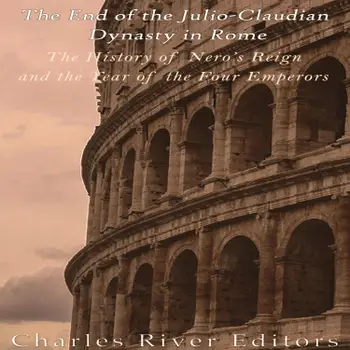
The End of the Julio-Claudian Dynasty in Rome: The History of Nero’s Reign and the Year of the Four Emperors

Throughout the annals of history, there have been few figures as reviled as Lucius Domitius Ahenobarbus, better known as Nero Claudius Caesar Drusus Germanicus, or more simply, Nero. Even today, he remains one of the Roman Empire’s most famous – or notorious – figures, a villain whose impact on popular culture is so vast that his name crops up consistently to this day in literature, film, TV and mediums as unlikely as video games and anime.

Nero ranks among the very worst of the Caesars, alongside the likes of mad Caligula, slothful Commodus, and paranoid Domitian, a figure so hated that, in many ancient Christian traditions, he is literally, without hyperbole, considered the Antichrist; according to a notable Biblical scholar, the coming of the Beast and the number 666 in the Book of Revelation are references to Nero. He was the man who, famously, “fiddled while Rome burned”, an inveterate lecher, a murderous tyrant who showed little compunction in murdering his mother and who liked to use Christian martyrs as a source of illumination at night – by burning them alive. His economic policies, according to many historians, virtually bankrupted Rome.

Having left no heir, Nero’s death plunged the empire into confusion and chaos, bringing to an end the Julio-Claudian lineage while at the same time offering no clear rule of succession. This presented the opportunity for influential individuals in the empire, and in particular provincial governors who also commanded large military garrisons, to express and further their own ambitions to power. The result was a period of instability and civil war as several pretenders to the throne, among them the emperors Galba, Otho and Vitellius, gained and lost power, until finally the emperor Vespasian seized and retained the imperial principate. Vespasian subsequently imposed order and discipline on a chaotic empire and went on to establish the Flavian Dynasty.
Starte noch heute mit diesem Buch für 0 €

  • Hole dir während der Testphase vollen Zugriff auf alle Bücher in der App
  • Keine Verpflichtungen, jederzeit kündbar
Jetzt kostenlos testen
Mehr als 52 000 Menschen haben Nextory im App Store und auf Google Play 5 Sterne gegeben.

  1. 1.0

    Die Panzer: Die Geschichte und das Vermächtnis von Nazideutschlands berühmtesten Panzern des Zweiten Weltkriegs

    Charles River Editors

  2. 4.0

    The Empires of India: The History of the Dynasties that Ruled India Before the British

    Charles River Editors

  3. The Spanish Empire in the Americas: The History of Spain’s Colonization across Central America and South America

    Charles River Editors

  4. 2.0

    Göbekli Tepe: The History and Mystery of One of the World’s Oldest Neolithic Sites

    Charles River Editors

  5. 3.8

    Hans-Ulrich Rudel: The Life and Legacy of the Luftwaffe’s Deadliest Stuka Pilot

    Charles River Editors

  6. 4.0

    The Philippines Campaigns of World War II: The History of the Japanese Invasion in 1941-1942 and the Allied Liberation in 1944-1945

    Charles River Editors

  7. The Rise and Fall of the Third Reich: The History and Legacy of Nazi Germany under Adolf Hitler

    Charles River Editors

  8. Chiang Kai-Shek: The Life and Legacy of the Republic of China’s Revolutionary Leader

    Charles River Editors

  9. The Disappearance of the USS Thresher: The History of the American Nuclear Submarine that Sank at the Height of the Cold War

    Charles River Editors

  10. Spain and the American Revolution: The History of the Spanish Empire’s Participation in the Revolutionary War

    Charles River Editors

  11. J. Edgar Hoover and Allen Dulles: The History of 20th Century America’s Most Controversial FBI and CIA Directors

    Charles River Editors

  12. Das mittelalterliche Russland: Die Geschichte und das Erbe der Gruppen, die den russischen Staat im Mittelalter entwickelten

    Charles River Editors