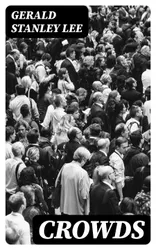
CROWDS : Enriched Edition. Mass Society, Public Opinion, and the Spiritual Promise of Democracy in the Industrial Age

In CROWDS: A MOVING-PICTURE OF DEMOCRACY, Gerald Stanley Lee offers a vigorous meditation on mass society, public opinion, and the spiritual possibilities of democratic life in the modern industrial age. Written in a prophetic, aphoristic, and often cinematic prose style, the book treats the crowd not merely as a political fact but as a new cultural organism shaped by newspapers, machines, commerce, cities, and spectacle. Its "moving-picture" method reflects early twentieth-century fascination with motion, speed, and collective perception. Lee was an American essayist, minister, lecturer, and social critic whose career was devoted to interpreting modernity in moral and imaginative terms. Educated in the religious and literary traditions of New England, he sought to reconcile individual vision with collective progress. His interest in democracy, technology, and personality naturally led him to examine how leadership, art, and moral energy might transform anonymous crowds into creative publics. This book is recommended to readers interested in democratic theory, cultural criticism, media history, and the literature of social reform. Though unmistakably of its era, it remains stimulating for its bold attempt to understand mass democracy as both danger and promise.

This enriched edition has been carefully crafted to add value to your reading experience.

- Hand‐picked Memorable Quotes shine a spotlight on moments of literary brilliance.

- Interactive footnotes clarify unusual references, historical allusions, and archaic phrases for an effortless, more informed read.

Om denne bog

In CROWDS: A MOVING-PICTURE OF DEMOCRACY, Gerald Stanley Lee offers a vigorous meditation on mass society, public opinion, and the spiritual possibilities of democratic life in the modern industrial age. Written in a prophetic, aphoristic, and often cinematic prose style, the book treats the crowd not merely as a political fact but as a new cultural organism shaped by newspapers, machines, commerce, cities, and spectacle. Its "moving-picture" method reflects early twentieth-century fascination with motion, speed, and collective perception. Lee was an American essayist, minister, lecturer, and social critic whose career was devoted to interpreting modernity in moral and imaginative terms. Educated in the religious and literary traditions of New England, he sought to reconcile individual vision with collective progress. His interest in democracy, technology, and personality naturally led him to examine how leadership, art, and moral energy might transform anonymous crowds into creative publics. This book is recommended to readers interested in democratic theory, cultural criticism, media history, and the literature of social reform. Though unmistakably of its era, it remains stimulating for its bold attempt to understand mass democracy as both danger and promise.

This enriched edition has been carefully crafted to add value to your reading experience.

- Hand‐picked Memorable Quotes shine a spotlight on moments of literary brilliance.

- Interactive footnotes clarify unusual references, historical allusions, and archaic phrases for an effortless, more informed read.
Kom i gang med denne bog i dag for 0 kr.

  • Få fuld adgang til alle bøger i appen i prøveperioden
  • Ingen forpligtelser, opsiges når som helst
Prøv gratis nu
Mere end 52.000 mennesker har givet Nextory fem stjerner i App Store og Google Play.