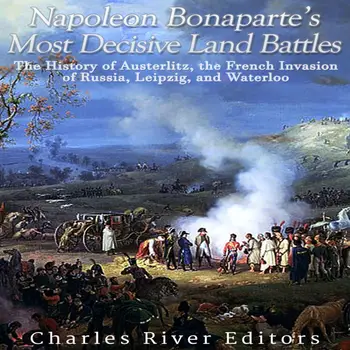
Om denne bog

Nearly 50 years after Napoleon met his Waterloo, generals across the West continued to study his tactics and engage their armies the same way armies fought during the Napoleonic Era. Despite advances in military technology and the advent of railroads for transportation, all of which made defensive warfare more effective, acclaimed military geniuses like Robert E. Lee used flank attacks and infantry charges against superior numbers in an effort to win decisive victories, and it would not be until World War I that concepts of modern warfare made the Napoleonic Era of the early 19th century outdated.

For those questioning why generals continued using tactics from the Napoleonic Era even as technology changed the battlefield, the Battle of Austerlitz may provide the best answer. Napoleon is regarded as one of history’s greatest generals, and Austerlitz was his greatest victory. In 1805, Britain, Austria, and Russia allied together to form the Third Coalition against the French, and the Third Coalition’s forces consisted of armies from Austria and Russia, with Britain providing naval support as well as its financial powers. Napoleon had already defeated and mostly destroyed an Austrian army in October at Ulm before it could link up with the Russians, setting the stage for the Battle of Austerlitz to be the culmination of the war against the Third Coalition as a whole in early December. Despite the smashing victory at Ulm, Napoleon’s French army would still be well outnumbered at Austerlitz by a joint Russo-Austrian army in a battle that would also come to be known as the Battle of Three Emperors.

At Waterloo, however, it would end disastrously, as Napoleon’s armies were unable to dislodge Wellington and unable to keep the Prussians from linking up with the British. The battle would end with the French suffering nearly 60% casualties, the end of Napoleon’s reign, and the restructuring of the European map.

Kom i gang med denne bog i dag for 0 kr.

  • Få fuld adgang til alle bøger i appen i prøveperioden
  • Ingen forpligtelser, opsiges når som helst
Prøv gratis nu
Mere end 52.000 mennesker har givet Nextory fem stjerner i App Store og Google Play.

  1. 4.0

    ODESSA : The Controversial History of the Mysterious Network that Helped Nazis Escape Germany after World War II

    Charles River Editors

  2. Hollywood’s Star-Crossed Blonde Bombshells: The Lives of the Influential Actresses Who Suffered Premature Deaths at the Height of Their Fame

    Charles River Editors

  3. Kublai Khan and Marco Polo: The History of a Unique Partnership at the Court of the Mongol Empire

    Charles River Editors

  4. 3.5

    Sigmund Freud and Carl Jung: The Pioneering Lives and Works of History’s Most Influential Psychologists

    Charles River Editors

  5. The Crypto-Jews: The History of the Forcibly Converted Jews Who Secretly Practiced Judaism during the Inquisition

    Charles River Editors

  6. 4.0

    The Innovations of World War I: The History of the Technological Advances that Defined the Great War

    Charles River Editors

  7. 3.5

    Patrice Lumumba: The Life and Legacy of the Pan-African Politician Who Became Congo's First Prime Minister

    Charles River Editors

  8. 4.0

    The Voyager Program: The History and Legacy of NASA's First Probes that Traveled to the Outer Solar System

    Charles River Editors

  9. 5.0

    The Rise and Fall of the Third Reich: The History and Legacy of Nazi Germany under Adolf Hitler

    Charles River Editors

  10. 3.0

    The Anglo-Saxon Settlement of England: The History and Legacy of the Anglo-Saxons at the Start of the Middle Ages

    Charles River Editors

  11. 3.6

    Jack the Ripper and the Zodiac Killer: The History of the Most Famous Serial Killers Who Were Never Caught

    Charles River Editors

  12. 3.8

    The Pleistocene Era: The History of the Ice Age and the Dawn of Modern Humans

    Charles River Editors