The earliest form of temple was a mere hut of plaited wickerwork, serving as a shrine for the symbols of the god; the altar but a mat of reeds. The earliest temples evolve from a wall built round the name-stela, which was afterward roofed in. With the advent of the New Empire the temple-building became of a much more complicated character, though the essential plan from the earliest period to the latest remained practically unchanged. The simplest form was a surrounding wall, the pylon or entrance gateway with flanking towers, before which were generally placed two colossal statues of the king and two obelisks, then the innermost sanctuary, the naos, which held the divine symbols. This was elaborated by various additions, such as three pylons, divided by three avenues of sphinxes, then columned courts, and a hypostyle or columnar hall. In this way many of the Egyptian kings enlarged the buildings of their predecessors.

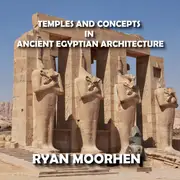
Temples and Concepts in Ancient Egyptian Architecture : Understanding Egyptian Religious Monuments
Skrevet af RYAN MOORHEN