2.0(2)

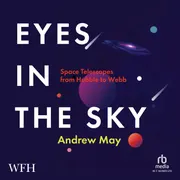
Eyes in the Sky : Space Telescopes from Hubble to Webb

Over 50 years ago, astronomers launched the world's first orbiting telescope. This allowed them to gaze further into outer space and examine anything that appears in the sky above our heads, from comets and planets to galaxy clusters and stars. Since then, almost 100 space telescopes have been launched from Earth and are orbiting our planet, with 26 still active and relaying information back to us.

As a result of these space-based instruments, such as NASA's iconic Hubble Space Telescope, we know much more about the universe than we did half a century ago. But why is Hubble, orbiting just 540 kilometres above the Earth, so much more effective than a ground-based telescope? How can a glorified camera tell us not only what distant objects look like, but their detailed chemical composition and three-dimensional structure as well?

In Eyes in the Sky, science writer Andrew May takes us on a journey into space to answer these questions and more. Looking at the development of revolutionary instruments, such as Hubble and the James Webb Space Telescope, May explores how such technology has helped us understand the evolution of the Universe.
Sobre este libro

Over 50 years ago, astronomers launched the world's first orbiting telescope. This allowed them to gaze further into outer space and examine anything that appears in the sky above our heads, from comets and planets to galaxy clusters and stars. Since then, almost 100 space telescopes have been launched from Earth and are orbiting our planet, with 26 still active and relaying information back to us.

As a result of these space-based instruments, such as NASA's iconic Hubble Space Telescope, we know much more about the universe than we did half a century ago. But why is Hubble, orbiting just 540 kilometres above the Earth, so much more effective than a ground-based telescope? How can a glorified camera tell us not only what distant objects look like, but their detailed chemical composition and three-dimensional structure as well?

In Eyes in the Sky, science writer Andrew May takes us on a journey into space to answer these questions and more. Looking at the development of revolutionary instruments, such as Hubble and the James Webb Space Telescope, May explores how such technology has helped us understand the evolution of the Universe.
Empieza este libro hoy por 0 €

  • Disfruta de acceso completo a todos los libros de la app durante el periodo de prueba
  • Sin compromiso, cancela cuando quieras
Pruébalo gratis ahora
Más de 52 000 clientes han dado a Nextory 5 estrellas en la App Store y Google Play.