3.3(3)

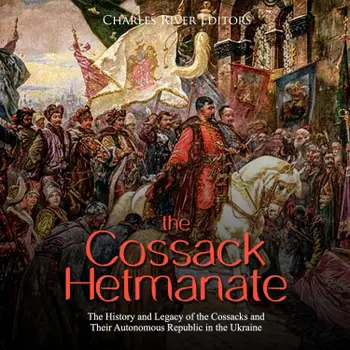
The Cossack Hetmanate: The History and Legacy of the Cossacks and Their Autonomous Republic in the Ukraine

“Had I just 10,000 Cossacks, I would have conquered the whole world.” – Napoleon Bonaparte

The history of Ukraine is a fascinating story of how cultures, political systems, religions, and power have met, intersected, morphed, and expanded. The region was relatively sparsely populated for much of ancient history, a wilderness of rivers, forests, and steppes, but that does not detract from the rich historical development of the region. A huge area, Ukraine is wedged between the continents of Asia and Europe, and its position as a crossroads ensured there was fierce competition for influence there. Historians have called the formation of Ukraine the “establishment of a unity among three zones…the ports of Crimea and the coast, the rich steppe heartland, and the forests,” based around the themes of “geography, ecology and culture.”

After various cultures helped develop the region, the legendary Cossacks arrived during the early modern period and dominated the region for several centuries, forming an independent republic that helped forge Ukrainian identity to this day. The modern myth of the Cossack presents striking images of a stern warrior mounted on horseback, with a long woolen coat, papakha (distinctive tall fur cap ) and fur-lined cloak, with bandoliers holding large-caliber bullets crisscrossing his chest. The warrior is armed with a mixture of rifle, lance, daggers and pistols, but he always has his signature weapons: the shashka (a single-edged, guard-less, slightly curved saber originally designed by the Circassian foes) and the nagyka (short, thick whip of braided leather with a heavy weight worked into the end originally designed for fighting off wolves but more commonly used in later years against enemies of the state in the streets of Moscow or Odessa). As enemies conjured up the Cossack as semi-tamed steppe barbarian, a dog of the state, and the fist of the Czar, it’s no surprise they were terrified.
Sobre este libro

“Had I just 10,000 Cossacks, I would have conquered the whole world.” – Napoleon Bonaparte

The history of Ukraine is a fascinating story of how cultures, political systems, religions, and power have met, intersected, morphed, and expanded. The region was relatively sparsely populated for much of ancient history, a wilderness of rivers, forests, and steppes, but that does not detract from the rich historical development of the region. A huge area, Ukraine is wedged between the continents of Asia and Europe, and its position as a crossroads ensured there was fierce competition for influence there. Historians have called the formation of Ukraine the “establishment of a unity among three zones…the ports of Crimea and the coast, the rich steppe heartland, and the forests,” based around the themes of “geography, ecology and culture.”

After various cultures helped develop the region, the legendary Cossacks arrived during the early modern period and dominated the region for several centuries, forming an independent republic that helped forge Ukrainian identity to this day. The modern myth of the Cossack presents striking images of a stern warrior mounted on horseback, with a long woolen coat, papakha (distinctive tall fur cap ) and fur-lined cloak, with bandoliers holding large-caliber bullets crisscrossing his chest. The warrior is armed with a mixture of rifle, lance, daggers and pistols, but he always has his signature weapons: the shashka (a single-edged, guard-less, slightly curved saber originally designed by the Circassian foes) and the nagyka (short, thick whip of braided leather with a heavy weight worked into the end originally designed for fighting off wolves but more commonly used in later years against enemies of the state in the streets of Moscow or Odessa). As enemies conjured up the Cossack as semi-tamed steppe barbarian, a dog of the state, and the fist of the Czar, it’s no surprise they were terrified.
Empieza este libro hoy por 0 €

  • Disfruta de acceso completo a todos los libros de la app durante el periodo de prueba
  • Sin compromiso, cancela cuando quieras
Pruébalo gratis ahora
Más de 52 000 clientes han dado a Nextory 5 estrellas en la App Store y Google Play.

  1. The Texas Revolution and Mexican-American War: The History and Legacy of the Conflicts that Led to Mexico’s Cession of the American Southwest

    Charles River Editors

  2. La Alhambra y el Alcázar de Sevilla: la historia de las famosas fortalezas construidas por los moros en España

    Charles River Editors

  3. American Monsters: The History of America’s Most Persistent Urban Tales about Strange Birds, Serpents and Wolfmen

    Charles River Editors

  4. Las pirámides de Egipto: los orígenes y la historia de los monumentos más famosos del mundo

    Charles River Editors

  5. La Guerra Civil española: La historia y el legado del controversial conflicto que estableció la dictadura de Francisco Franco en España

    Charles River Editors

  6. Hispania romana: La historia de la conquista de España y la península ibérica por la antigua Roma

    Charles River Editors

  7. 4.0

    The Battle of Lepanto: The History of the Decisive Naval Battle between the Ottoman Empire and the Holy League

    Charles River Editors

  8. The Acropolis and the Agora: The History of Ancient Athens’ Most Important Sites

    Charles River Editors

  9. El robo nazi de arte: La historia de la confiscación y destrucción de obras de arte europeas por parte de Alemania durante la Segunda Guerra Mundial

    Charles River Editors

  10. Georgy Zhukov: The Life and Legacy of the Soviet Union’s Greatest General during World War II

    Charles River Editors

  11. La Primera Guerra Mundial sobre el terreno: la historia y el legado de la vida en las trincheras

    Charles River Editors

  12. Edith Stein: The Life and Legacy of the Jewish Philosopher Who Became a Catholic Saint

    Charles River Editors