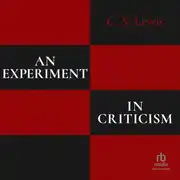
Why do we read literature and how do we judge it? C. S. Lewis's classic An Experiment in Criticism springs from the conviction that literature exists for the joy of the reader and that books should be judged by the kind of reading they invite. He argues that 'good reading', like moral action or religious experience, involves surrender to the work in hand and a process of entering fully into the opinions of others: 'in reading great literature I become a thousand men and yet remain myself'. Crucial to his notion of judging literature is a commitment to laying aside expectations and values extraneous to the work, in order to approach it with an open mind. Amid the complex welter of current critical theories, C. S. Lewis's wisdom is valuably down-to-earth, refreshing and stimulating in the questions it raises about the experience of reading.
An Experiment in Criticism
Aloita tämä kirja jo tänään, hintaan 0€
- Kokeilujakson aikana käytössäsi on kaikki sovelluksen kirjat
- Ei sitoumusta, voit perua milloin vain
Kirjailija:
Lukija:
Kieli:
englanti
Muoto:

How to Be Sort of Happy in Law School

Three-Martini Afternoons at the Ritz : The Rebellion of Sylvia Plath & Anne Sexton

Kuinka musiikkia käytetään

Tutkimus ja päätöksenteko hyvinvointivaltiossa : Havaintoja viideltä vuosikymmeneltä

Arkkitehtuurista

Päätöksenteko : Uskalla tehdä toisin

Vähän enemmän vähemmän : Löytöretkiä kestävämpään elämään

Syksy

Bulevardi - ja muita kirjoituksia

Karamazovin veljekset 1

Viesti. Valitut novellit 1971-1997

Naiset katsovat vastavaloon

Taikurin sisarenpoika

Velho ja leijona

Narnian viimeinen taistelu

Prinssi Kaspian

Hopeinen tuoli

Kaspianin matka maailman ääriin

The Magician’s Nephew

Hevonen ja poika

The Screwtape Letters

Mere Christianity

On Writing (and Writers) : A Miscellany of Advice and Opinions

The Chronicles of Narnia: Complete Seven Book Box Set