3.8(5)

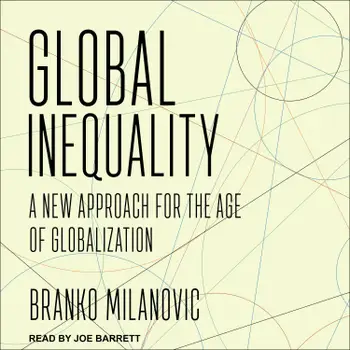
Global Inequality : A New Approach for the Age of Globalization

Branko Milanovic presents a bold new account of the dynamics that drive inequality on a global scale. Drawing on vast data sets and cutting-edge research, he explains the benign and malign forces that make inequality rise and fall within and among nations. He also reveals who has been helped the most by globalization, who has been held back, and what policies might tilt the balance toward economic justice.

Global Inequality takes us back hundreds of years to show that inequality moves in cycles, fueled by war and disease, technological disruption, access to education, and redistribution. The recent surge of inequality in the West has been driven by the revolution in technology. But even as inequality has soared within nations, it has fallen dramatically among nations. A more open migration policy would reduce global inequality even further.

Both American and Chinese inequality seems well entrenched and self-reproducing, though it is difficult to predict if current trends will be derailed by emerging plutocracy, populism, or war. For those who want to understand how we got where we are, where we may be heading, and what policies might help reverse that course, Milanovic’s compelling explanation is the ideal place to start.

Tietoa kirjasta

Branko Milanovic presents a bold new account of the dynamics that drive inequality on a global scale. Drawing on vast data sets and cutting-edge research, he explains the benign and malign forces that make inequality rise and fall within and among nations. He also reveals who has been helped the most by globalization, who has been held back, and what policies might tilt the balance toward economic justice.

Global Inequality takes us back hundreds of years to show that inequality moves in cycles, fueled by war and disease, technological disruption, access to education, and redistribution. The recent surge of inequality in the West has been driven by the revolution in technology. But even as inequality has soared within nations, it has fallen dramatically among nations. A more open migration policy would reduce global inequality even further.

Both American and Chinese inequality seems well entrenched and self-reproducing, though it is difficult to predict if current trends will be derailed by emerging plutocracy, populism, or war. For those who want to understand how we got where we are, where we may be heading, and what policies might help reverse that course, Milanovic’s compelling explanation is the ideal place to start.
Aloita tämä kirja jo tänään, hintaan 0€

  • Kokeilujakson aikana käytössäsi on kaikki sovelluksen kirjat
  • Ei sitoumusta, voit perua milloin vain
Kokeile nyt ilmaiseksi
Yli 52 000 ihmistä on antanut Nextorylle viisi tähteä App Storessa ja Google Playssä.

Muut ovat myös lukeneet

Ohita lista
  1. Star Maker

    William Stapledon

  2. L'Homme unidimensionnel. Essai sur l'idéologie de la société industrielle avancée d'Herbert Marcuse : Les Fiches de lecture d'Universalis

    Encyclopaedia Universalis

  3. Short Circuiting Policy : Interest Groups and the Battle Over Clean Energy and Climate Policy in the American States

    Leah Cardamore Stokes

  4. 3.0

    The Tyranny of Virtue : Identity, the Academy, and the Hunt for Political Heresies

    Robert Boyers

  5. The Christian Imagination : Theology and the Origins of Race

    Willie James Jennings

  6. 4.2

    More From Less : How We Learned to Create More Without Using More

    Andrew McAfee

  7. The Enlightenment that Failed : Ideas, Revolution, and Democratic Defeat, 1748-1830

    Jonathan I. Israel

  8. 4.5

    A Bigger Picture: My Fight to Bring a New African Voice to the Climate Crisis

    Vanessa Nakate

  9. Four Ways to Click : Rewire Your Brain for Stronger, More Rewarding Relationships

    Amy Banks

  10. 2.5

    Electrify : An Optimists Playbook for Our Clean Energy Future

    Saul Griffith

  11. 4.0

    Liberty : The Evolution of an Idea

    Kemi Badenoch, John Bew, Adrian Bradshaw, Richard Chartres, Christopher Coker, Marie Daouda, Peter Frankopan, Jessica Frazier, Francis J. Gavin, Matthew Goodwin, Katja Hoyer, Jeremy Jennings, Rob Johnson, Alexander Lee, Janne Haaland Matláry, Richard Miles, Fraser Nelson, Iulia Osmolovska, Agnès C. Poirier, Alina Polyakova, Sergey Radchenko, Charly Salonius-Pasternak, Juliet Samuel, Mary E. Sarotte, Kori Schake, Mark J. Schiefsky, Brendan Simms, Alexander McCall Smith, Roel Sterckx, Merryn Somerset Webb

  12. 4.0

    Politics is for Power : How to Move Beyond Political Hobbyism, Take Action, and Make Real Change

    Eitan Hersh