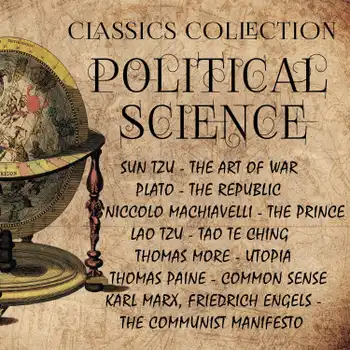
Political Science. Classics Collection:

Why Political Science Classics Collection is so important? In today's world, providing quality training for the younger generation at colleges and universities is of primary importance. But higher education is not enough. Any graduate is first and foremost a citizen of his nation. He has the right to be an actor in the political life of his society. The political changes taking place today in the modern world are dependent on the civic stance of each person. In this way, a serious challenge facing the world system of higher education is to educate citizens who are capable of navigating and influencing the modern political processes in his country. Youth today actively participate in campaigns carried out by political parties and community organizations. However, it is impossible to develop conditions which foster a civic position without the existence of a political culture. In today's global community, facing growing pressures of political extremism and radicalism, knowledge of basic political science principles should help students develop a democratic ethos and foster qualities, such as political tolerance, compromise, and cooperation, while learning to express and defend their interests in a civilized manner. The foundation of political science lies in the accumulated knowledge of mankind. This collection was compiled as an aid to college and university students. Each included piece is required reading at some of the best universities on the planet including: Harvard, Princeton, Yale, and Columbia Universities, the Massachusetts Institute of Technology (MIT), and the Universities of Oxford and Cambridge, among others. This collection includes works famous authors: The Art of War by Sun Tzu Tao Te Ching by Lao Tzu The Republic by Plato Meditations by Marcus Aurelius The Prince by Niccolo Machiavelli Utopia by Thomas More Common Sense by Thomas Paine Utilitarianism by John Stuart Mill The Communist Manifesto by Karl Marx and Friedrich Engels The State and Revolution by Vladimir lenin
Tietoa kirjasta

Why Political Science Classics Collection is so important? In today's world, providing quality training for the younger generation at colleges and universities is of primary importance. But higher education is not enough. Any graduate is first and foremost a citizen of his nation. He has the right to be an actor in the political life of his society. The political changes taking place today in the modern world are dependent on the civic stance of each person. In this way, a serious challenge facing the world system of higher education is to educate citizens who are capable of navigating and influencing the modern political processes in his country. Youth today actively participate in campaigns carried out by political parties and community organizations. However, it is impossible to develop conditions which foster a civic position without the existence of a political culture. In today's global community, facing growing pressures of political extremism and radicalism, knowledge of basic political science principles should help students develop a democratic ethos and foster qualities, such as political tolerance, compromise, and cooperation, while learning to express and defend their interests in a civilized manner. The foundation of political science lies in the accumulated knowledge of mankind. This collection was compiled as an aid to college and university students. Each included piece is required reading at some of the best universities on the planet including: Harvard, Princeton, Yale, and Columbia Universities, the Massachusetts Institute of Technology (MIT), and the Universities of Oxford and Cambridge, among others. This collection includes works famous authors: The Art of War by Sun Tzu Tao Te Ching by Lao Tzu The Republic by Plato Meditations by Marcus Aurelius The Prince by Niccolo Machiavelli Utopia by Thomas More Common Sense by Thomas Paine Utilitarianism by John Stuart Mill The Communist Manifesto by Karl Marx and Friedrich Engels The State and Revolution by Vladimir lenin

Aloita kirja saman tien hintaan 0 €

  • Kokeilujakson aikana käytössäsi on kaikki sovelluksen kirjat
  • Ei sitoumusta, voit perua milloin vain
Kokeile nyt ilmaiseksi
Yli 52 000 ihmistä on antanut Nextorylle viisi tähteä App Storessa ja Google Playssä.

  1. 3.0

    50 Masterpieces you have to read before you die vol: 1 (2020 Edition) : Included: Little Women, The Richest Man in Babylon Emma, The Call Of The Wild ....

    Louisa May Alcott, Dante Alighieri, Marcus Aurelius, Jane Austen, L. Frank Baum, Charlotte Brontë, Emily Brontë, Anne Brontë, Miguel de Cervantes, Agatha Christie, George S. Clason, Arthur Conan Doyle, Joseph Conrad, Charles Dickens, Fyodor Dostoyevsky, Alexandre Dumas, George Eliot, G.K. Chesterton, G.K. Chesterton, Zane Grey, Nathaniel Hawthorne, Napoleon Hill, Homer, Victor Hugo, Frances Hodgson Burnett, Washington Irving, Henry James, Franz Kafka, Rudyard Kipling, Jack London, Leo Tolstoy, H.P. Lovecraft, Lucy Maud Montgomery, Joseph Murphy, Robert Louis Stevenson, Edgar Allan Poe, Marcel Proust, Publius, Mary Shelley, Bram Stoker, Mark Twain, Sun Tzu, Lew Wallace, Wallace D. Wattles, H.G. Wells

  2. 4.2

    Meditations

    Marcus Aurelius

  3. Meditations - Audiobook

    Marcus Aurelius

  4. Complete Works of Marcus Aurelius (Illustrated)

    Marcus Aurelius

  5. 4.1

    Meditations

    Marcus Aurelius

  6. 4.3

    Meditations

    Marcus Aurelius

  7. 4.2

    The Meditations of Marcus Aurelius

    Marcus Aurelius

  8. Meditations - Annotated Edition : A modern version with a new translation and step-by-step explanations of each meditation—designed for today’s reader

    Marcus Aurelius

  9. Meditations

    Marcus Aurelius

  10. The Ultimate Philosophy Collection : Meditations, As a Man Thinketh, Self-Reliance, Book of Five Rings, The Art of War, and On the Shortness of Life

    Marcus Aurelius, James Allen, Ralph Waldo Emerson, Miyamoto Musashi, Sun Tzu, Seneca

  11. The MEDITATIONS of Marcus Aurelius

    Marcus Aurelius

  12. Yhteenveto

    Meditations - Stoic philosophy Wisdom :

    Marcus Aurelius