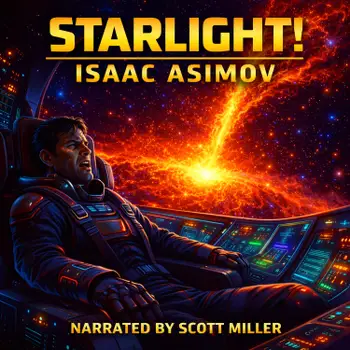
Starlight! : The Star That Should Not Be There

Arthur Trent thinks he has planned the perfect escape. A stolen cargo of Krillium worth ten million credits, a fast ship, and a hyperspace Jump that will carry him farther than any pursuer could hope to track.

The real genius behind the plan belonged to an old computer designer named Brennmeyer. For thirty years he gathered astronomical records and fed them into a powerful navigation computer. After a random hyperspace Jump, the machine would scan the sky, identify the pattern of nearby stars, and calculate the ship’s position anywhere in the Galaxy. From there, one more Jump would deliver Trent safely to the nearest inhabited world.

It was brilliant. It was foolproof. It was built on decades of careful observation and data.

Now Trent sits alone in deep space while the computer searches the heavens for a pattern it recognizes. The stars are bright. The sky is full of them. Yet the machine keeps searching, comparing, rejecting, and starting again.

Time passes. Air grows thin.

And Trent slowly realizes that one tiny change in the universe—something no one could have predicted—may have turned the perfect escape into the longest final hour of his life.

Isaac Asimov wrote “Starlight!” as a compact demonstration of how scientific detail can become the engine of suspense. The story appeared in the 1960s and later became part of Asimov’s collection Asimov’s Mysteries, where he blended science fiction ideas with puzzle-style storytelling.

Asimov (1920–1992) was one of the most prolific writers in modern literature. He published more than 500 books and thousands of essays, stories, and articles. His science fiction classics include Foundation, I, Robot, and The Caves of Steel. He also wrote extensively about science itself, helping millions of readers understand astronomy, physics, chemistry, and robotics.
Tietoa kirjasta

Arthur Trent thinks he has planned the perfect escape. A stolen cargo of Krillium worth ten million credits, a fast ship, and a hyperspace Jump that will carry him farther than any pursuer could hope to track.

The real genius behind the plan belonged to an old computer designer named Brennmeyer. For thirty years he gathered astronomical records and fed them into a powerful navigation computer. After a random hyperspace Jump, the machine would scan the sky, identify the pattern of nearby stars, and calculate the ship’s position anywhere in the Galaxy. From there, one more Jump would deliver Trent safely to the nearest inhabited world.

It was brilliant. It was foolproof. It was built on decades of careful observation and data.

Now Trent sits alone in deep space while the computer searches the heavens for a pattern it recognizes. The stars are bright. The sky is full of them. Yet the machine keeps searching, comparing, rejecting, and starting again.

Time passes. Air grows thin.

And Trent slowly realizes that one tiny change in the universe—something no one could have predicted—may have turned the perfect escape into the longest final hour of his life.

Isaac Asimov wrote “Starlight!” as a compact demonstration of how scientific detail can become the engine of suspense. The story appeared in the 1960s and later became part of Asimov’s collection Asimov’s Mysteries, where he blended science fiction ideas with puzzle-style storytelling.

Asimov (1920–1992) was one of the most prolific writers in modern literature. He published more than 500 books and thousands of essays, stories, and articles. His science fiction classics include Foundation, I, Robot, and The Caves of Steel. He also wrote extensively about science itself, helping millions of readers understand astronomy, physics, chemistry, and robotics.
Aloita kirja saman tien hintaan 0 €

  • Kokeilujakson aikana käytössäsi on kaikki sovelluksen kirjat
  • Ei sitoumusta, voit perua milloin vain
Kokeile nyt ilmaiseksi
Yli 52 000 ihmistä on antanut Nextorylle viisi tähteä App Storessa ja Google Playssä.

  1. 4.1
    #1

    Foundation

    Isaac Asimov

  2. 4.3
    #1

    Säätiö

    Isaac Asimov

  3. 4.1
    #2

    Säätiö ja Imperiumi

    Isaac Asimov

  4. 4.3
    #3

    Toinen Säätiö

    Isaac Asimov

  5. Uusi
    3.0

    Synthetic Minds : Classic Tales of Robots, Androids & Artificial Intelligence

    Philip K Dick, Harry Harrison, Robert Silverberg, Clifford D. Simak, Sol Boren, Isaac Asimov, Robert Sheckley

  6. Uusi

    The Great Time Travel Collection 2 : Twenty-Three Classic Journeys Through Time Where One Small Change Can Rewrite History

    Isaac Asimov, Philip K Dick, Frank Belknap Long, Brian W. Aldiss, Fritz Leiber, Randall Garrett, Alfred Bester, Lester del Rey, Ray Cummings, Frederik Pohl, Robert Silverberg, Fredric Brown, Edward Halibut, Richard R. Smith, Mack Reynolds, George O. Smith, Mel Hunter, J.T. McIntosh, Joe Gibson, Bryce Walton

  7. 1950s Science Fiction 8 - 29 Classic Science Fiction Short Stories from the 1950s

    Robert Silverberg, Isaac Asimov, Ray Bradbury, Frank Herbert, lord Dunsany, Walter M. Jr., Bryce Walton, Mike Curry, Edward W. Ludwig, Charles Einstein, Miguel Hidalgo, Dean Evans, Robert Sheckley, Charles E. Fritch, William Oberfield, Frank M. Robinson, Evelyn E. Smith, C. M. Kornbluth, Lynn Venable, Fritz Leiber, Alfred Bester, Donald E. Westlake, J. F. Bone, Roger D. Aycock, Joseph Slotkin, David Mason

  8. The Frank Herbert, Isaac Asimov, Philip K. Dick, and Ray Bradbury Short Story Collection : 38 Science Fiction Short Stories

    Frank Herbert, Isaac Asimov, Philip K Dick, Ray Bradbury

  9. The Frank Herbert and Isaac Asimov Collection : 8 Science Fiction Short Stories

    Frank Herbert, Isaac Asimov

  10. Encounters From Beyond 3 : Where Humanity Meets the Unknown

    Philip K Dick, Evan Hunter, Poul Anderson, Robert Zacks, Fredric Brown, Robert Silverberg, Clifford D. Simak, Ray Bradbury, Allen K. Lang, Isaac Asimov, Henry Kuttner, Theodore Sturgeon

  11. 3.5

    Youth

    Isaac Asimov

  12. 4.0

    Let's Get Together

    Isaac Asimov