Tietoa kirjasta

Thomas More's "The Collected Works" is an essential compendium that showcases the breadth of More's intellectual prowess and his multifaceted contributions to literature, philosophy, and political thought during the Renaissance. This compilation includes seminal texts such as "Utopia," where More innovatively critiques social and political structures through the lens of speculative fiction, blending allegory with humanist ideals. Through eloquent prose and sharp, insightful commentary, More engages with themes of morality, governance, and the human condition, situating his work within the rich tapestry of Renaissance thought that challenged and enriched the scholastic tradition of his time. Thomas More (1478-1535) was not only a prolific author but also a statesman and renowned scholar, whose life was intricately woven into the fabric of 16th-century England. His deep commitment to his faith and humanist principles propelled him to examine the moral complexities of politics, especially during a turbulent era marked by the Reformation. More's staunch opposition to the Acts of Supremacy and his subsequent martyrdom highlight the profound integrity that informs his writings, showcasing a man whose beliefs deeply influenced his literary output. For scholars and casual readers alike, "The Collected Works" offers a profound glimpse into the mind of a Renaissance thinker whose ideas resonate today. This volume is not just a collection of writings; it is an invitation to explore the philosophical inquiries that shaped Western thought. Whether one is interested in political theory, ethics, or the intricate interplay of faith and reason, More's collected works serve as a vital resource for comprehending the enduring relevance of his vision.

In this enriched edition, we have carefully created added value for your reading experience:

- An Introduction draws the threads together, discussing why these diverse authors and texts belong in one collection.

- Historical Context explores the cultural and intellectual currents that shaped these works, offering insight into the shared (or contrasting) eras that influenced each writer.

- A combined Synopsis (Selection) briefly outlines the key plots or arguments of the included pieces, helping readers grasp the anthology's overall scope without giving away essential twists.

- A collective Analysis highlights common themes, stylistic variations, and significant crossovers in tone and technique, tying together writers from different backgrounds.

- Reflection questions encourage readers to compare the different voices and perspectives within the collection, fostering a richer understanding of the overarching conversation.
Aloita kirja saman tien hintaan 0 €

  • Kokeilujakson aikana käytössäsi on kaikki sovelluksen kirjat
  • Ei sitoumusta, voit perua milloin vain
Kokeile nyt ilmaiseksi
Yli 52 000 ihmistä on antanut Nextorylle viisi tähteä App Storessa ja Google Playssä.

  1. 3.0

    Utopia

    Thomas More

  2. 12 Masterpieces You Have to Read Before You Die. Philosophy

    Niccolo Machiavelli, Tommaso Campanella, Francis Bacon, Thomas More, John Stuart Mill, Immanuel Kant, Kahlil Gibran, Leo Tolstoy, G.K. Chesterton, Henry David Thoreau

  3. 15+ Political Science. Classics Collection : The Art of War, Tao Te Ching, The Republic, Meditations, The Prince, Utopia, Utilitarianism, Anarchism and others

    Sun Tzu, Lao Tzu, Plato, Marcus Aurelius, Niccolo Machiavelli, Thomas More, Tommaso Campanella, Francis Bacon, Thomas Paine, John Stuart Mill, Karl Marx, Friedrich Engels, Vladimir Lenin, Rosa Luxemburg, Peter Kropotkin, Emma Goldman, Leon Trotsky

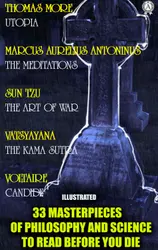
  4. 33 Masterpieces of Philosophy and Science to Read Before You Die (Illustrated) : Utopia, The Meditations, The Art of War, The Kama Sutra, Candide

    Thomas More, Marcus Aurelius Antoninus, Sun Tzu, Vatsyayana, Voltaire, Edwin A. Abbott, Aristotle, Dale Carnegie, Gilbert Keith Chesterton, René Descartes, Epictetus, Sigmund Freud, Hermann Hesse, David Hume, Lao Tzu, David Herbert Lawrence, Niccolò Machiavelli, John Mill, Prentice Mulford, Friedrich Nietzsche, Plato, Bertrand Russell, H.G. Wells, Frances Bacon

  5. Uusi

    Harvard Classics : The Five-Foot Shelf of Books

    Aesop, Dante Alighieri, Hans Christian Andersen, Augustine of Hippo, Marcus Aurelius, Jane Austen, Francis Bacon, Honoré de Balzac, Francis Beaumont, Bjørnstjerne Bjørnson, Thomas Browne, Robert Browning, John Bunyan, EDMUND BURKE, Robert Burns, Lord Byron, Thomas Carlyle, Benvenuto Cellini, Miguel de Cervantes, Marcus Tullius Cicero, Richard Henry Jr., Charles Darwin, Alphonse Daudet, Thomas Dekker, Charles Dickens, Fyodor Dostoevsky, John Dryden, Charles W. Eliot, George Eliot, Ralph Waldo Emerson, Epictetus, John Fletcher, Theodor Fontane, Benjamin Franklin, Johann Wolfgang Goethe, Oliver Goldsmith, Jacob Grimm, Edward Everett Hale, Bret Harte, Nathaniel Hawthorne, Homer, Victor Hugo, Washington Irving, Henry James, Ben Jonson, Gottfried Keller, Thomas à Kempis, Alexander L. Kielland, Martin Luther, Niccolò Machiavelli, Alessandro Manzoni, Christopher Marlowe, Philip Massinger, Guy De Maupassant, John Stuart Mill, John Milton, Thomas More, William Morris, Alfred de Musset, William Allan Neilson, William Penn, Plato, Pliny the Younger, Plutarch, George Sand, Percy Bysshe Shelley, Richard Brinsley Sheridan, Adam Smith, Laurence Sterne, Theodor Storm, William Makepeace Thackeray, Leo Tolstoy, Ivan Turgenev, Mark Twain, Juan Valera, Virgil, Izaak Walton, John Webster, John Woolman

  6. Uusi
    3.3

    Utopia

    Thomas More

  7. 3.3

    Utopia

    Thomas More

  8. Uusi
    3.3

    Utopia

    Thomas More

  9. 3.3

    Utopia

    Thomas More

  10. 3.3

    Utopia

    Thomas More

  11. 3.3

    Utopia

    Thomas More

  12. 3.3

    Utopia

    Thomas More