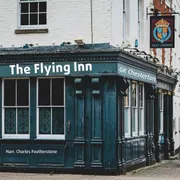
The Flying Inn : A tale of revolution against Progressive Islam as only an Englishman would

Progressive Islam takes over England, and two men go on the run with a barrel of rum and a wheel of cheese, intent on keeping English pub life alive. Packed with songs, satire, and style as only Chesteron could write.

"Perhaps prophetical more so than prosaic (and not at all in the sense Chesterton intended it) The Flying Inn is one of those books which should rank among the classics" - The Distributist Review

"Chesterton said that the book he most enjoyed writing was The Flying Inn. He enjoyed creating the comical scenes as much as the polemical ones, the drinking songs as much as the bitter satire and the hard-edged debate. As the hero of the novel says, “It’s as innocent as Heaven and as hot as hell.” The novel is a vehicle for Chesterton to tee off against corrupt and ineffectual politicians who had not merely lost touch with common citizens but were actively taking away their basic rights and freedoms. Besides politicians, he also makes room on his skewer for journalists, textual critics, health gurus, idiot socialists and capitalist toadies. [...] the drinking songs in The Flying Inn [are] "true Temperance songs: temperance is about moderation not abstinence. Self-restraint and self-control are acts of freedom. Prohibition is not. Though drinking may be a caprice [...] it is a caprice that cannot be forbidden to a citizen, but can be forbidden to a slave.”

And what are these drinking songs that came under such fire? Simply some of the dearest and most delightful poems that Chesterton or anyone else has ever written: The Song of Right and Wrong, The Song of the Dog Quoodle, Wine and Water, The Logical Vegetarian, The Good Rich Man, The Saracen’s Head, and The Rolling English Road."
Tietoa kirjasta

Progressive Islam takes over England, and two men go on the run with a barrel of rum and a wheel of cheese, intent on keeping English pub life alive. Packed with songs, satire, and style as only Chesteron could write.

"Perhaps prophetical more so than prosaic (and not at all in the sense Chesterton intended it) The Flying Inn is one of those books which should rank among the classics" - The Distributist Review

"Chesterton said that the book he most enjoyed writing was The Flying Inn. He enjoyed creating the comical scenes as much as the polemical ones, the drinking songs as much as the bitter satire and the hard-edged debate. As the hero of the novel says, “It’s as innocent as Heaven and as hot as hell.” The novel is a vehicle for Chesterton to tee off against corrupt and ineffectual politicians who had not merely lost touch with common citizens but were actively taking away their basic rights and freedoms. Besides politicians, he also makes room on his skewer for journalists, textual critics, health gurus, idiot socialists and capitalist toadies. [...] the drinking songs in The Flying Inn [are] "true Temperance songs: temperance is about moderation not abstinence. Self-restraint and self-control are acts of freedom. Prohibition is not. Though drinking may be a caprice [...] it is a caprice that cannot be forbidden to a citizen, but can be forbidden to a slave.”

And what are these drinking songs that came under such fire? Simply some of the dearest and most delightful poems that Chesterton or anyone else has ever written: The Song of Right and Wrong, The Song of the Dog Quoodle, Wine and Water, The Logical Vegetarian, The Good Rich Man, The Saracen’s Head, and The Rolling English Road."
Aloita kirja saman tien hintaan 0 €

  • Kokeilujakson aikana käytössäsi on kaikki sovelluksen kirjat
  • Ei sitoumusta, voit perua milloin vain
Kokeile nyt ilmaiseksi
Yli 52 000 ihmistä on antanut Nextorylle viisi tähteä App Storessa ja Google Playssä.

  1. 3.0

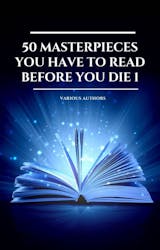
    50 Masterpieces you have to read before you die vol: 1 (2020 Edition) : Included: Little Women, The Richest Man in Babylon Emma, The Call Of The Wild ....

    Louisa May Alcott, Dante Alighieri, Marcus Aurelius, Jane Austen, L. Frank Baum, Charlotte Brontë, Emily Brontë, Anne Brontë, Miguel de Cervantes, Agatha Christie, George S. Clason, Arthur Conan Doyle, Joseph Conrad, Charles Dickens, Fyodor Dostoyevsky, Alexandre Dumas, George Eliot, G.K. Chesterton, G.K. Chesterton, Zane Grey, Nathaniel Hawthorne, Napoleon Hill, Homer, Victor Hugo, Frances Hodgson Burnett, Washington Irving, Henry James, Franz Kafka, Rudyard Kipling, Jack London, Leo Tolstoy, H.P. Lovecraft, Lucy Maud Montgomery, Joseph Murphy, Robert Louis Stevenson, Edgar Allan Poe, Marcel Proust, Publius, Mary Shelley, Bram Stoker, Mark Twain, Sun Tzu, Lew Wallace, Wallace D. Wattles, H.G. Wells

  2. 2.9
    #1

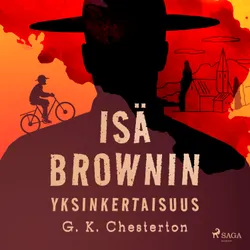
    Isä Brownin yksinkertaisuus

    G.K. Chesterton

  3. The Club of Queer Trades

    G.K. Chesterton

  4. The Man Who Knew Too Much: And Other Stories : 8 Detective Short Stories

    G.K. Chesterton

  5. 4.0

    The Everlasting Man

    G.K. Chesterton

  6. #2

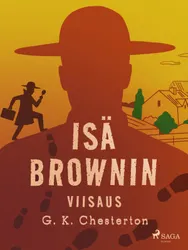
    Isä Brownin viisaus

    G.K. Chesterton

  7. A Short History of England

    G.K. Chesterton

  8. Orthodoxy

    G.K. Chesterton

  9. 50+ Self-Help Classics Collection

    Napoleon Hill, James Allen, Kahlil Gibran, Sun Tzu, Lao Tzu, Confucius, Benjamin Franklin, Marcus Aurelius Antoninus, Russell H. Conwell, Ralph Waldo Emerson, Florence Scovel Shinn, Charles F. Haanel, Wallace D. Wattles, Orison Swett Marden, George Samuel Clason, William Walker Atkinson, P.T. Barnum, G.K. Chesterton, Leo Tolstoy

  10. The Everlasting Man

    G.K. Chesterton

  11. The Everlasting Man

    G.K. Chesterton

  12. 50 Masterpieces you have to read before you die Vol: 2 [newly updated] (Golden Deer Classics)

    Lewis Carroll, Mark Twain, Jules Verne, Oscar Wilde, Golden Deer, Arthur Conan Doyle, Louisa May Alcott, Jane Austen, J.M. Barrie, B.M. Bower, Frances Hodgson Burnett, Robert William Chambers, G.K. Chesterton, Wilkie Collins, Charles Darwin, Daniel Defoe, Margaret Deland, Charles Dickens, Fyodor Dostoyevsky, Alexandre Dumas, Francis Scott Fitzgerald, E. M. Forster, Sigmund Freud, Thomas Hardy, Hermann Hesse, James Joyce, Andrew Lang, Jack London, H.P. Lovecraft, Lucy Maud Montgomery, Friedrich Wilhelm Nietzsche, Edgar Allan Poe, Marcel Proust, William Shakespeare, Robert Louis Stevenson, William Strunk Jr., Vatsyayana, H.G. Wells, Virginia Woolf