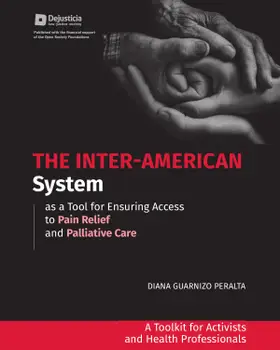
The Inter-American System as a Tool for Ensuring Access to Pain Relief and Palliative Care

Through the financial support from the Open Society Foundations, Dejusticia developed a diagnostic research from eight countries, Argentina, Chile, Colombia, Costa Rica, El Salvador, Guatemala, Panama and Uruguay, regarding the access to palliative care, the institutional development and the guidelines, and the existing barriers of access to opioid medications – used for pain relief.

This document is aimed at medical personnel, civil society organizations, policy makers, and any¬one interested in addressing the issue of palliative care from a human rights perspective. Although for years palliative care was confined to a strictly medical analysis, in recent times the international community and United Nations bodies have recognized palliative care as a human rights issue. This document seeks to demonstrate the many linkages between palliative care and human rights in terms of both the conception and the protection of palliative care.

We hope this report serves as a useful tool for the medical community, patients, and patients' fam¬ilies throughout the American continent who seek legal and human rights arguments to facilitate access to more humane end-of-life care, as well as for litigants and human rights activists who wish to protect and guarantee a life without pain for patients, including during their last days of life.
Tietoa kirjasta

Through the financial support from the Open Society Foundations, Dejusticia developed a diagnostic research from eight countries, Argentina, Chile, Colombia, Costa Rica, El Salvador, Guatemala, Panama and Uruguay, regarding the access to palliative care, the institutional development and the guidelines, and the existing barriers of access to opioid medications – used for pain relief.

This document is aimed at medical personnel, civil society organizations, policy makers, and any¬one interested in addressing the issue of palliative care from a human rights perspective. Although for years palliative care was confined to a strictly medical analysis, in recent times the international community and United Nations bodies have recognized palliative care as a human rights issue. This document seeks to demonstrate the many linkages between palliative care and human rights in terms of both the conception and the protection of palliative care.

We hope this report serves as a useful tool for the medical community, patients, and patients' fam¬ilies throughout the American continent who seek legal and human rights arguments to facilitate access to more humane end-of-life care, as well as for litigants and human rights activists who wish to protect and guarantee a life without pain for patients, including during their last days of life.

Aloita kirja saman tien hintaan 0 €

  • Kokeilujakson aikana käytössäsi on kaikki sovelluksen kirjat
  • Ei sitoumusta, voit perua milloin vain
Kokeile nyt ilmaiseksi
Yli 52 000 ihmistä on antanut Nextorylle viisi tähteä App Storessa ja Google Playssä.

  1. Sembrando el derecho a la alimentación en Colombia: avances y propuestas desde los territorios

    Diana Guarnizo Peralta, Felipe Roa-Clavijo

  2. Derecho, comercio y etiquetado nutricional: Reflexiones y experiencias desde América Latina. 2.ª edición

    Diana Guarnizo Peralta, Rene Urueña Hernández, Juan Carballo

  3. Transición energética justa para la Guajira.

    Diana Guarnizo Peralta, Jhonatan Malagón Palacios, Ivonne Elena Díaz García, Luisa Fernanda Guerra Carrera, Julián Gutiérrez Martínez

  4. Diferentes industrias, un mismo manual : Interferencia de las industrias de tabaco, alcohol y ultraprocesados en las políticas para la prevención de enfermedades no transmisibles en Colombia

    Diana Guarnizo Peralta, Paula Angarita Tovar, Adriana Torres Bastidas

  5. Law, Trade, and Nutrition Labeling : Reflections and Experiences from Latin America

    Diana Guarnizo Peralta, René Urueña Hernández, Juan Martín Carballo

  6. Cruce seguro: Sistemas de Retención Infantil y Derechos Humanos contra la siniestralidad vial en Colombia

    María Gabriela Vargas Parada, Julián Gutiérrez Martínez, Randy Villalba Arango, Diana Guarnizo Peralta

  7. Sin impacto comprobado: análisis de un impuesto a las bebidas azucaradas en el mercado laboral colombiano

    Randy Villalba, Diana Guarnizo Peralta

  8. Derecho, comercio y etiquetado nutricional: Reflexiones y experiencias desde América Latina

    Diana Guarnizo Peralta, René Urueña Hernández, Juan Martin Carballo

  9. Seguridad vehicular y derecho internacional económico: Preguntas y respuestas para Colombia

    Rene Urueña, Paula Angarita Tovar, Diana Guarnizo Peralta

  10. Normas, vehículos y usuarios: un análisis constitucional de la siniestralidad vial y la seguridad vehicular en Colombia

    Paula Angarita Tovar, Diana Guarnizo Peralta

  11. Territorio Wayúu: entre distancias y ausencias: Pobreza alimentaria, malnutrición y acceso a agua potable en los entornos escolares de Uribia

    Julián Gutiérrez Martínez, Ana María Narváez Olaya, Johnattan García Ruiz, Diana Guarnizo Peralta

  12. Omisiones que matan: Estándares en seguridad vehicular y calidad del aire, su impacto en los derechos humanos

    Paula Angarita Tovar, Johnattan García Ruiz, Diana Guarnizo Peralta