The Kaggle Workbook : Self-learning exercises and valuable insights for Kaggle data science competitions

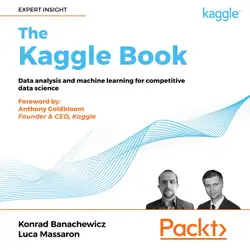
More than 80,000 Kaggle novices currently participate in Kaggle competitions. To help them navigate the often-overwhelming world of Kaggle, two Grandmasters put their heads together to write The Kaggle Book, which made plenty of waves in the community. Now, they’ve come back with an even more practical approach based on hands-on exercises that can help you start thinking like an experienced data scientist.

In this book, you’ll get up close and personal with four extensive case studies based on past Kaggle competitions. You’ll learn how bright minds predicted which drivers would likely avoid filing insurance claims in Brazil and see how expert Kagglers used gradient-boosting methods to model Walmart unit sales time-series data. Get into computer vision by discovering different solutions for identifying the type of disease present on cassava leaves. And see how the Kaggle community created predictive algorithms to solve the natural language processing problem of subjective question-answering.

You can use this workbook as a supplement alongside The Kaggle Book or on its own alongside resources available on the Kaggle website and other online communities. Whatever path you choose, this workbook will help make you a formidable Kaggle competitor.
Tietoa kirjasta

More than 80,000 Kaggle novices currently participate in Kaggle competitions. To help them navigate the often-overwhelming world of Kaggle, two Grandmasters put their heads together to write The Kaggle Book, which made plenty of waves in the community. Now, they’ve come back with an even more practical approach based on hands-on exercises that can help you start thinking like an experienced data scientist.

In this book, you’ll get up close and personal with four extensive case studies based on past Kaggle competitions. You’ll learn how bright minds predicted which drivers would likely avoid filing insurance claims in Brazil and see how expert Kagglers used gradient-boosting methods to model Walmart unit sales time-series data. Get into computer vision by discovering different solutions for identifying the type of disease present on cassava leaves. And see how the Kaggle community created predictive algorithms to solve the natural language processing problem of subjective question-answering.

You can use this workbook as a supplement alongside The Kaggle Book or on its own alongside resources available on the Kaggle website and other online communities. Whatever path you choose, this workbook will help make you a formidable Kaggle competitor.
Aloita kirja saman tien hintaan 0 €

  • Kokeilujakson aikana käytössäsi on kaikki sovelluksen kirjat
  • Ei sitoumusta, voit perua milloin vain
Kokeile nyt ilmaiseksi
Yli 52 000 ihmistä on antanut Nextorylle viisi tähteä App Storessa ja Google Playssä.