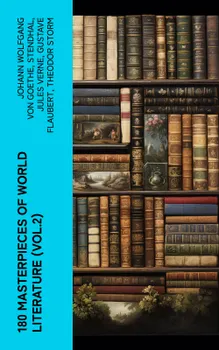



180 Masterpieces of World Literature (Vol.2) gathers an extraordinary constellation of fiction, drama, poetry, philosophy, and social critique, presenting world literature as a sustained conversation across centuries. Its range extends from ancient epic and classical wisdom to Gothic romance, realist and naturalist fiction, adventure narrative, modernist experiment, and political reflection. The volume's significance lies in its breadth: psychological confession, satirical comedy, metaphysical inquiry, imperial encounter, and domestic drama coexist within a single literary field. The contributors represent an immense span of cultural and historical formations: Greco-Roman and Asian antiquity, European Romanticism, Victorian and American realism, Russian moral philosophy, Indian and Chinese literary traditions, fin-de-siècle decadence, and early twentieth-century modernism. As a collective, these writers shaped debates about nationhood, faith, gender, class, empire, and the self. Their varied idioms illuminate how literary movements arise not in isolation but through translation, influence, resistance, and reinvention. This volume is ideal for readers seeking a capacious introduction to the global canon and for scholars wishing to trace continuities across genres and eras. It offers the rare pleasure of encountering many voices in productive juxtaposition, encouraging comparison rather than passive admiration. Read as anthology, archive, and dialogue, it invites sustained exploration of literature's power to educate, unsettle, and enlarge the imagination.
This enriched edition has been carefully crafted to add value to your reading experience.
- An Introduction draws the threads together, discussing why these diverse authors and texts belong in one collection.
- Historical Context explores the cultural and intellectual currents that shaped these works, offering insight into the shared (or contrasting) eras that influenced each writer.
- A combined Synopsis (Selection) briefly outlines the key plots or arguments of the included pieces, helping readers grasp the anthology's overall scope without giving away essential twists.
- A collective Analysis highlights common themes, stylistic variations, and significant crossovers in tone and technique, tying together writers from different backgrounds.
- Reflection questions encourage readers to compare the different voices and perspectives within the collection, fostering a richer understanding of the overarching conversation.