À propos de ce livre

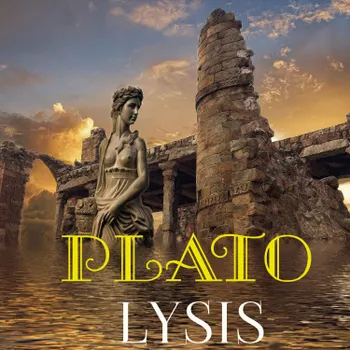
Lysis is a dialogue of Plato which discusses the nature often translated as friendship, while the word's original content was of a much larger and more intimate bond. It is generally classified as an early dialogue.

The main characters are Socrates, the boys Lysis and Menexenus who are friends, as well as Hippothales, who is in unrequited love with Lysis and therefore, after the initial conversation, hides himself behind the surrounding listeners. Socrates proposes four possible notions regarding the true nature of loving friendship as:

Friendship between people who are similar, interpreted by Socrates as friendship between good men.

Friendship between men who are dissimilar.

Friendship between men who are neither good nor bad and good men.

Gradually emerging: friendship between those who are relatives (οἰκεῖοι "not kindred") by the nature of their souls.

Of all those options, Socrates thinks that the only logical possibility is the friendship between men who are good and men who are neither good nor bad.

In the end, Socrates seems to discard all these ideas as wrong, although his para-logical refutations have strong hints of irony about them.

Commencez ce livre dès aujourd'hui pour 0 €

  • Accédez à tous les livres de l'app pendant la période d'essai
  • Sans engagement, annulez à tout moment
Essayer gratuitement
Plus de 52 000 personnes ont noté Nextory 5 étoiles sur l'App Store et Google Play.

Plus de Plato

  1. Apologie de Socrate

    Plato

  2. Ion

    Plato

  3. 4.5

    The Republic

    Plato

  4. 33 Masterpieces of Philosophy and Science to Read Before You Die (Illustrated) : Utopia, The Meditations, The Art of War, The Kama Sutra, Candide

    Thomas More, Marcus Aurelius Antoninus, Sun Tzu, Vatsyayana, Voltaire, Edwin A. Abbott, Aristotle, Dale Carnegie, Gilbert Keith Chesterton, René Descartes, Epictetus, Sigmund Freud, Hermann Hesse, David Hume, Lao Tzu, David Herbert Lawrence, Niccolò Machiavelli, John Mill, Prentice Mulford, Friedrich Nietzsche, Plato, Bertrand Russell, H.G. Wells, Frances Bacon

  5. 4.4

    Plato’s Apology

    Plato

  6. 4.3

    Plato's Ion

    Plato

  7. 4.5

    Plato's Gorgias :

    Plato

  8. 4.5

    The Republic

    Plato

  9. Nouveau

    Plato: The Complete Works

    Plato

  10. Nouveau

    The Essential Ancient Wisdom Library : 10 Classics of Philosophy, Strategy and Self-Mastery

    Marcus Aurelius, Seneca, Epictetus, Laozi, Plato, Sun Tzu, Musashi Miyamoto, Niccolò Machiavelli, Friedrich Wilhelm Nietzsche, James Allen

  11. Nouveau

    The Complete Plato

    Plato

  12. Nouveau

    Harvard Classics : The Five-Foot Shelf of Books

    Aesop, Dante Alighieri, Hans Christian Andersen, Augustine of Hippo, Marcus Aurelius, Jane Austen, Francis Bacon, Honoré de Balzac, Francis Beaumont, Bjørnstjerne Bjørnson, Thomas Browne, Robert Browning, John Bunyan, EDMUND BURKE, Robert Burns, Lord Byron, Thomas Carlyle, Benvenuto Cellini, Miguel de Cervantes, Marcus Tullius Cicero, Richard Henry Jr., Charles Darwin, Alphonse Daudet, Thomas Dekker, Charles Dickens, Fyodor Dostoevsky, John Dryden, Charles W. Eliot, George Eliot, Ralph Waldo Emerson, Epictetus, John Fletcher, Theodor Fontane, Benjamin Franklin, Johann Wolfgang Goethe, Oliver Goldsmith, Jacob Grimm, Edward Everett Hale, Bret Harte, Nathaniel Hawthorne, Homer, Victor Hugo, Washington Irving, Henry James, Ben Jonson, Gottfried Keller, Thomas à Kempis, Alexander L. Kielland, Martin Luther, Niccolò Machiavelli, Alessandro Manzoni, Christopher Marlowe, Philip Massinger, Guy De Maupassant, John Stuart Mill, John Milton, Thomas More, William Morris, Alfred de Musset, William Allan Neilson, William Penn, Plato, Pliny the Younger, Plutarch, George Sand, Percy Bysshe Shelley, Richard Brinsley Sheridan, Adam Smith, Laurence Sterne, Theodor Storm, William Makepeace Thackeray, Leo Tolstoy, Ivan Turgenev, Mark Twain, Juan Valera, Virgil, Izaak Walton, John Webster, John Woolman