À propos de ce livre

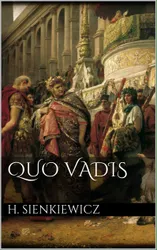
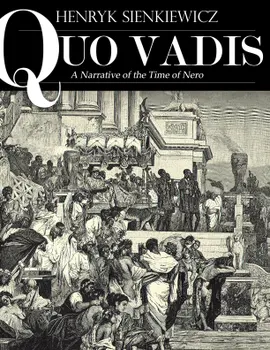
Quo Vadis: A Narrative of the Time of Nero, commonly known as Quo Vadis, is a historical novel written by Henryk Sienkiewicz in Polish. "Quo vadis Domine" is Latin for "Where are you going, Lord?" and alludes to the apocryphal Acts of Peter, in which Peter flees Rome but on his way meets Jesus and asks him why he is going to Rome. Jesus says "I am going back to be crucified again", which makes Peter go back to Rome and accept martyrdom. Sienkiewicz studied the Roman Empire extensively prior to writing the novel, with the aim of getting historical details correct. As such, several historical figures appear in the book. As a whole, the novel carries an outspoken pro-Christian message. This novel contributed to Sienkiewicz's Nobel Prize for literature in 1905, and has been translated into more than 50 languages. Several movies have been based on Quo Vadis including the 1925 Italian silent film Quo Vadis, the 1951 Hollywood production Quo Vadis and the 2001 adaptation by Jerzy Kawalerowicz.

Commencez ce livre dès aujourd'hui pour 0 €

  • Accédez à tous les livres de l'app pendant la période d'essai
  • Sans engagement, annulez à tout moment
Essayer gratuitement
Plus de 52 000 personnes ont noté Nextory 5 étoiles sur l'App Store et Google Play.

  1. Prix Nobel

    Quo Vadis ?

    Henryk Sienkiewicz

  2. Nouveau

    Quo vadis : Tome 1

    Henryk Sienkiewicz

  3. QUO VADIS ? : Une passion interdite au cœur de l’incendie de la Rome impériale.

    Henryk Sienkiewicz

  4. Prix Nobel
    2.0

    Quo Vadis

    Henryk Sienkiewicz

  5. Nouveau

    Quo Vadis : The Illustrated Gift Edition

    Henryk Sienkiewicz

  6. Nouveau

    Quo Vadis : A Narrative of the Time of Nero

    Henryk Sienkiewicz

  7. Prix Nobel
    3.5

    Quo vadis?

    Henryk Sienkiewicz

  8. 100 Clásicos de la Literatura Universal

    Francis Scott Fitzgerald, Mary Shelley, Lyman Frank Baum, Louisa May Alcott, Dante Alighieri, Jane Austen, Ambrose Bierce, Emily Brontë, Edgar Rice Burroughs, Lewis Carroll, Wilkie Collins, René Descartes, Charles Dickens, Emily Dickinson, Alexandre Dumas, Gustave Flaubert, Benito Pérez Galdós, Johann Wolfgang von Goethe, Thomas Hardy, E T A Hoffmann, Washington Irving, Henry James, James Joyce, Franz Kafka, Gaston Leroux, Federico García Lorca, H.P. Lovecraft, Publio Virgilio Marón, Lucy Maud Montgomery, John William Polidori, Marco Polo, Antoine de Saint-Exupéry, Emilio Salgari, Walter Scott, Mark Twain, Jules Verne, Julio Verne, H.G. Wells, Edith Wharton, Mary Wollstonecraft, Stefan Zweig, Sun Tzu, Bram Stoker, - Aristoteles, George Bernard Shaw, Henryk Sienkiewicz, Concepción Arenal, Charlotte Brontë, Miguel de Cervantes, G.K. Chesterton, Daniel Defoe, Fyodor Mikhailovich Dostoyevsky, Arthur Conan Doyle, Sigmund Freud, H. Rider Haggard, Homero, Immanuel Kant, Rudyard Kipling, Molière, Friedrich Nietzsche, Fernando de Rojas, Sófocles, William Makepeace Thackeray, León Tolstói, Voltaire, Ramón María del Valle-Inclán, Oscar Wilde, Virginia Woolf

  9. #10

    Quo Vadis?

    Henryk Sienkiewicz

  10. Relatos

    Henryk Sienkiewicz

  11. Quo Vadis

    Henryk Sienkiewicz

  12. Prix Nobel

    Med ild og sværd. Bind 1

    Henryk Sienkiewicz