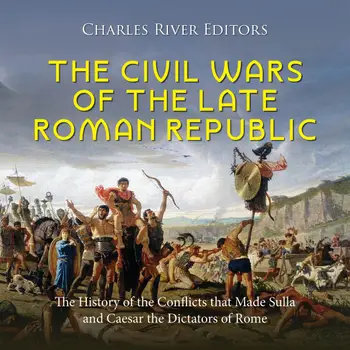
The Civil Wars of the Late Roman Republic: The History of the Conflicts that Made Sulla and Caesar the Dictators of Rome

Julius Caesar is still remembered for winning a civil war and helping bring about the end of the Roman Republic, leaving a line of emperors in its place, but it’s quite possible that none of what Caesar did would’ve happened without the template for such actions being set 40 years earlier. At the time, when Caesar was in his teens, war was being waged both on the Italian peninsula and abroad, with domestic politics pitting the conservative, aristocratic optimates against the populist, reformist populares, and this tension ultimately escalated into an all-out war. One of the leading populares was Caesar’s uncle, Gaius Marius, a military visionary who had restructured the legions and extended the privileges of land ownership and citizenship to legionaries on condition of successful completion of a fixed term of service. In the late 2nd century B.C., Marius had waged a successful campaign against several Germanic tribes, and after earning eternal fame in the Eternal City, Marius was appointed a consul several times. In 88 B.C., he entered into conflict with his erstwhile protégé, the optimate Sulla, over command of the army to be dispatched against Mithridates VI of Pontus, a long-time enemy of Rome and its Greek allies.

Ironically, Marius’s reforms had made the legions fiercely loyal to their individual generals rather than the state, which allowed Sulla to march his army against Rome and force Marius into exile. With that, Rome’s first civil war was officially underway, but Sulla’s triumph proved short-lived. Just as Sulla departed for a campaign, Marius returned at the head of a scratch army of veterans and mercenaries, taking over the city and purging it of Sulla’s optimate supporters, and though Marius died in 86 B.C., his party remained in power.
À propos de ce livre

Julius Caesar is still remembered for winning a civil war and helping bring about the end of the Roman Republic, leaving a line of emperors in its place, but it’s quite possible that none of what Caesar did would’ve happened without the template for such actions being set 40 years earlier. At the time, when Caesar was in his teens, war was being waged both on the Italian peninsula and abroad, with domestic politics pitting the conservative, aristocratic optimates against the populist, reformist populares, and this tension ultimately escalated into an all-out war. One of the leading populares was Caesar’s uncle, Gaius Marius, a military visionary who had restructured the legions and extended the privileges of land ownership and citizenship to legionaries on condition of successful completion of a fixed term of service. In the late 2nd century B.C., Marius had waged a successful campaign against several Germanic tribes, and after earning eternal fame in the Eternal City, Marius was appointed a consul several times. In 88 B.C., he entered into conflict with his erstwhile protégé, the optimate Sulla, over command of the army to be dispatched against Mithridates VI of Pontus, a long-time enemy of Rome and its Greek allies.

Ironically, Marius’s reforms had made the legions fiercely loyal to their individual generals rather than the state, which allowed Sulla to march his army against Rome and force Marius into exile. With that, Rome’s first civil war was officially underway, but Sulla’s triumph proved short-lived. Just as Sulla departed for a campaign, Marius returned at the head of a scratch army of veterans and mercenaries, taking over the city and purging it of Sulla’s optimate supporters, and though Marius died in 86 B.C., his party remained in power.
Commencez ce livre dès aujourd'hui pour 0 €

  • Accédez à tous les livres de l'app pendant la période d'essai
  • Sans engagement, annulez à tout moment
Essayer gratuitement
Plus de 52 000 personnes ont noté Nextory 5 étoiles sur l'App Store et Google Play.

  1. 2.0

    The Portuguese Inquisition: The History of the Portuguese Empire’s Religious Persecution of Non-Christians in Portugal and Asia

    Charles River Editors

  2. The Executions of British and French Royalty: The Lives of the Royals Who Were Put to Death in England and France

    Charles River Editors

  3. France in World War II: The History of Nazi Germany’s Conquest of France and Its Liberation By the Allies

    Charles River Editors

  4. France in the Early Middle Ages: The History of the Dynasties that Brought about the Kingdom of France

    Charles River Editors

  5. The Moors of Andalusia: The History of the Muslims in the Iberian Peninsula during the Middle Ages

    Charles River Editors

  6. La Capilla Sixtina: Historia y legado de la capilla más famosa del mundo

    Charles River Editors

  7. La Guerra Civil española: La historia y el legado del controversial conflicto que estableció la dictadura de Francisco Franco en España

    Charles River Editors

  8. The World’s Most Famous Physicists: The Lives and Legacies of the Scientists Who Pioneered Physics

    Charles River Editors

  9. The Velociraptor: The History of the Popular but Misunderstood Dinosaur Genus

    Charles River Editors

  10. The Rise and Fall of the Stuart Dynasty in Britain: The History of the Stuarts from the Tudor Era to the Glorious Revolution and the Jacobites

    Charles River Editors

  11. 3.3

    Ukraine: The History and Legacy of Ukraine from the Middle Ages to Today

    Charles River Editors

  12. The Jacobites: The History and Legacy of the Movement to Restore the Stuart Dynasty to the British Throne

    Charles River Editors