À propos de ce livre

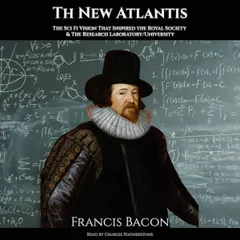
Four centuries ago, the philosopher, statesman and father of the scientific method Francis Bacon wrote a proto sci-fi book that would help reshape the world. The vision of ‘Salomon’s House’ inspired the Royal Society (the oldest continuously existing scientific academy on earth, founded in 1660 “for Improving Natural Knowledge”), and the research laboratory/university.

When a crew of lost European sailors is blown off course and stumbles upon the hidden island of Bensalem, they discover a civilisation far in advance of their own. At its heart sits Salomon’s House, a state-funded college of scholars dedicated to “the knowledge of causes, and secret motions of things; and the enlarging of the bounds of human empire, to the effecting of all things possible.”

The New Atlantis is among the earliest works of fiction to imagine a hidden, technologically advanced civilisation discovered by shipwrecked travellers, a premise that would recur throughout science fiction for centuries to come. Bacon outlines a culture far in advance of its day, that has already discovered are submarines, aeroplanes, artificial flavourings, amplifiers, hearing aids, microscopes, telephones, air-conditioning, refrigeration, skyscrapers, particle accelerators, artificial light, artificial metals and materials, and perpetual motion machines.

The book is appropriately unfinished, due to Bacon’s death in 1626, from pneumonia possibly caught while experimenting with snow as a preservative. Alongside Thomas More’s Utopia, the book defined the genre of utopian literature. It is also credited as a cornerstone of modern political thought, outlining a state built around enabling human betterment through reason. The vision of Salomon’s House as a place of organised, public science gave the world a lasting blueprint for institutionalised research as collaborative, state-sponsored, and methodical.
Commencez ce livre dès aujourd'hui pour 0 €

  • Accédez à tous les livres de l'app pendant la période d'essai
  • Sans engagement, annulez à tout moment
Essayer gratuitement
Plus de 52 000 personnes ont noté Nextory 5 étoiles sur l'App Store et Google Play.

Plus de Francis Bacon

  1. 1800 Citations de philosophes

    Aristote, Épicure, Platon, Thalès de Milet, – Socrate, Protagoras, Anaximandre, Épictète, Héraclite, Marc Aurèle, René Descartes, Michel de Montaigne, Alexis de Tocqueville, Voltaire, Charles De Montesquieu, Jean-Jacques Rousseau, Emmanuel Kant, Hannah Arendt, Gottfried Wilhelm Leibniz, Georg Wilhelm Friedrich Hegel, Friedrich Nietzsche, Arthur Schopenhauer, David Hume, John Locke, Francis Bacon, Thomas Hobbes, Thomas More, Confucius, Érasme, Lao Tseu, Baruch Spinoza, Søren Kierkegaard, Nicolas Machiavel, Thomas d'Aquin, Henry David Thoreau

  2. 250 citations de philosophes anglais

    David Hume, John Locke, Francis Bacon, Thomas Hobbes, Thomas More

  3. 50 citations de Francis Bacon

    Francis Bacon

  4. Comprendre Francis Bacon

    Francis Bacon

  5. The Ultimate SF Collection : Visions of Dystopias, Galactic Adventures & Forgotten Realms

    Jules Verne, Mark Twain, Robert Louis Stevenson, James Fenimore Cooper, Edgar Allan Poe, William Hope Hodgson, George MacDonald, Percy Greg, Jack London, Arthur Conan Doyle, Ernest Bramah, Jonathan Swift, Cleveland Moffett, William Morris, Anthony Trollope, Richard Jefferies, Samuel Butler, David Lindsay, Edward Everett Hale, Edward Bellamy, Charlotte Perkins Gilman, Edgar Wallace, Francis Bacon, Robert Cromie, Abraham Merritt, Ignatius Donnelly, Owen Gregory, H.G. Wells, Stanley G. Weinbaum, Fred M. White, H.P. Lovecraft, Garrett P. Serviss, Henry Rider Haggard, Mary Shelley, Malcolm Jameson, Edward Bulwer-Lytton, Lewis Grassic Gibbon, Otis Adelbert Kline, C.J. Hyne, Edwin A. Abbott, Arthur Dudley Vinton, Gertrude Barrows Bennett, Hugh Benson, Margaret Cavendish

  6. The Greatest Sci-Fi Books of All Time

    Jules Verne, Mark Twain, Robert Louis Stevenson, Edgar Allan Poe, William Hope Hodgson, George MacDonald, Percy Greg, Jack London, Arthur Conan Doyle, Ernest Bramah, Jonathan Swift, Cleveland Moffett, William Morris, Anthony Trollope, Richard Jefferies, Samuel Butler, David Lindsay, Edward Everett Hale, Edward Bellamy, Charlotte Perkins Gilman, Edgar Wallace, Francis Bacon, Robert Cromie, Abraham Merritt, Ignatius Donnelly, Owen Gregory, H.G. Wells, Stanley G. Weinbaum, Fred M. White, H.P. Lovecraft, Garrett P. Serviss, Henry Rider Haggard, Mary Shelley, Malcolm Jameson, Edward Bulwer-Lytton, Lewis Grassic Gibbon, Otis Adelbert Kline, C.J. Hyne, Edwin A. Abbott, Arthur Dudley Vinton, Gertrude Barrows Bennett, Hugh Benson, Margaret Cavendish, James Fenimore Coope

  7. 300 citations de la philosophie de la Renaissance

    Francis Bacon, Michel de Montaigne, Nicolas Machiavel

  8. 900 citations de la philosophie moderne

    Francis Bacon, Michel de Montaigne, Emmanuel Kant, Nicolas Machiavel, Montesquieu, Blaise Pascal, Jean-Jacques Rousseau, Baruch Spinoza, Voltaire

  9. SCIENCE FICTION Ultimate Collection : Foundations of Speculative Fiction

    Jules Verne, H.G. Wells, Abraham Merritt, Edgar Wallace, Edgar Allan Poe, Mary Shelley, Edwin A. Abbott, Jack London, Robert Louis Stevenson, George MacDonald, Henry Rider Haggard, William Hope Hodgson, H.P. Lovecraft, Edward Bellamy, Mark Twain, Arthur Conan Doyle, Francis Bacon, C.J. Hyne, Lewis Grassic Gibbon, Margaret Cavendish, Jonathan Swift, William Morris, Samuel Butler, Edward Bulwer-Lytton, James Fenimore Coope, Charlotte Perkins Gilman, Owen Gregory, Hugh Benson, Fred M. White, Ignatius Donnelly, Ernest Bramah, Arthur Dudley Vinton, Robert Cromie, Anthony Trollope, Cleveland Moffett, Richard Jefferies, Percy Greg, David Lindsay, Edward Everett Hale, Stanley G. Weinbaum, Otis Adelbert Kline, Malcolm Jameson, Garrett P. Serviss, Gertrude Barrows Bennett

  10. Harvard Classics : The Five-Foot Shelf of Books

    Aesop, Dante Alighieri, Hans Christian Andersen, Augustine of Hippo, Marcus Aurelius, Jane Austen, Francis Bacon, Honoré de Balzac, Francis Beaumont, Bjørnstjerne Bjørnson, Thomas Browne, Robert Browning, John Bunyan, EDMUND BURKE, Robert Burns, Lord Byron, Thomas Carlyle, Benvenuto Cellini, Miguel de Cervantes, Marcus Tullius Cicero, Richard Henry Jr., Charles Darwin, Alphonse Daudet, Thomas Dekker, Charles Dickens, Fyodor Dostoevsky, John Dryden, Charles W. Eliot, George Eliot, Ralph Waldo Emerson, Epictetus, John Fletcher, Theodor Fontane, Benjamin Franklin, Johann Wolfgang Goethe, Oliver Goldsmith, Jacob Grimm, Edward Everett Hale, Bret Harte, Nathaniel Hawthorne, Homer, Victor Hugo, Washington Irving, Henry James, Ben Jonson, Gottfried Keller, Thomas à Kempis, Alexander L. Kielland, Martin Luther, Niccolò Machiavelli, Alessandro Manzoni, Christopher Marlowe, Philip Massinger, Guy De Maupassant, John Stuart Mill, John Milton, Thomas More, William Morris, Alfred de Musset, William Allan Neilson, William Penn, Plato, Pliny the Younger, Plutarch, George Sand, Percy Bysshe Shelley, Richard Brinsley Sheridan, Adam Smith, Laurence Sterne, Theodor Storm, William Makepeace Thackeray, Leo Tolstoy, Ivan Turgenev, Mark Twain, Juan Valera, Virgil, Izaak Walton, John Webster, John Woolman

  11. Ensayos : Reflexiones renacentistas sobre poder, moral práctica, política clásica y sabiduría aforística inglesa

    Francis Bacon