À propos de ce livre

The year 753 B.C. has been immortalized as the birth year of Rome, the Eternal City, which according to legend was founded by the brothers Romulus and Remus. When Remus was killed, allegedly by Romulus or one of his followers, Romulus’s new city found itself with a male-to-female ratio that was severely unbalanced, and the Romans on Palatine Hill had trouble spawning the next generation. To remedy this problem, the men, under Romulus's orders, kidnapped Latin and Sabine women from nearby hills, raping them and intimidating them into marriage. Latin and Sabine forces later attempted to retrieve the unarmed women, only to be stopped by the Sabine women themselves. According to the Roman historian Livy, the Sabine women, “from the outrage on whom the war originated, with hair disheveled and garments rent, the timidity of their sex being overcome by such dreadful scenes, had the courage to throw themselves amid the flying weapons, and making a rush across, to part the incensed armies, and assuage their fury; imploring their fathers on the one side, their husbands on the other, "that as fathers-in-law and sons-in-law they would not contaminate each other with impious blood, nor stain their offspring with parricide…” After that, many of the Sabines joined Rome itself, and the “Rape of the Sabine Women” became a cornerstone story for the establishment of Rome and a topic of art.

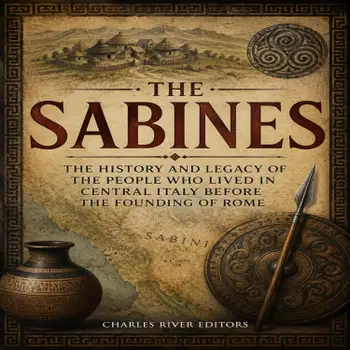
As gripping as the story has been for over 2,500 years, modern historians agree that it is mere legend, and of course, it has also obscured the actual history of the Sabines themselves. The Sabines were Italic people whose homeland lay in the rugged mountains of the central Apennines, and they occupy a rather peculiar place in ancient history, for they were neither a powerful empire nor were they a dominant military power.

Commencez ce livre dès aujourd'hui pour 0 €

  • Accédez à tous les livres de l'app pendant la période d'essai
  • Sans engagement, annulez à tout moment
Essayer gratuitement
Plus de 52 000 personnes ont noté Nextory 5 étoiles sur l'App Store et Google Play.

  1. Women in Ancient Egypt: The History of the Lives and Social Roles of Egyptian Women

    Charles River Editors

  2. The Monterey International Pop Festival: The History and Legacy of the First Major Rock Festival in the 1960s

    Charles River Editors

  3. 4.3

    The Life and Trial of Lizzie Borden : The History of 19th Century America's Most Famous Murder Case

    Charles River Editors

  4. The Praetorian Guard: The History of the Roman Emperors’ Imperial Bodyguards

    Charles River Editors

  5. Shirley Temple, Judy Garland, and Mickey Rooney: Hollywood’s Child Stars of the 1930s

    Charles River Editors

  6. 2.0

    The Portuguese Inquisition: The History of the Portuguese Empire’s Religious Persecution of Non-Christians in Portugal and Asia

    Charles River Editors

  7. 3.5

    The Portuguese Empire and Africa: The History and Legacy of Portugal’s Exploration and Colonization of the West African Coast

    Charles River Editors

  8. The Pacific Theater in 1944: The History of the Decisive Campaigns that Contributed to the Allies’ Victory over Japan

    Charles River Editors

  9. Antoni Gaudi and Frank Lloyd Wright: The Lives and Works of the Most Influential Modern Architects

    Charles River Editors

  10. The End of World War II in the Pacific: The History of the Final Campaigns that Led to Imperial Japan’s Surrender

    Charles River Editors

  11. 1.0

    Das mittelalterliche Russland: Die Geschichte und das Erbe der Gruppen, die den russischen Staat im Mittelalter entwickelten

    Charles River Editors

  12. The Cheka: The History of the Soviet Agency that Eventually Became the KGB

    Charles River Editors