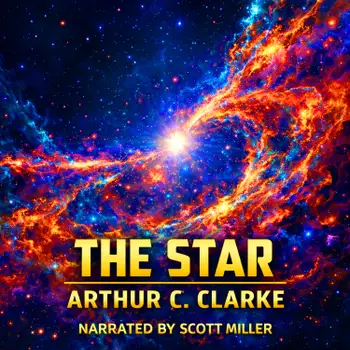
Some discoveries expand our understanding of the universe. Others challenge the stories we tell ourselves about our place within it.
In The Star, Arthur C. Clarke delivers a quiet, devastating meditation on faith, knowledge, and moral consequence. Set against the immense backdrop of deep space, the story follows a brilliant scientific mind grappling with the emotional weight of an astronomical revelation. What begins as a triumph of exploration slowly transforms into an intimate reckoning, where logic and belief no longer move in parallel. Clarke resists spectacle in favor of restraint, allowing the enormity of the implications to unfold through reflection rather than action.
This is science fiction at its most contemplative. The tension does not come from danger or conflict, but from understanding. As evidence accumulates, certainty erodes, and the listener is drawn into a profound internal struggle that mirrors humanity’s oldest questions. The story’s power lies in what it asks, not what it answers, leaving echoes long after the final line.
Arthur C. Clarke is one of the defining voices of twentieth-century science fiction. Renowned for blending scientific rigor with philosophical depth, his work consistently explores how humanity responds when confronted by the true scale of the cosmos. The Star stands as one of his most enduring short works, frequently cited for its emotional precision and moral weight, and remains a landmark example of how science fiction can illuminate the human condition.