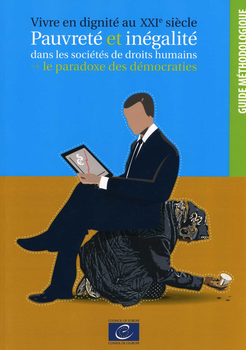
Vivre en dignité au XXIe siècle – Pauvreté et inégalité dans les sociétés de droits humains : le paradoxe des démocraties

In the early 21st century, poverty, impoverishment and inequalities are increasing across the European continent. These phenomena not only weaken the social cohesion of European societies, they also violate human rights, including social and civil and political rights, and question the functioning of democracy. How can people living in poverty make their voices heard in polarised societies, where more than 40% of assets and 25% of revenues are held by 10% of the population?

This guide is the result of two years of collective discussion held within the framework of the project "The human rights of people experiencing poverty". It was prepared with the assistance of many individuals and organisations, including people living in poverty, researchers, associations and representatives of public authorities. As well as offering a critique of the current situation, analysing inequality and poverty through the prism of human rights, democracy and redistributive policies, the guide also invites the reader to explore the possibilities of a renewed strategy to fight poverty in order to restore a sense of social justice. It makes proposals that aim to overcome the stigmatisation and categorisation of people, opening pathways of learning to build well-being through sharing, avoiding waste and by enhancing public awareness around the principle of human dignity as a human right for all.

Commencez ce livre dès aujourd’hui pour 0 €

  • Accédez à tous les livres de l'app pendant la période d'essai
  • Sans engagement, annulez à tout moment
Essayer gratuitement
Plus de 52 000 personnes ont noté Nextory 5 étoiles sur l'App Store et Google Play.

D'autres ont également lu

Passer la liste
  1. Une brûlante inquiétude

    Bruno Colmant

  2. Mondialisation et régionalisation : La coopération économique internationale est-elle encore possible ?

    Christian Deblock, Diane Éthier

  3. 4.0

    Le monde d'après : Les conséquences de la COVID-19 sur les relations internationales

    Frédéric Mérand, Jennifer Welsh

  4. L'Occident contre le monde

    Jean-Pierre Urgin

  5. Revue des Deux Mondes octobre 2017 : Qu'est-ce que le macronisme ?

    Olivier Mongin, Laure Adler, Véronique Taquin, Richard Millet, Jean-Paul Clément, Julie Wolkenstein, Michel Delon, Kyrill Nikitine, Bertrand Raison, Valérie Toranian, Didier Leschi, Annick Steta, Franz-Olivier Giesbert, Philippe Raynaud, Stéphane Guégan, Laurence Teper, Olivier Abel, Patrick Kéchichian, Marin De Viry, Jean-Luc Macia, Sébastien Lapaque, Thierry Lentz, Stéphane Ratti

  6. La politique en questions : volume 2

    Les professeurs de science politique de l'Université de Montréal Les professeurs de science politique de l'Université de Montréal

  7. Pour une nouvelle mondialisation : Le défi d'innover

    Juan-Luis Klein, Matthieu Roy

  8. Écologie et Économie aujourd'hui : L'urgence de recentrer l'économie sur l'homme et la nature

    Jean Cornelis

  9. Introduction critique aux relations internationales du Québec - 2e édition revue et augmentée : Le mythe d'une politique étrangère

    Jean-François Payette

  10. Exporter le New Deal : Les normes du travail dans la politique commerciale des États-Unis

    Sylvain Zini

  11. La puissance décomplexée de la Chine

    Éric Mottet

  12. S'adapter : Demain : les villes résilientes

    François William Croteau